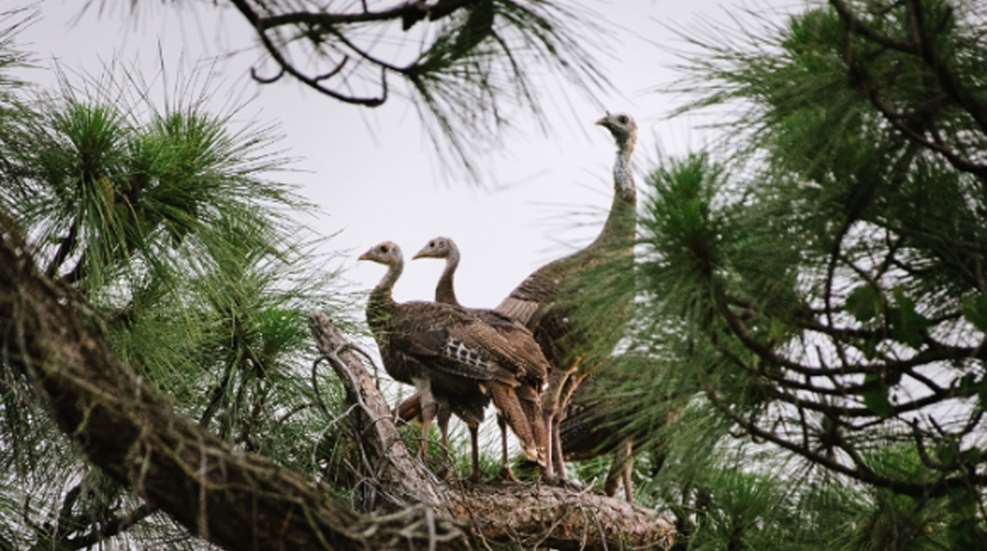
The National Wild Turkey Federation (NWTF) is helping fund a new wild-turkey research project conducted by Mississippi State University and the Mississippi Department of Wildlife, Fisheries and Parks. The pioneering research project will utilize recent advances in genetic analysis to better understand wild turkey ecology and how certain factors—such as hunting seasons, land type and management practices—lead to more robust population densities.
"The goal of this research project is to provide improved estimates of multiple turkey population parameters, which will allow state wildlife agencies and turkey managers to make informed decisions regarding their management actions and hunting season frameworks," said Mark McConnell, Ph.D., assistant professor at Mississippi State University.
Dana Morin, Ph.D., assistant professor at MSU and McConnell are the principal investigators of this project and are working in conjunction with MDWFP.
Accurately gauging the number of wild turkeys on a particular landscape is complicated. Population estimates are often made using rough approximations that rely on anecdotal accounts, volunteer surveys and catch-per-unit information.
The other, more labor-intensive way wild-turkey researchers and managers can estimate wild-turkey numbers is by trapping and marking. While trapping and marking birds has provided valuable and insightful information for decades, it is expensive, takes a lot of personnel, is time-consuming and involves risks. Researchers at MSU and MDWFP are going around the challenges typically associated with trapping and marking by efficiently collecting genetic material left behind in the field, such as feathers or fecal droppings.
These genetic materials will be analyzed with DNA-based lab techniques and identify unique, individual birds on eight sites throughout Mississippi. The sites will include differing habitat types, management practices and turkey hunting seasons. Research sites fall within two of the NWTF's Big Six Regions of Conservation, Southern Piney Woods and Mid-South Rebirth.
This new way to explore population densities will effectively allow researchers to create a database of individual wild turkeys on a specific project site, all by analyzing genetic material found in the field.
This new process will uncover information that will be especially useful to researchers and wildlife managers, including:
• Estimating the total number of male and female turkeys at a range of sites with different management and hunting frameworks;
• Comparing survival rates across sites with different management and hunting frameworks;
• Assess the accuracy of commonly used techniques such as brood and camera surveys; and
• Relate health parameters, such as disease, parasite and aflatoxin prevalence to changes in turkey numbers over time
"At the end of the day, the basic thing both hunters and managers want to know is why there are more turkeys in some places than in others and what are the factors which drive those differences," said Adam Butler, wild turkey program coordinator for the MDWFP and NWTF Technical Committee representative for Mississippi. "We’re excited about this opportunity to harness new technologies to get at those questions, and really believe this project will move the ball forward in understanding how this bird we all treasure ticks."
By having well-grounded estimates of wild-turkey populations across varying regions in Mississippi, researchers and managers can ascertain a deeper understanding of wild turkey ecology and their response to management and human influence, allowing the agency to deliver the best management practices at the best time, ultimately bolstering both wild-turkey numbers and hunter satisfaction.
"The NWTF is proud to partner with academics, agencies and other NGOs for the betterment of the resource," said Mark Hatfield, NWTF national director of conservation services. "This exciting new project will use cutting-edge science to help inform management decisions and give us a better understanding of how we can bolster wild turkey populations."
This project is one of seven new research projects the NWTF is funding. At the 12th National Wild Turkey Symposium, the NWTF announced NWTF’s new $360,000 investment into wild turkey research.
In addition to the NWTF’s recent investment, the organization further illustrated the importance of wild turkey research by committing to hold the 13th National Wild Turkey Symposium in 2025. The symposium is usually held every five years, but the NWTF is working to fast-track the meeting of researchers and managers to turn the tide of population declines.