This spring marks Willie Bloomquist’s 14th year in Major League Baseball. Widely recognized as one of the league’s top utility players, Bloomquist has played every position except pitcher and catcher, and is currently a shortstop for the Arizona Diamondbacks. Bloomquist was recently selected to the roster of Team USA in the World Baseball Classic, an international competition with final rounds slated for this March.
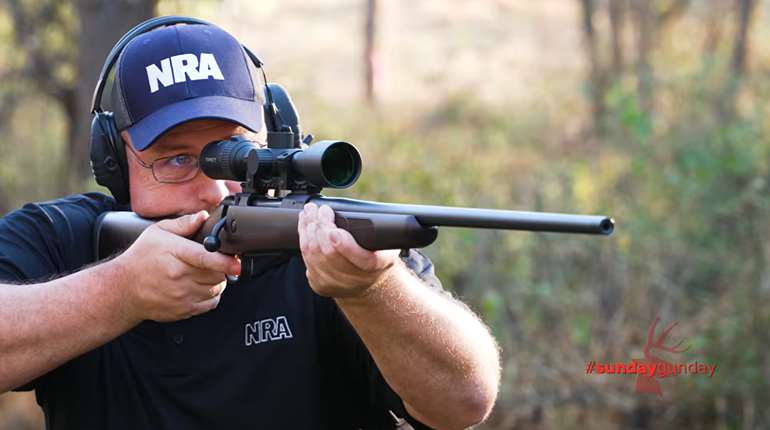
A native of Port Orchard, Wash., Bloomquist is a husband and father to two young daughters. He’s also a lifelong shooter and hunter, and recently became a member of Team Weatherby, a promotional effort by the rifle maker to attract more young people to the shooting sports. AmericanHunter.org caught up with Bloomquist at a recent Team Weatherby wild hog hunt in central coastal California.
AH: How did you become a hunter and shooter?
Bloomquist: I grew up around it. My dad and my [older] brother were hunting and shooting all the time. I heard all the hunting stories from my dad, and that got me really interested in it. Dad was always hunting elk and deer, bear when he could, too. Waterfowl—just everything.
AH: So you did a lot of hunting as a youngster?
Bloomquist: I did some duck and goose hunts with Dad and my brother Joe. I’ve loved hunting ever since I was a little kid. But by the time I got to high school, I wasn’t able to do a lot of it. I was always locked up in one sport or another by then—baseball, football, basketball—and with homework and chores, getting out to hunt kind of got pushed to the back burner.
Once I got drafted (by the Seattle Mariners in 1999), everything was about baseball. But as my career’s gone on, I’ve had more time during the off season to pursue hunting. And I have.
AH: Do you have a “best ever” hunt?
Bloomquist: The most memorable hunt for me was probably the one I did in Arizona, the second to the last elk I got, and hunting with my brother. We’d hunted all week, hard, and nothing. We saw a number of elk, but they were either too small or too far away and we couldn’t get on them.
Then, the morning of that last day, I got my bull elk and Joe got his. I think it was only like 45 minutes apart. Just the fact that we’d done it together and that it was our first hunt without my dad [who was injured in an automobile accident and has been unable to hunt ever since], made it real special, a real bonding experience for us. I’ll always remember that hunt.
AH: Do you have a dream hunt?
Bloomquist: Once my baseball career is over, my dream is to do a combo hunt, grizzly, moose, caribou or sheep. Go up to Alaska for two or three weeks, really rough it, and take three or four species.
AH: How did you become involved with Weatherby?
Bloomquist: I was talking to my agent, and I said, “You know, it’s getting a little later in my career, and I’d like to do some different things—like some outdoor promotional stuff, hunting and fishing if anyone’s interested.”
He called me about two months later and said, “Have you ever heard of this company, it’s called Weatherby? I just laughed and said, Yeah, I’ve heard of them. You’re not a hunter are you?”
Anyway, my agent told me they were thinking about this Team Weatherby concept, and wanted to know if I’d be a part of it. I was really flattered. I told my agent, “Get it done!”
AH: So you had experience with Weatherby rifles before Team Weatherby?
Bloomquist: That was my dad’s sweetheart rifle, a Weatherbry Mark V. I knew from a young age that, when he was on a trophy hunt and there might only be one shot, he was taking his .300 Weatherby Magnum. On a “meat” hunt, he might grab one of his other rifles. But if it was a big, special hunt? That was a “Weatherby hunt.”
AH: Sounds like your father’s influenced you a great deal.
Bloomquist: Very much. One thing Dad taught me was you want to try to leave hunting better for the next generation. You have to save it for future generations, and that’s why conservation’s so important. He instilled that in us at a young age.
AH: Any other lessons from him?
Bloomquist: You need to be a good shot. He really stressed that to me and my brother. You need to try to be good enough, that it only takes one shot to bring down that animal. That doesn’t always happen, of course, no matter how good of a shot you are. But that’s the goal—one shot. That means a lot to me, so I try to practice a lot. I guess I try to be a perfectionist when it comes to shooting. I do get a little upset with myself if I miss.
AH: The Second Amendment has come under heavy attack of late. As a hunter, shooter and NRA member—what are your feelings about that?
Bloomquist: You know, politically, I’m not the kind of guy who’s going to carry around a poster for or against something. That’s just not me. But the Second Amendment? I believe in it 100 percent!
I think it’s an amendment for very good reasons. Obviously, the people who founded this country thought it was pretty important—important enough to include in the Constitution. And I think it’s still very important.
You have the right to own and use firearms, and these restrictions people keep trying to put on us and our guns? It’s ridiculous, and I’ll do what I can to oppose these restrictions.
AH: You said earlier you have several more seasons left in baseball. But once you hang up the cleats, what are your plans?
Bloomquist: I love this hunting. Today, when we were out hog hunting, I realized just how much I really miss it. So I hope that when I retire from baseball I am able to do something with hunting and the outdoors. Maybe something promotional or related to conservation. As long as it’s outdoors and keeps me hunting!