Elmer Keith’s handgun cartridge development brought us some wonderful designs, most notably his involvement in the .357 Mag. and the .44 Mag. But even Elmer recognized the gap between the two cartridges, and envisioned another cartridge, offering more power than the .357, but less recoil than the .44. Keith envisioned a cartridge of .410” caliber, of two power levels; one driving a 210-grain bullet at a muzzle velocity of 1300 to 1400 fps, and another with a lighter bullet moving at 900 fps or so.
By the time the .41 Rem. Mag. hit the shelves in 1964, the ammunition was considerably faster than Keith’s vision. The .41 Mag. will drive a 210-grain slug at right around 1550 fps—depending on your barrel length—generating over 1100 ft.-lbs. of muzzle energy. All this stems from a straight-walled, rimmed case measuring 1.290” in length—the same length as the .357 Mag., but with a bigger case head diameter of 0.492”, perfect for the large-frame revolvers. The ancestry of cartridges has been a big part of the Behind the Bullet series, but the family tree is awfully fuzzy on this one. Unlike the .357 and .44, which were longer and stronger versions of the .38 Spl. and .44 Spl., respectively, there was no .41 Spl. used as a basis for the cartridge. Research indicates that the estimable Mr. Keith didn’t want to use the .401” bullet diameter of the .38-40 Winchesters, to prevent any modification of the older handguns to the higher pressure cartridge. At any rate, the .410” bullet diameter got the nod, and the .41 Mag. was introduced to the world.
 Skeeter Skelton, the Texas Border Patrol Agent and famous handgun writer, felt that as a cartridge for law enforcement the .41 Mag. was just right. He had a good point, indicating that the .41 Mag. gave better terminal performance than the .357 Mag., but significantly less recoil than the .44 Mag.. I feel his assessment translates perfectly into the hunting world. Look, both the .357 and .44 work well as hunting cartridges, but both have their issues. The bullet weights of the .357 can be on the light side for some hunters, and the recoil of the .44 can be a bit too stiff, leaving the .41 Rem. Mag. as the Goldilocks of hunting revolver cartridges: just right.
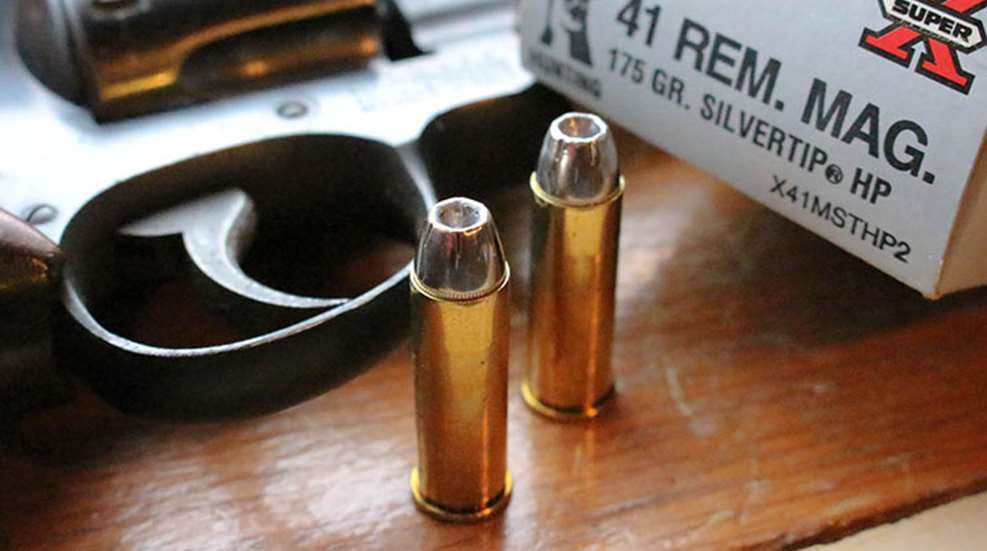
There are many more choices in the ammunition department for the .41 Mag. than there were in 1964. Federal is loading the .41 Mag. in its Vital-Shok line, loaded with a 210-grain Swift A-Frame bonded-core bullet at a muzzle velocity of 1360 fps, for an excellent blend of expansion and penetration. Should you prefer double-duty for your .41 Mag., Hornady loads the excellent 210-grain XTP bullet at 1545 fps, making a solid choice for both a defensive round and a hunting round. If you like the heavyweights, Grizzly loads a 265-grain Wide Nose Gas Check cast bullet at 1400 fps—a load I’d wager Elmer Keith would appreciate, and one that would make serious bear medicine. Should you want to work with a lighter bullet, for plinking or training, Winchester offers its 175-grain SilverTip hollowpoint moving at just 1250 fps, for a nice, light-recoiling option. The diversity of ammunition available for the .41 Mag. makes it a perfectly viable choice.
Handloading the .41 Rem. Mag. makes a lot of sense, especially if you do a considerable amount of shooting. A good set of carbide dies will quickly become your friend, just be certain to use a bullet with a nice cannelure, and put a heavy roll crimp on your cartridges to prevent them from walking their way out of the case under recoil and locking up your cylinder. The .41 Mag. runs on a large pistol primer, and is fueled best by powders like Hodgdon’s H110, Accurate No. 9 and Winchester 296.
I have always enjoyed shooting a .41 Mag.; it seems to have enough oomph to feel like a big revolver, but none of the fast recoil of the bigger guns. However, the .41 Rem. Mag. suffers from the lost-middle-child syndrome; it lives in the shadow of the both the .357 and the .44 magnums. Perhaps if it had been released before either, or at least one of them, things might be different, but recently it’s been reduced to what amounts to a cult following, and that’s a shame. The .41 Rem. Mag. is a better cartridge than that.
Looking for previous installments of Behind the Bullet? We've got you covered.
• 7mm Remington Magnum
• .470 Nitro Express
• .280 Remington
• .300 Winchester Magnum
• .270 Winchester
• .222 Remington
• .45 ACP
• .404 Jeffery
• .44 Remington Magnum
• .243 Winchester
• .338 Winchester Magnum
• .357 S&W Magnum
• 6.5-284 Norma
• 8x57 Mauser
• .38 Smith & Wesson Special
• 7x57mm Mauser
• 9 mm Luger
• .35 Whelen
• .454 Casull
• .375 H&H Magnum
• .45 Colt
• .22-250 Remington
• 10mm Auto
• .308 Winchester