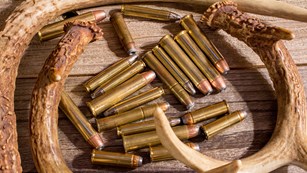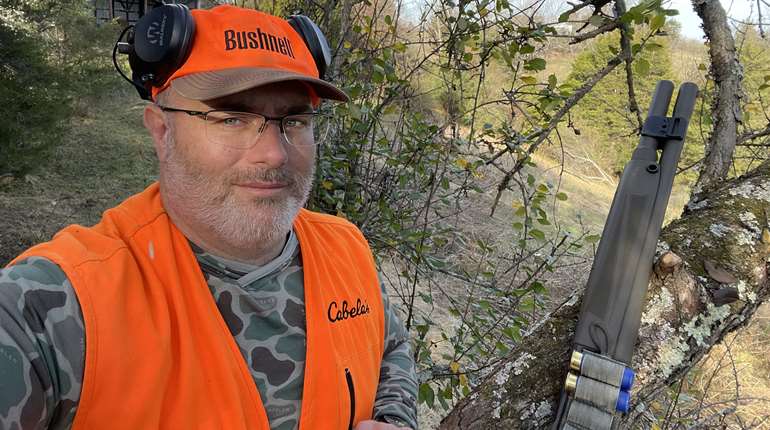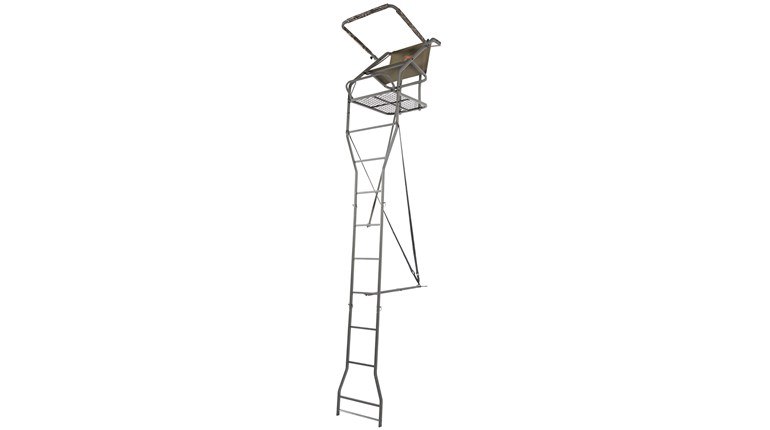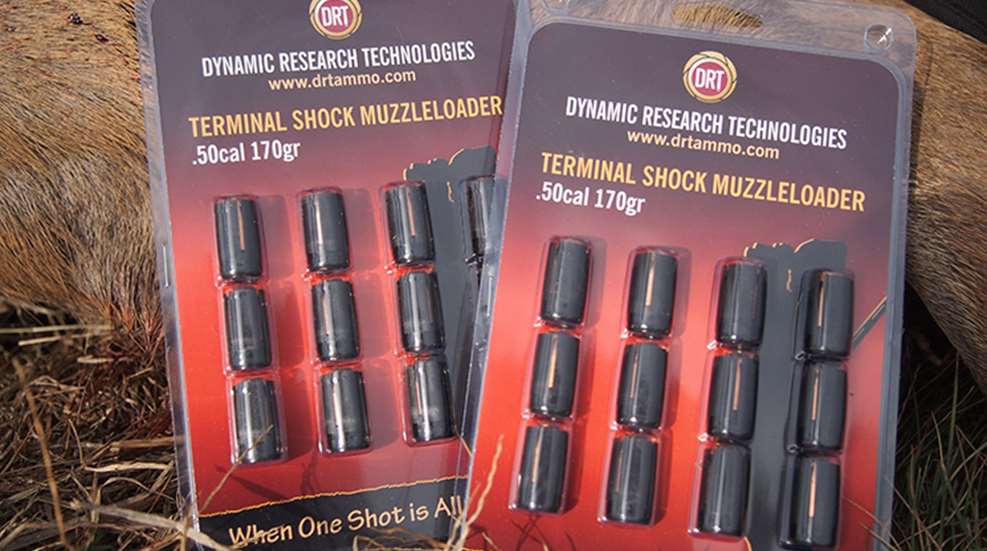
There was an hour of daylight left, the warm Northern Missouri sun just beginning slant through the trees, when the whitetail does and small bucks started drifting out of the woods. A few days after Christmas 2014, and I was hunting deer at the invitation of Dynamic Research Technologies (DRT), an ammunition maker that specializes in frangible hunting and self-defense ammo. I was here to try out the company's 170-grain Terminal Shock Muzzleloader .50 caliber bullets and a Redemption in-line rifle from LHR Sporting Arms.
I’d hunted the hardwood-covered ridges the day before, but all I had seen were a couple does a few hundred yards away. Zero deer that morning. But now, and the first time in this particular stand, it looked like I might have hit the jackpot.
 In twos and threes, the deer stepped out of the tree line three hundred yards away, gave the area a quick scan and then moved toward their evening feeding grounds. One band of smallish does passed within a stone’s throw of my elevated stand. Most of the deer, though, jumped the barbed wire fence half-hidden by a line of brush and made their way into the cut-over corn field to my right.
I saw the first buck appear behind a string of does. He turned in my direction, but before I could even decide if he was a shooter, he veered into the tall brush along fence line and I lost him.
The light was disappearing fast. Should I take a doe? I had a tag for one, and, after all, a big part of this hunt was an ammo test. OK shoot the next decent-sized doe, I told myself—and about three seconds later I spotted antlers.
He trotted right toward me, and then stopped and looked into the harvested corn field where a few does were feeding. I had my Redemption up on the window ledge. I looked through my Vortex Optics Diamondback HD 3-12x44mm scope, and counted eight points in the gloom. He wasn’t Boone and Crockett huge, but eight points and a good-sized body?
That’s a shooter in my book.
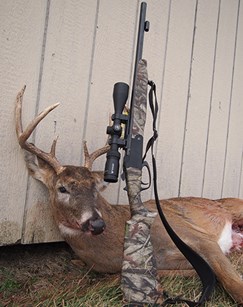
He paused at less than 100 yards, turned and went up on his hind legs to nibble a tree branch. I slid the crosshairs onto his shoulders, and when he dropped back down and presented a broadside shot, I fired. The blast of powder obscured everything for several seconds, though I thought I saw the buck jump the fence. I waited 15 minutes, got down and found him piled up in the field; he’d run just over a small rise and dropped.
I came to Northern Missouri with some concerns about the 170-grain DRT bullet. Previously, the lightest muzzleloader bullet I had used weighed 250 grains. I’d always assumed you needed to use a big, heavy bullet for blackpowder given the slower feet-per-second delivery versus centerfire.
In the past, I’ve used DRT’s centerfire ammo on many hunts and it always worked as advertised: penetration of tough skin, bone and hard muscle, followed by massive expansion inside the animal as the jacket came apart and the compressed powdered metal inside the bullet blew up.
But I just wasn’t sure the muzzleloader bullet would go fast enough to get the full effect, especially as I was using only two pellets of IMR White Hots, for a 100-grain powder load.
I was wrong.
On my buck, the DRT bullet drilled through the right side of the rib cage, shredded its way through the right lung and then pulverized an area larger than a half-dollar coin in the left lung. The metal powder inside the bullet plus the bullet jacket peppered the rest of the lung area and the left side of the ribcage.
I also watched the field dressing of three other deer harvested on the hunt, two bucks and a giant of a doe (nearly 200 pounds), and all three showed similar damage. The DRT bullet punched through the bone and harder muscles, and then opened up inside the soft tissue, tearing large holes in the deer. In one case, it simply made a large chunk of heart, well, disappear.
The rifle and scope combo was a sweet set up. The Redemption is an in-line with a European look to it thanks to the oversized trigger guard—which is also a very handy trigger guard in cold weather when wearing gloves. Instead of a hammer, the Redemption uses a striker fired system, where you pull back the lever and fire. It easily de-cocks, too.
Images in the Vortex Diamondback scope were clear and sharp, even in low light, the crosshairs precise. The magnification ring turned smoothly, and the scope has a handy parallax knob on the left side of the tube.
My shooting at the range was a rather rushed affair, as I was late for three other things, but within a half hour I was punching a 1.5-inch, three shot group at 100 yards.
All in all, a fine deer hunting rig.