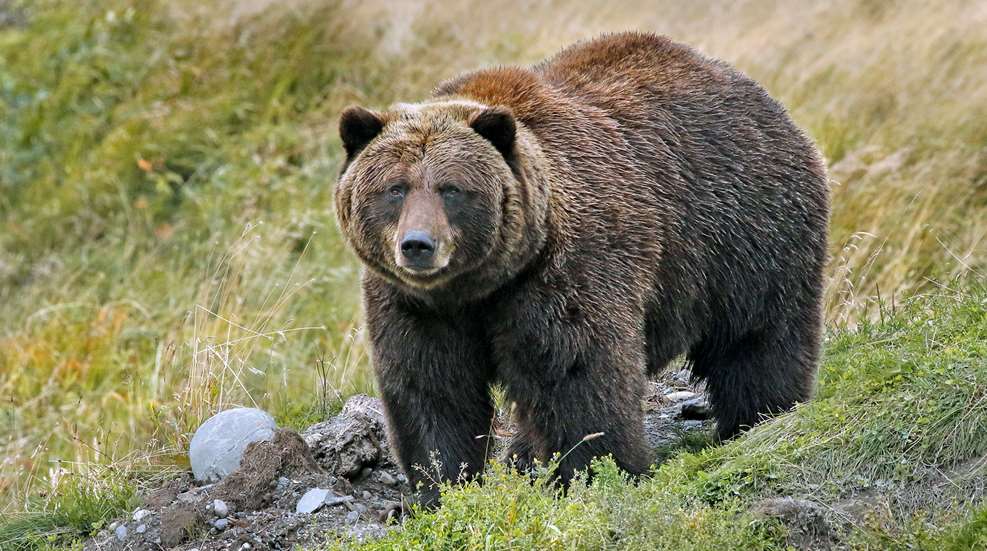
Of the many North American big-game camps I’ve been in, bears are the most commonly missed and misjudged game animals. When spotting a bear, keep calm. Many hunters get in a rush, which leads to misjudging a bear and poor shot placement.
Most of us want a big bear. These are five things I look for to assess a bear’s size, respectively.
First, watch the walk. If a bear’s bulky hindquarters appear to rotate independently of the front shoulders, you’re looking at a mature bear. The bigger the hind end in proportion to the front shoulders, the bigger the bear. Old, giant bears seem to almost struggle to walk.
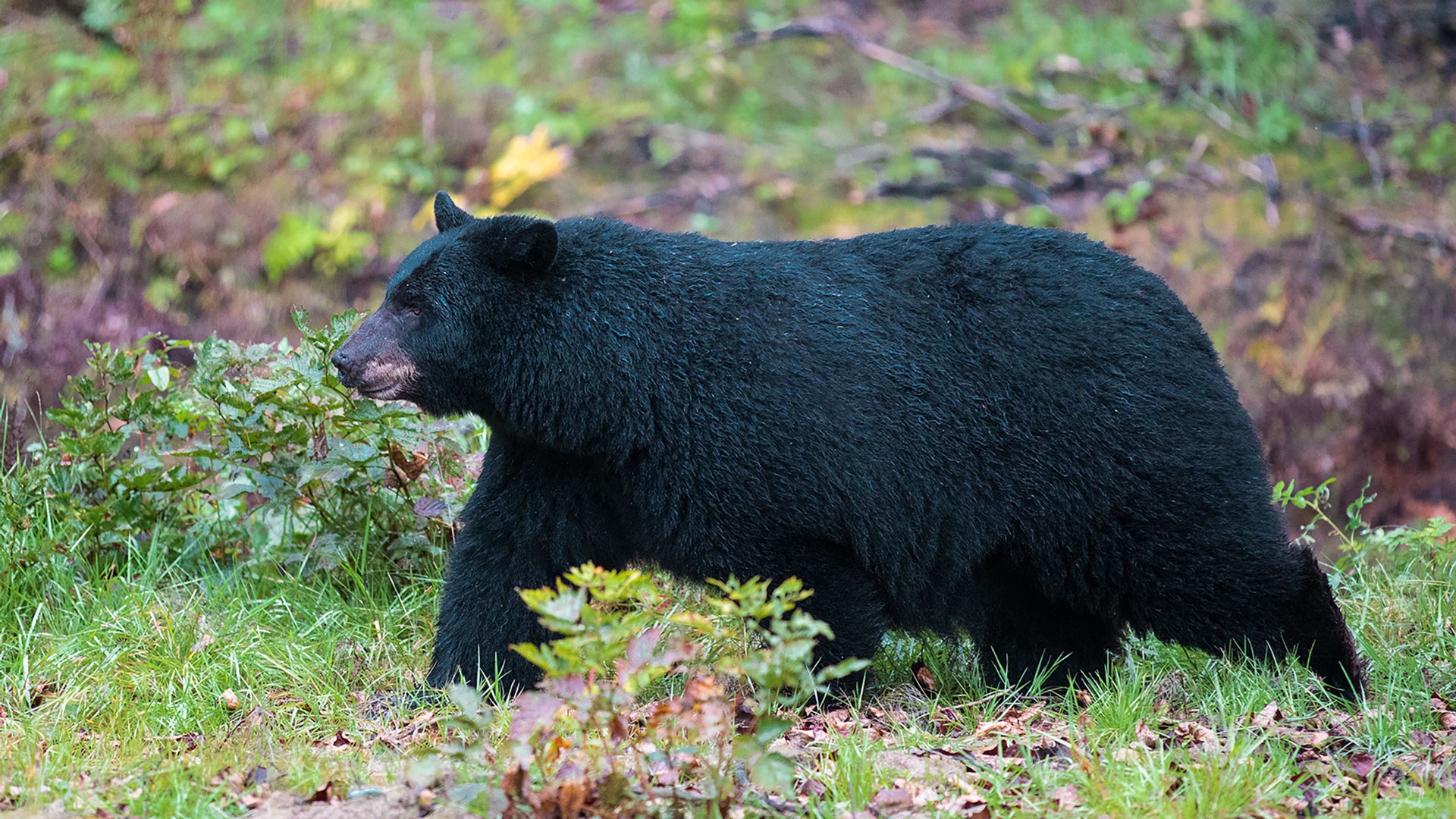
Next, evaluate the front legs. If the width of the shoulder and elbow are equal, with no distinct elbow being visible when the bear stands broadside, it’s a mature bear. If the width of the leg continues all the way down to the paw, it’s a big bear. If there’s no differentiation between the foreleg and paw, it’s a shooter. A flipping of the wrist when a bear walks, or a narrowing of the lower leg, is indicative of a young bear.
Third, above the eyes, in the center of the forehead, a mature boar develops a triangular divot. It forms below where the cranial muscles attach to the skull, along the cranial ridge. The bigger the muscles atop the head, the more pronounced the divot. The older a bear, the more prominent the cranial muscles. It’s the development of these muscles that also sets the ears wide on the skull.
If a bear’s ears appear small and turned to the side of the head, and the other three checkpoints are favorable, get ready to shoot. The ears of big bears seem to almost lay flat across the top of their head. On massive bears with fully developed cranial muscles, the tips of the ears will lay slightly below the top of the head. The larger and more pointed the ears appear, and the higher on the head they sit, the smaller the bear. Additionally, if the neck is wider than the head and ears, it’s almost certainly a big bear.
The fifth and final checkpoint is a bear’s belly. Not always do massive bears have sagging bellies. The area being hunted, time of year, food availability, a bear’s physical health and even the severity of the prior winter can have a direct correlation as to the size of a bear’s gut. I’ve seen a number of big, slender boars, along with fat yearlings mistaken for mature boars.
Generally, the bigger the bear appears on the outside, the greater the skull size. But you’re never assured of what a bear skull will measure until you skin the beast. I’ve seen record-book skulls on bears of average size, and small skulls on some giant-framed bruins. By utilizing quality optics–especially a spotting scope–and taking time to study bears, you’ll learn what identifying features set one apart from another, whereby boosting the odds of killing a big bear rather than a small one.
The process of sizing-up a bear requires concentration, which helps calm the nerves. In turn, shot accuracy increases. In addition to frazzled nerves, there are other reasons why hunters blow shots on bears.
Because bears have long hair and lack muscle definition, picking the precise spot for shot placement can be challenging. This is especially true in low light situations, particularly in thick timber or over bait in the waning hours of daylight. Shooting a scope with an illuminated reticle is a quick remedy. Finding black crosshairs on dark hair can be challenging. Locating a glowing reticle on a black pelage relieves any doubt as to the point of aim.
The bullet and arrow placement with the highest kill percentage on bears is broadside. Never have I seen a big-game animal expire as quickly as a bear that’s shot through both lungs. Many have expired in less than 10 yards, including some true giants.
If a bear is standing broadside, place the reticle at the back of the front leg. Start low on the leg, find the edge of the long fur, then follow it up the back of the leg to the center of the body. That’s your point of aim.
If a bear is standing on all fours, facing you, chest exposed with the head up, putting a bullet beneath the chin–where the base of the neck meets the chest–is lethal. The same is true if a bear is sitting on its hind end, chest up, facing straight away. Put the crosshairs between the shoulder blades, on the spine, and that bear is dead. My biggest brown bear, a 10-foot, 9-inch brute, fell to one shot in this position.
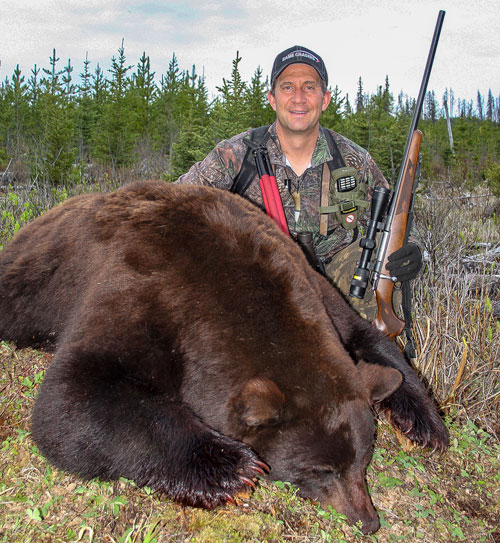
Quartering shots can be effective, but the outcome depends on shot distance, accuracy, the size of the bear and the angle at which it’s standing. Quartering-away shots are preferred over quartering-to. Aim for the middle of the body and deliver the bullet when the off-side front leg is farthest forward. The intent is to drive the bullet through the midsection and into the opposite front leg. The entry point may feel far back, but it’s not. Shoot too far forward and you’ll hit one lung. Those bears can be tough to recover.
If shooting a big-bore gun at close range, I’ll take a shot at a bear quartering toward me. The shot will come when the nearside front leg is back, opening the gap between the shoulder and sternum. I hope the will bullet will exit midway through the body on the opposite side. If the angle is too severe, don’t shoot.
The more bears you watch, the more you’ll learn about sizing them up. Even after 40 years of hunting bears, they’ll still humble me.