Airgun development has progressed by leaps and bounds over the past decade, and that progression has undoubtedly contributed to a rise in pellet-gun popularity. At the forefront of this development, pre-charged pneumatic technology has empowered modern airguns to emulate traditional firearms, while being easier to own and feed. As most states do not regulate these items, bringing one into enemy territory is effortless and trouble-free. Additionally, when the ammunition market was turned upside down, many gun owners found it easier to get (or mold) pellets, which kept them in the hunt.
Today’s airguns are not the Red Ryders of yesteryear. Firing pellets at velocities unheard of decades ago, these guns are capable of dispatching game of all sizes. As such they fill a niche where a bow or crossbow might be too cumbersome. Also, they offer hunters the ability to employ standard optics while reaching out farther than they would with an arrow.
As an NRA-certified rifle instructor, I have said as much for years. So I was ecstatic when my friends from Gamo invited me on a pig hunt to test their latest, the TC-50. This big-bore cannon fires .50-caliber slugs at blistering speeds from the same form factor as any modern sporting rifle. As Gamo is part of the Iconic Outdoor Group, this hunt would also include some Benjamin airguns, which I was equally excited to catch up on.
Our journey took us to central Florida, where we would hunt the storied Kempfer Ranch, formally known as Osceola Outfitters. Stretched across Osceola and Brevard counties, the 25,000-acre ranch is currently manned by its fifth and sixth generations of Kempfers. Hoppy Kempfer and his sons, Sage and Case, maintain a plethora of traditional operations that take advantage of the fertile soil and abundant sunshine of this stretch of Florida. Operations here include raising cattle and growing timber and sod, all of which are uphill battles in the midst of the region’s feral hog population. But, as they were already guiding for deer, turkey and alligator, the Kempfers learned adding these pests to the hunting-and-guiding list was a logical solution to controlling them.
I sat with Hoppy as he explained that most of their property is “improved grazing land”; the natural palmettos were cleared to make way for grass and other nourishing vegetation for the cattle. However, wild pigs undermine these efforts, literally. These swine destroy all forms of plant life as they dig to uncover insects and plant tubers to sustain their insatiable appetite. Making matters worse, a pair of breeding pigs can produce more than two dozen piglets each year. This factor alone is fueling their widespread invasion throughout the country. Feral hog populations now span coast to coast and as far north as Pennsylvania.
I kicked off my trip by linking up with members of Iconic’s staff and some of their influencers from across the nation. We began by familiarizing ourselves with big-bore PCP airguns, including their basic operation and zeroing procedure. The PC (pre-charged) portion of the moniker means they must be pumped up by a high-power compressor or hand pump, often to 3,000 psi or higher. Likewise, they can be filled from a SCUBA tank, which is handy in states like Florida as you don’t have to go far here to find a dive shop. (Many firehouses can help with this, too.) You can expect at least five, full-power shots from a fully charged rifle, making a PCP airgun sufficient for your typical hunt. To be fair, I met this with a bit of trepidation, as “reloading” wasn’t as simple as reaching into my pack for a box of ammo. Then I got really honest and asked myself how often I actually carry more than just what’s in my magazine, and quickly saw the light. At the same time, Florida sounders are typically smaller than those found in Western states, so odds are you won’t even encounter enough pigs here to empty a tank in an entire evening.
In the past, I have hunted hogs from a helicopter and from a high-rack, both of which proved immensely effective methods of population control for this feral and rapidly spreading species. While those methods were indeed a thrill, neither delivered any experience with taking hogs via more conventional methods. Nothing can compare to the intimacy of still-hunting hogs, or a higher-stakes spot-and-stalk hunt. Here on the Kempfer Ranch, since I had two full days to fill my two-pig limit, I decided to try bagging one using each method. At that point I determined that, just like firearms, air rifles are better suited for one type of hunt than another. So I plunked down on the bench to determine which air rifle might be best for each type of hunt.
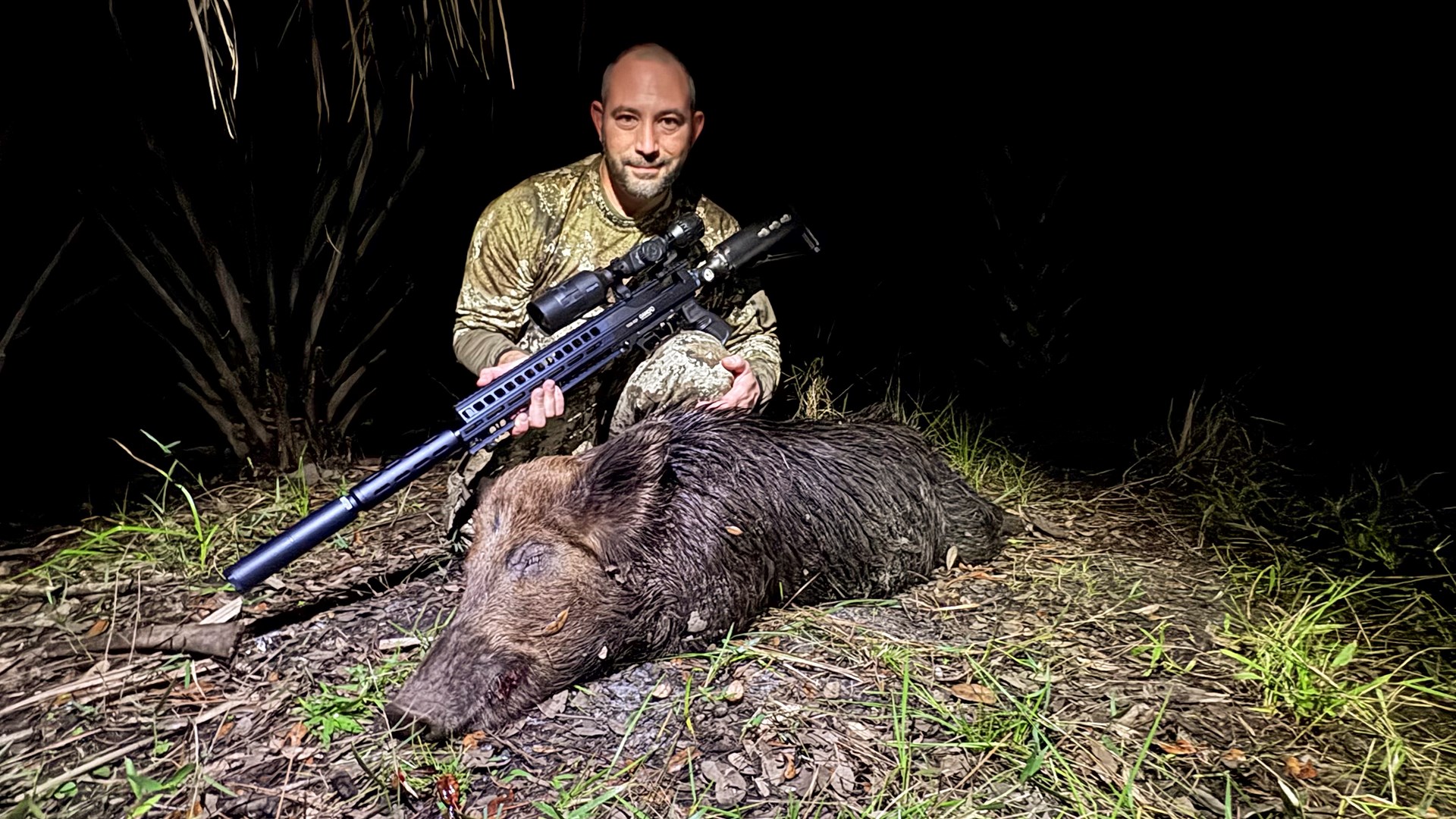 The Gamo TC-50 is a PCP .50-caliber single-shot with ergonomics similar to an AR-15. Its 336-grain pellets travel 900 fps with 400 ft.-lbs. energy.
The Gamo TC-50 was the latest release, so I was naturally drawn to it first. This massive .50-caliber single-shot rifle is built with a pistol grip and its air tank in the rear; it’s very AR-15-esque and ought to be attractive to anybody looking for an airgun that looks and feels like a powder-burning rifle. The operation was a bit peculiar, as the lever-action cocking handle has a stop that engages when you close it. The idea behind it is that you can stop halfway if you don’t want a full-power shot, doubling the number of shots you can get off a given charge. Its length of almost 46 inches makes it a little cumbersome for a stalk, where I’d prefer to remain agile and might need an unburdened follow-up shot. However, for the open ladder stands that littered the ranch, this slugger would be ideal. Firing three-shot groups at 50 yards, I saw little vertical displacement, meaning velocities within this range were consistent enough to be predictable. So, after each group, I stepped back to the cabin to refill the air tank. Happy with its performance in just a few shots, I moved on to selecting a rifle for the stalk.
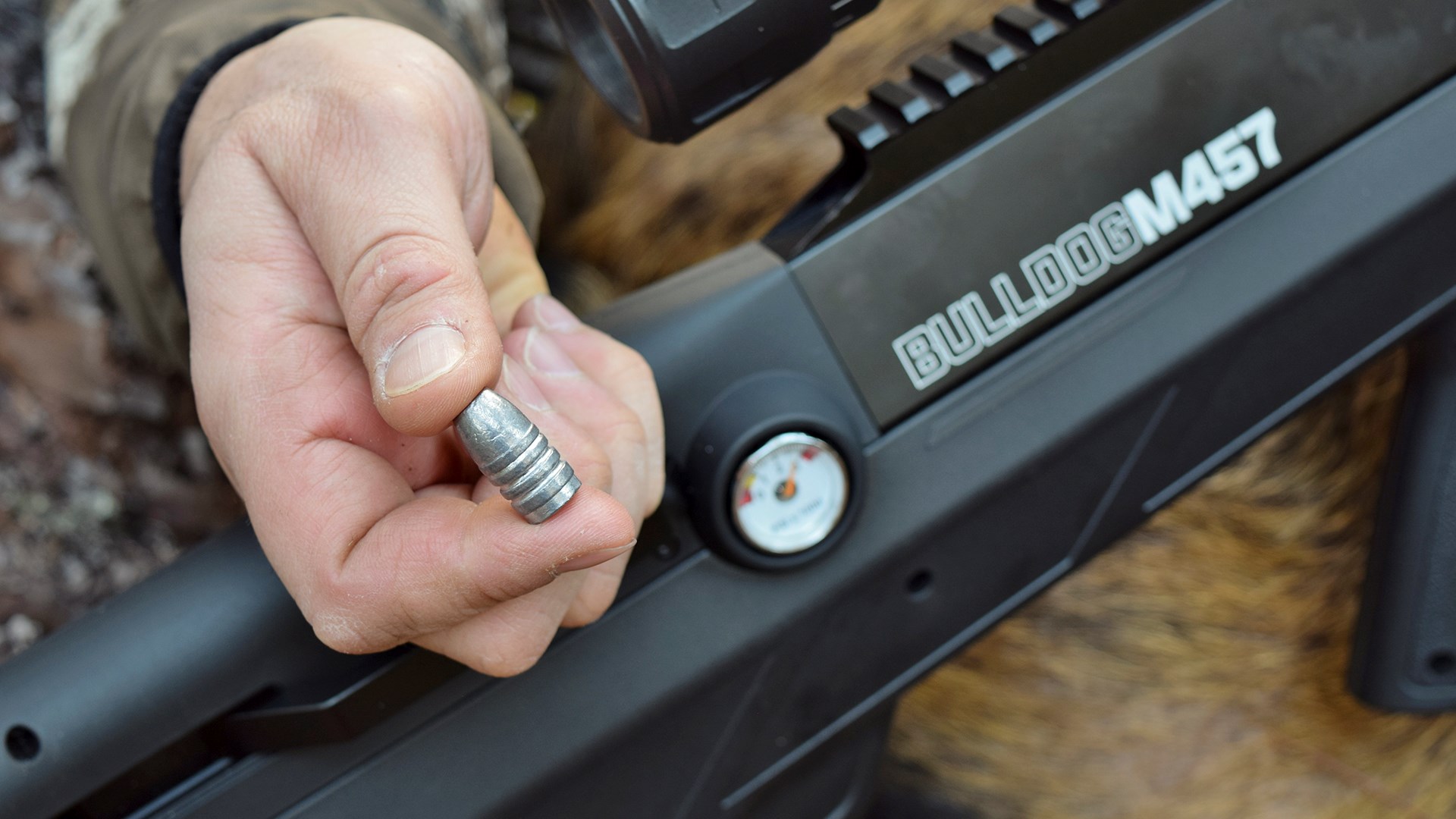
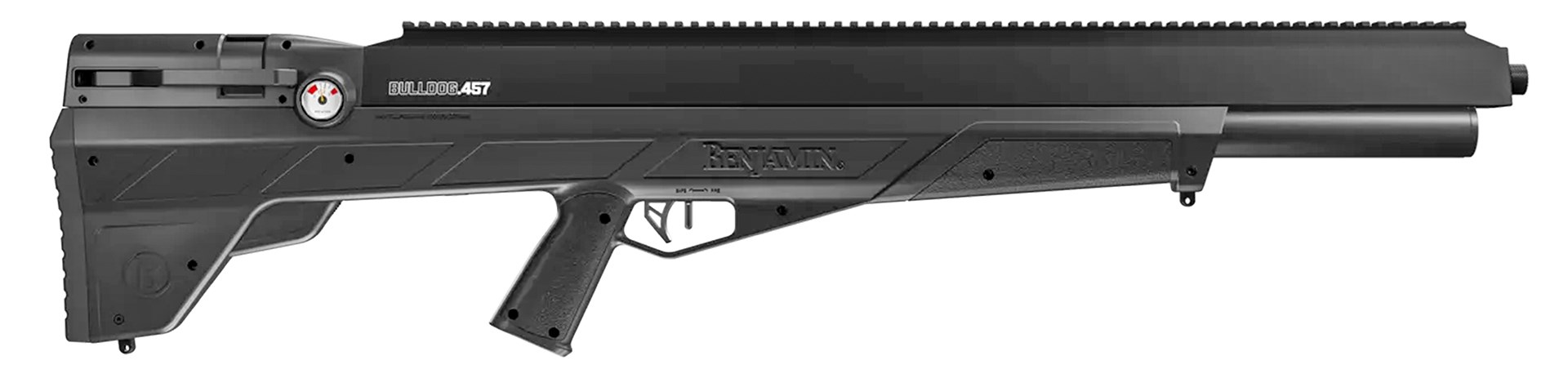
Benjamin has been at the PCP game for a touch longer than Gamo, so the folks there have worked out more of this power system’s limitations and have been able to shrink things quite a bit. Benjamin’s Bulldog .457 stood out to me. Measuring nearly 10 inches shorter than the TC-50 and feeding from a three-shot gravity-fed mag, it was the top candidate for the spot-and-stalk job. As the name suggests, the Bulldog .457 slings .457-inch-diameter slugs, which means even at the same weight as the pellets fired by the TC-50, these pellets have a better sectional density than the .50-caliber pills. If weights and velocities are similar, you can expect better penetration. Also, the smaller bore is partially responsible for less air usage per shot, thus I was able to get at least five pellets downrange before I noticed a change in impact.
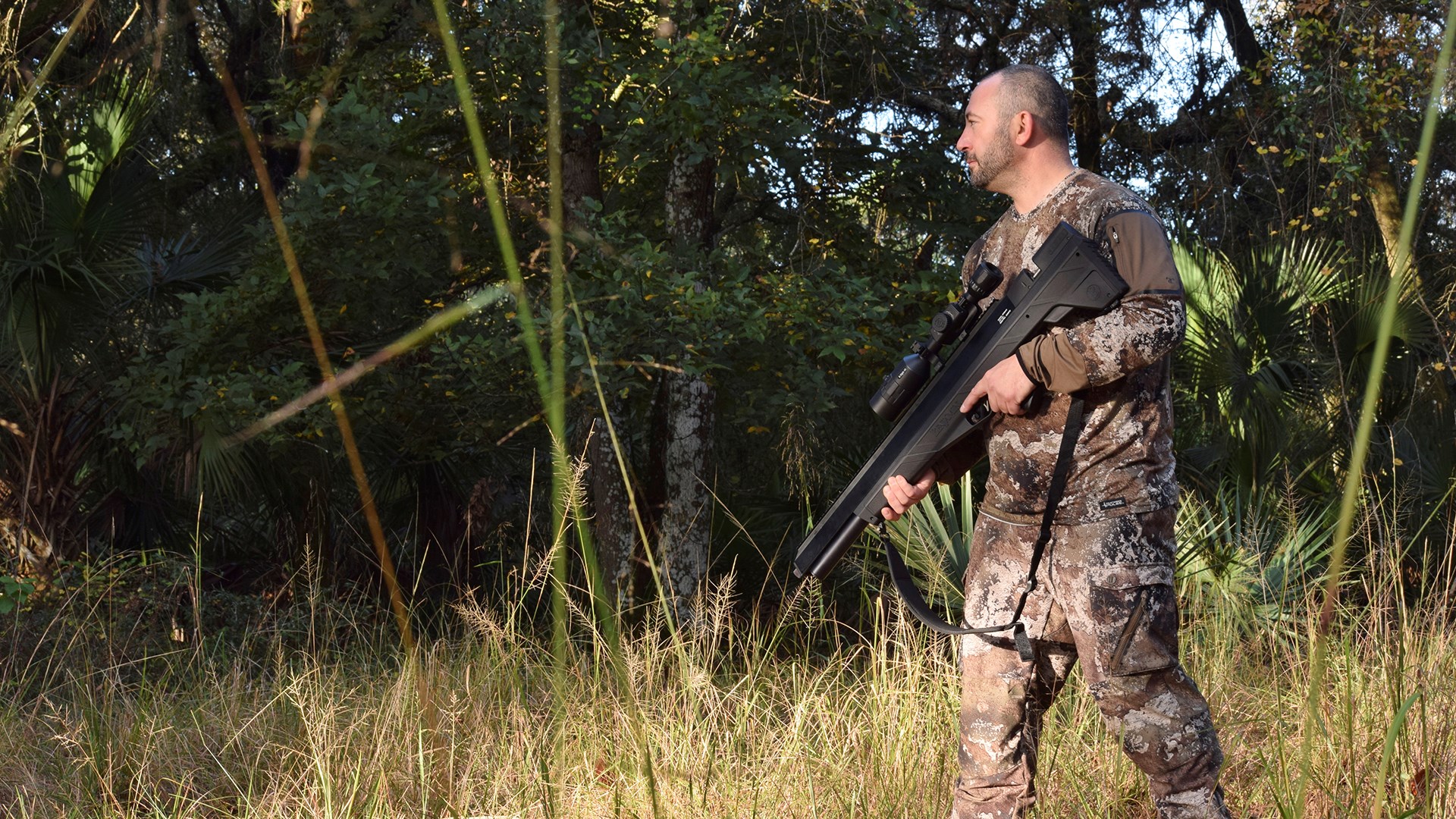 The bullpup-style Benjamin Bulldog .457 fires 336-grain pellets at upwards of 760 fps. At 10 inches shorter than the TC-50, it’s a good bet for stalking night pigs.
With hardware squared away, we hurried to our stands for a “bonus sit” as the group was dialed-in far ahead of schedule—and the weather was nice, and in Florida you learn to take advantage of that.
In the stand, the first hogs came in only a few minutes after the feeder went off. TC-50 in hand, I placed my crosshairs on the largest pig’s shoulder and cracked off a shot … and a miss. After a lengthy search failed to produce even a slight hint of blood, we decided I sorely missed and ought to check my zero. Back on the range, I uncovered a user error. Pellets placed in the chamber of the TC-50 are free to slide back into the receiver area if the gun is tilted up. If this happens, they do not enter the rifling straight and can miss a target at 50 yards by as much as 10 inches. Armed with this knowledge, I ensured that I kept my muzzle down for the rest of the hunt and carried on.
The next evening found me at a fresh stand on one side of a fire road deep within the palmetto forest. Again hunting over a feeder, I waited for it to dispense its corn, which would effectively ring a dinner bell. I watched as a solitary boar made its way along a trail it obviously knew well. This created a challenge as he had a determined path, one that would not offer a broadside opportunity. As the boar was partially obscured by the feeder, he quartered just enough for a head shot, which I decided would be enough to do the trick. This time, more confident in my firearm, I sent a 336-grain chunk of lead hurdling toward him, and he took just a few steps into the bush. There, later, he was quickly recovered by Missy, our fearless cocker spaniel.
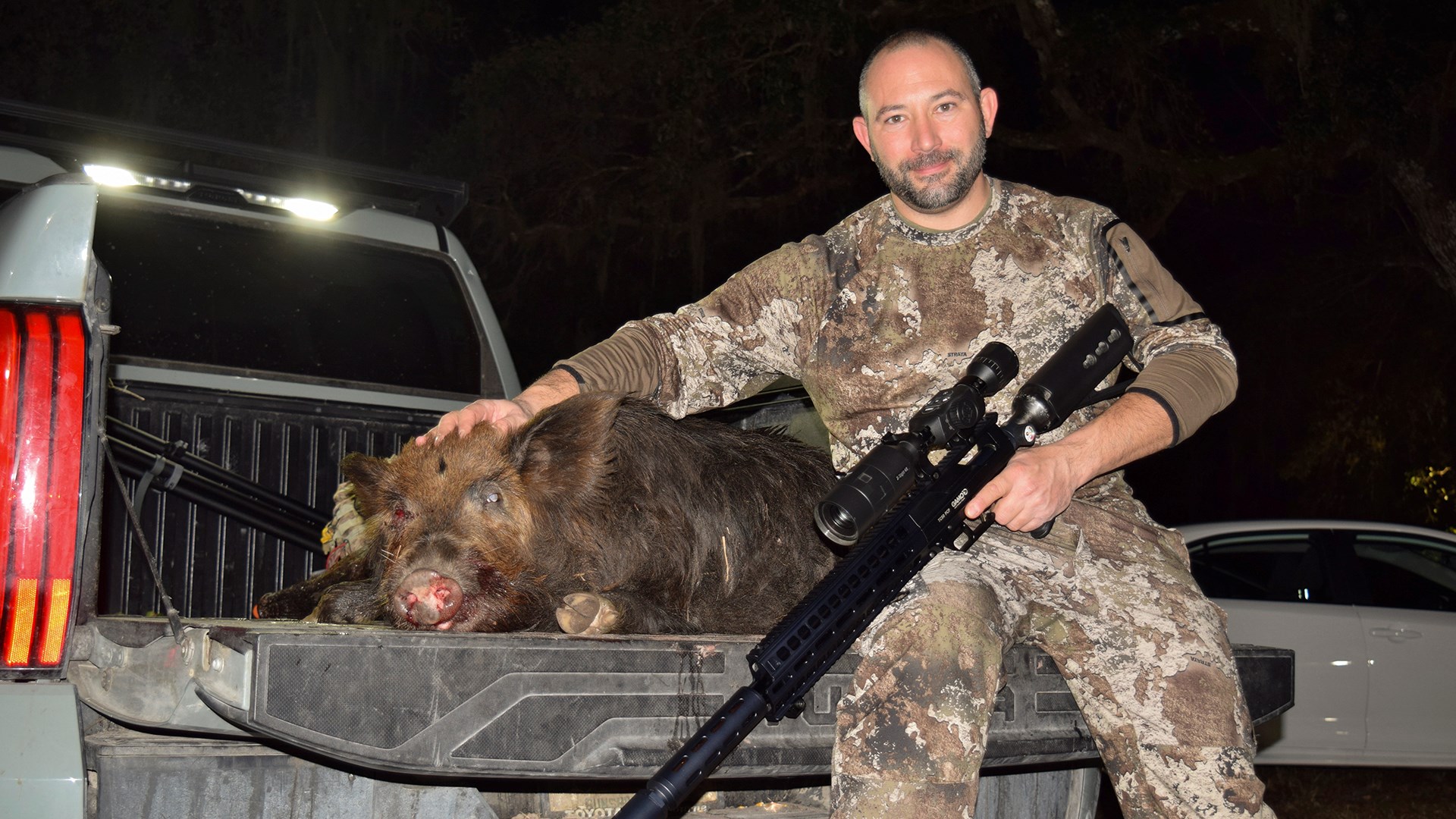
With a 130-pound boar on the board, I was ecstatic to celebrate not only my first Florida pig but my first airgun kill on anything larger than a squirrel. To that end, the next morning had me set for an immediate follow-up, placing me in the passenger seat of Hoppy’s truck as we hurried to the opposite side of the property. As I learned the evening prior, pigs are predictable. Hoppy had a good idea where to find some now, during the early hours, so we hurried in that direction to ditch the truck and sneak toward them. Hoppy drove to take advantage of the wind, as pigs can smell better than whitetails—so much so that they can use their noses to find food even buried deeply underground. When stalking them, there is simply no way to cover your scent; you have to play the wind. The good news, however, is that while they can smell nearly everything their eyesight isn’t particularly good. They even have a tell, Hoppy explained: “When they stop moving their heads, it’s likely they saw you, so get still, quick.”
Spotting some pigs roughly 200 yards out, we started our stalk down a narrow sandy path. Using the taller vegetation as cover, we methodically switched back and forth to maintain concealment before making a stand just 45 yards away. Deploying a pair of shooting sticks, I picked out a sow of roughly the same age and size as the boar in the cooler, placed my crosshairs on her shoulder and dropped her with a single shot right where she stood. Needless to say, I was pleased with the Benjamin Bulldog.
We ended our hunt with dinner and drinks back at the cabin, with every hunter filling a two-pig allotment for the hunt. Most of us took advantage of the on-site processing plant, and I took home frozen meat that proved to make excellent chops and sausage. My time spent with Osceola outfitters showed me what air power is truly capable of, and thinking that perhaps we ought to lean into their use in the field a little harder.
I requested the pair of airguns for some work back home; they will see some use during deer season, and I’m sure a few coons will meet their demise before that. I’ve learned that if you have air and lead you have everything you need to fill a tag.
 Gamo TC-50
AIR on the Range
Tweaking a zero at the lodge hardly constitutes a thorough gun test. So, I decided to get a pair in for evaluation in a controlled environment at 50 yards. As the guns had digital optics on the hunt, I decided to mount conventional scopes and chose a Burris FullField for each, as they’d offer a clearer sight picture.
With the same 336-grain solid lead slugs as I used in Florida, I gathered data with the TC-50. My first shot was chronographed at 706 fps, and I remained within the gauge’s operating range for a total of eight shots, ending at 591 fps. This yields an energy range of 372 to 260 ft.-lbs. Group size at this distance was roughly 2 inches. This is acceptable, but it might pay to try other pellets before settling on a load.
 Benjamin Bulldog .457
In the Benjamin .457 I also fed the same bullets we used on the hunt, but they were 350-grain. I found that I could pull nine usable shots from a fill that ranged from 694-540 fps, which spells out 374-227 ft.-lbs. of punch. This gun and ammo combo seemed to agree better, as groups were well within an inch. Having a Lothar Walther barrel also plays into that equation.
Both rifles performed admirably on the hunt and on the range, making it next to impossible to pick a winner. I will admit, though, that I feel I made the right choice pairing the TC-50 to a still-hunt and the Bulldog 457 to a stalk. gamousa.com