Recipe: Wild Turkey Soup

by
posted on February 27, 2018
** When you buy products through the links on our site, we may earn a commission that supports NRA's mission to protect, preserve and defend the Second Amendment. **
wildturkeysoup_lead.jpg

Though wild turkey is revered as a top quarry among America’s hunters, it’s often under-utilized as table fare. Many hunters will cut the breast meat out of the bird and toss the carcass, either because they think the legs and wings are inedible, or because they perceive them as being too tough to eat. To be sure, the legs are indeed tough, but are a gourmet’s delight when cooked properly. The wings are likewise delicious, but it takes some effort to pluck the large feathers, but the extra work is worth it. This recipe creates a gastronomic delight out of much-maligned meat. 

Ingredients:
• turkey legs and wings
• chicken broth
• juice of ½ lemon 
• ½ teaspoon salt 
• ½ teaspoon black pepper 
• ½ cup carrots, diced
• ½ cup celery, diced
• ½ cup onion, diced 
• 1 tablespoon grated Parmesan cheese
• cooked rice or noodles, if desired

Directions:
1. Using a sharp knife, remove the legs at the joint above the top of the drumstick where it joins the body. Once removed, don’t pluck them, skin them. The wings need to be plucked to remove the large feathers. Cut the wings off at the joint where the wing joins the body. Cut off the outer part of the wing at the joint. 
2. Place the legs and wings in a crockpot, and add enough chicken broth to cover. If necessary, cut the leg into two sections—the thigh and drumstick—if they won’t fit in your crockpot in one piece.
3. Add the juice of half a lemon, salt and pepper, and allow to cook until the meat is tender and can easily be pulled off the bones. Don’t be discouraged if they aren’t done after 8 hours in the crockpot, it could take 10 hours or more, especially if you’re cooking a longbeard—a jake will usually cook sooner than an older bird. If you’ve taken a hen during a fall hunt, you might not be able to determine age. Simply cook until it’s tender. Reserve the liquid. 
4. When deboning after the meat is cool enough to handle, you’ll notice the drumsticks will have long, slender flexible bones. Carefully pull the bones out of the meat, they’re easily removed. 
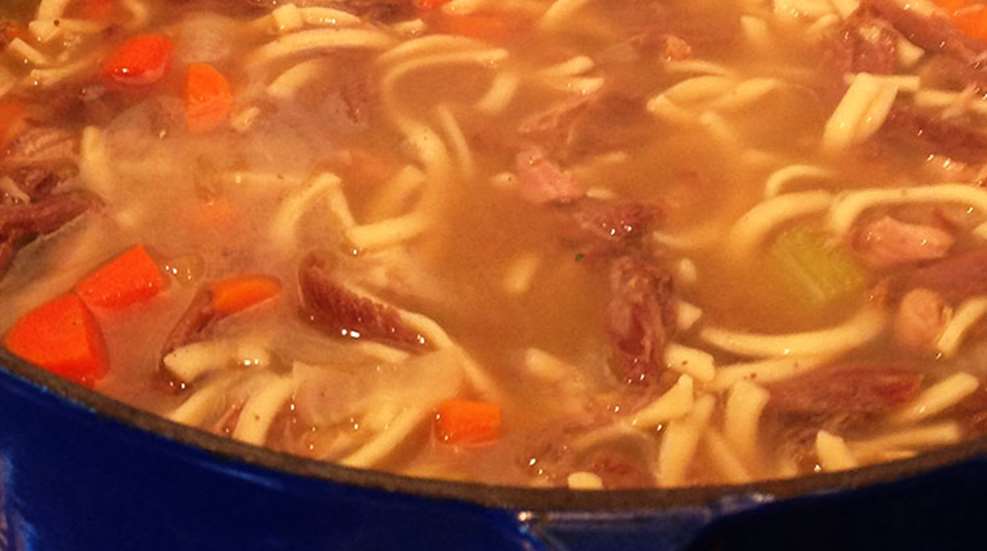
5. Separately cook diced carrots, celery and onion in water until tender. Drain and add to meat and liquid that was used to cook the legs. Add the Parmesan cheese and heat until all is warmed throughout. 
6. Stir in cooked rice, or cook noodles separately and add later, if desired.

Latest

LEDENRA YES Logo
LEDENRA YES Logo

NRA Announces 2026 Y.E.S. Grand Scholarship Recipients

The National Rifle Association has awarded $15,000 in college scholarships to attendees of the 2025 NRA Youth Education Summit (Y.E.S.) through the Y.E.S. Grand Scholarship program.

Recipe: Venison Empanadas

When Brad Fenson makes venison empanadas, the goal is simple. Keep the meat front and center, add enough flavor to complement it, and make a filling that stays juicy without overpowering the wild proteins. The filling is rich, balanced, and built to highlight venison, whether baked or fried.

Proof Research Unveils Shorter Barrels for Elevation 2.0 and MTR 2.0

Proof Research has announced shorter-barrel configurations for the Proof Elevation 2.0 and Elevation MTR 2.0. Both the Proof Elevation 2.0 and Elevation MTR 2.0 in shorter barrel configurations are available in Tactical Flat Dark Earth (TFDE) and the all-new Midnight color, offering shooters greater customization options alongside Proof Research's carbon fiber technology.

Range Review: Midwest Industries Bounty Hunter Revolver Brace

Thanks to Midwest Industries new Revolver Brace, you can easily mount a stabilizing brace to your favorite hunting revolvers. Check out B. Gil Horman's review of this game-changing product.

First Look: Marlin Mad Pig Customs Model 1894

Marlin has introduced its Mad Pig Customs Model 1894, a rifle developed—as its name implies—in collaboration with Mad Pig Customs. Built on Marlin's iconic lever‑action rifle platform, this model delivers modern, factory‑installed features previously found only on custom builds.

Funding Authorized to Conserve Critical Wetland Habitat

The Department of the Interior has announced that $44.79 million in North American Wetlands Conservation Act (NAWCA) funds have been approved by the Migratory Bird Conservation Commission. They will provide the U.S. Fish and Wildlife Service—and its partners—the ability to conserve, restore or enhance 185,203 acres of critical wetland and associated upland habitat for migratory birds across the United States.

Interests


Get the best of American Hunter delivered to your inbox.