A flock of turkeys fed up an open hillside. When they passed through a patch of Scotch broom and into a stand of fir trees on a steep slope, I sent Echo on the run. She quickly covered the 175 yards. The instant the turkeys noticed her, they flushed into the trees.
Tiffany, my wife, and I followed. Echo’s tracking collar confirmed a point. We couldn’t see her in the thick patch of briars inside the timber. Subtle cries of jennies and jakes in the trees above broke the silence.
Moving around the backside of the briars, we found Echo, steady as a stone statue; the perfect point. We inched closer. Then all hell broke loose.
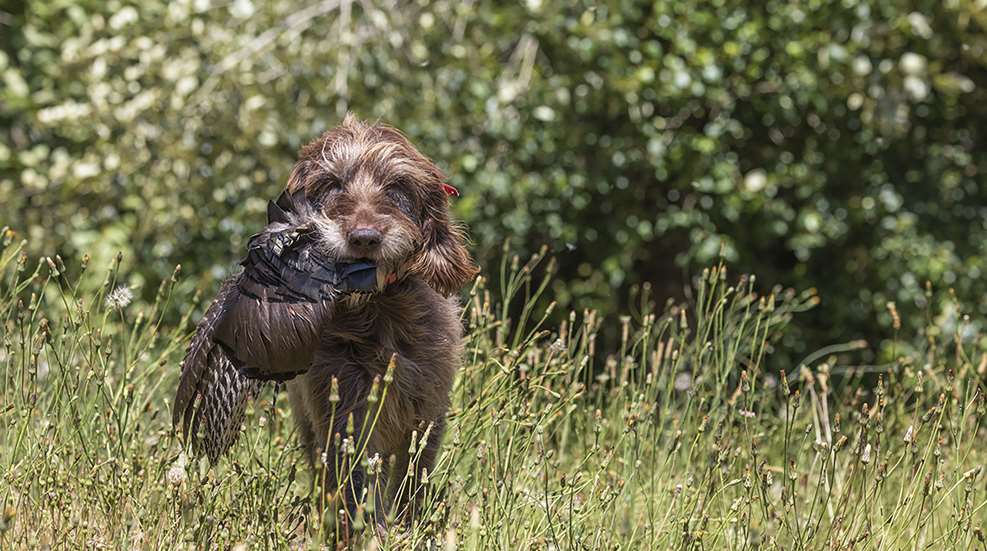
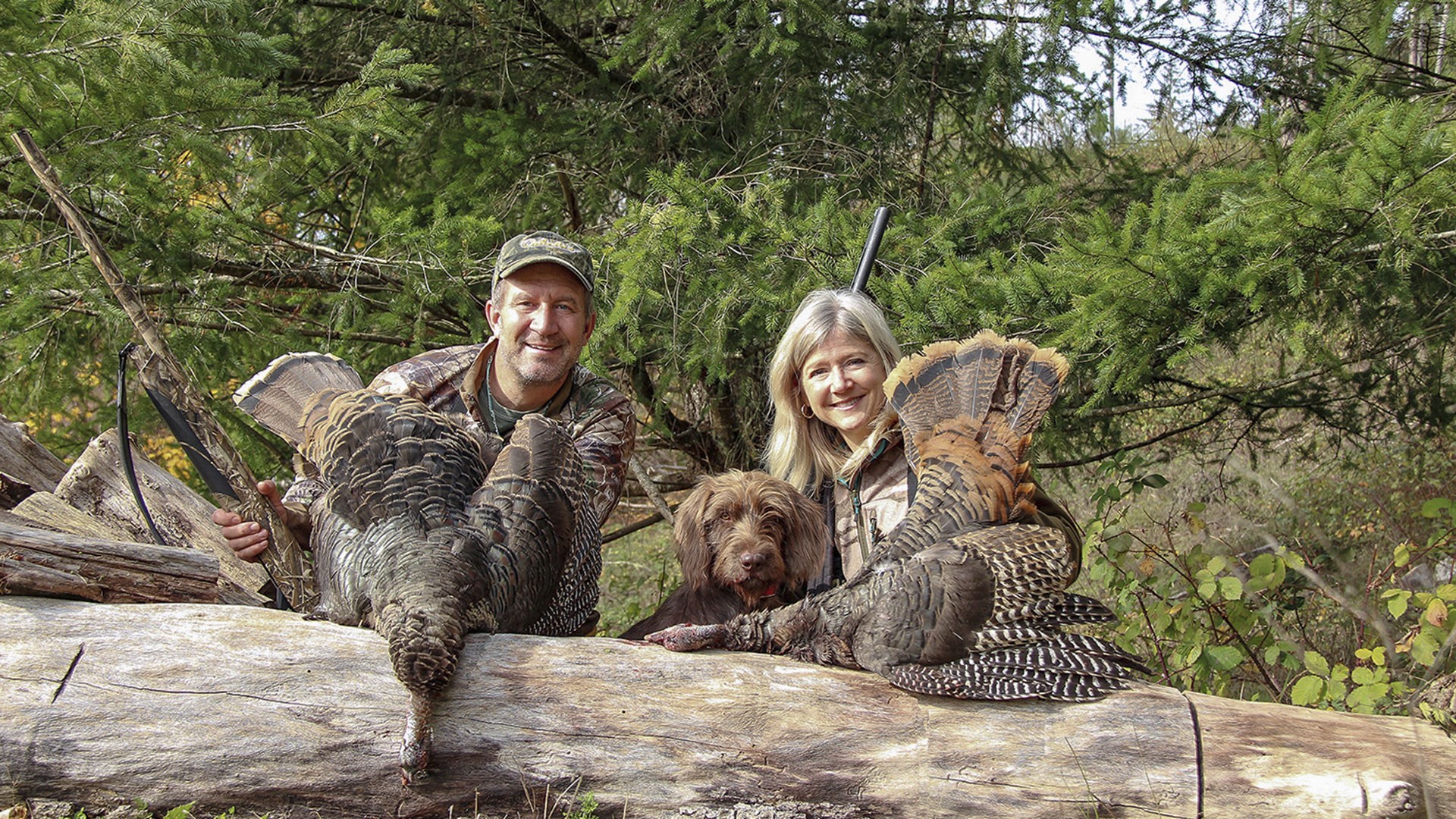
Upwards of a dozen turkeys erupted in loud chaos. Some we could almost touch, the wind from their wings slapping us in the face. Tiff swung right, me left. Two shots, two dead turkeys. Echo retrieved one, I grabbed the other.
Given the number of turkeys that fled into the trees, we figured only one or two were still on the ground. There were more birds in the flock than we thought.
Echo is a pudelpointer. She was almost a year old on that Thanksgiving turkey hunt. She’s nearing 12 now, and has been on numerous fall turkey hunts in her lifetime.
In states that allow it, hunting fall and winter turkeys with a dog is a rush, partly because these birds leave so much scent on the ground it drives dogs to another level, partly because of the uncertainty of it all.
On that hunt, we sent Echo to break up the flock and send birds into the trees. Breaking up a flock as they head uphill, into a canopy of trees, is more effective than on flat ground. From there, three things can happen.
The whole flock might tree. Beardless flocks—hens, jennies and jakes—tree best. They also respond the most aggressively to reassembly calls. When a flock trees, my dogs prance around, looking up. That’s when I give two beeps on the e-collar to bring them back. Then we hike to within 100 yards of the birds, keeping out of sight, take cover and start calling. Kee kees, yelps and purrs are great for calling beardless flocks in fall. Make sure your dog will lay low and hold tight as vocal birds approach.
Fall jake flocks are also quick to tree and receptive to calling back in. Mature bachelor flocks, not so much. Over the years I’ve found less than half of a mature flock of toms to take to the trees when busted up. Some inevitably take off running. Others hold tight as bobwhites.
When a fall turkey holds and a dog goes on point, reward their efforts. Move in for the flush but be ready to shoot because toms often make a break for it.
Sometimes turkeys end up in the trees while some hold and others run. If a dog sees a runner, it’ll sometimes go after it. If the dog loses sight, she’ll start tracking. No upland bird holds scent like a turkey. Your dog will love it. Tracking jobs can end up with a point, the bird taking wing into a tree, or sprinting to an opening and flying a mile across a canyon. Be prepared for any of these.
Kona, my 9-year-old male pudelpointer, loves tracking turkeys. A few seasons back I was catching a lone tom on a trail camera. It traveled an elk trail three days in a row. It was eating rose hips and insects. It passed by the camera each morning between 10 and 11:30.
On the night leading into day four it rained, our first precipitation in over a week. Like clockwork the tom passed in front of the trail camera. About a quarter-mile across the ridge, the trail headed into a draw choked with vine maple, Scotch broom and briars. Perfect holding habitat, and the moisture meant more scent on the ground. Kona and I weren’t far behind.
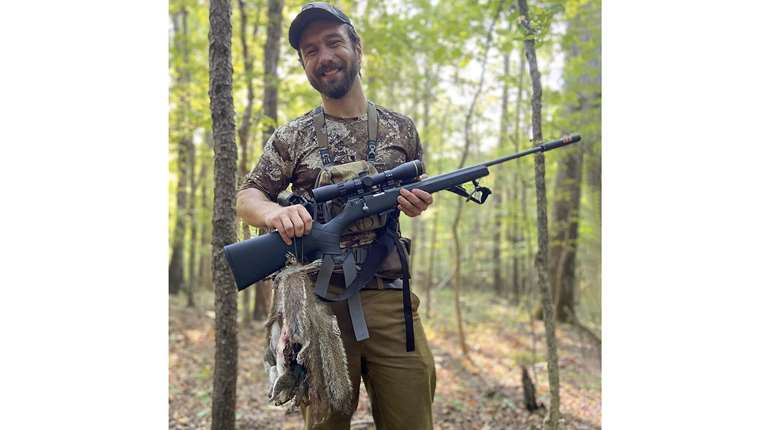
Kona picked up the scent and went to work. Three hundred yards later he was on point. When I reached Kona, he was locked in on a vine maple thicket. The tom got nervous and ran. It didn’t make it far, thanks to a payload of TSS fired from my 20-gauge. Kona delivered the 23-pound tom to hand. He loves that part. When tracked, I’ve found lone toms to hold better than bachelor flocks of mature birds.
I began training both dogs to hunt fall turkeys when they were eight weeks old. It started with wing training, first on a drag then hiding them to search. Turkey wings are big. Cutting them in half at the elbow allows for two training tools per wing. Turkey tails are also great; leave the fat and oil glands intact for added scent. Save turkey wings and tails from both fall and spring birds, keeping them in the freezer for year-round training. Thaw them out a couple hours prior to training, then refreeze them when you’re done. Don’t let them become chew toys.
When hunting fall turkeys with a dog, plans can quickly change. For this reason, disciplined training is key. You may need to immediately redirect a dog, asking it to go from an all-out sprint to sitting calmly by your side for two hours while you call. Birds might move and you may have to hike a ways before the hunt ensues. During the hunt you’ll communicate with your dog visually, verbally and with beeps of the e-collar, so train accordingly.
Hunting fall turkeys with a dog can be laced with uncertainty and challenges. The best reward is watching a dog figure it out, then heading back to the truck with a bird over your shoulder, your pup looking up at you with eyes that convey their pride and joy.
For signed copies of Scott Haugen’s popular book, Western Turkey Hunting: Strategies for All Levels, visit scotthaugen.com. Follow his adventures on Instagram & Facebook.