Daylight tediously revealed itself in Hells Canyon. A lengthy hike into the rugged land found me hot and sweating. Fortunately, falling thermals offered relief as I sat on the point of a rocky ridge overlooking two ravines on either side.
The first series of cow calls I delivered faded into mountains. But when I cut loose with a bugle, three bulls responded. I bugled back. Three bulls answered, followed by a fourth.
A small 4-point came running out of the timber from above. A 6x6 crept from the pines across the ravine. Both were young.
One bull to the right sounded different—deeper, raspier than the others. I bugled again. The bull hammered back as it skirted a thicket on timber’s edge. It was big but a long way off. It was too treacherous to reach the bull by hiking a direct line.
Hoofing it across the opposite ridge took nearly three hours. Periodic bugles kept the bull holding in the same spot. Nestling into position across the canyon, I called dozens of times throughout the day. The bull answered nearly every time, even during the heat of the day. It never left the brush pile. I never left my position. Two young bulls came to my calls in the middle of the day, one silent, one bugling.
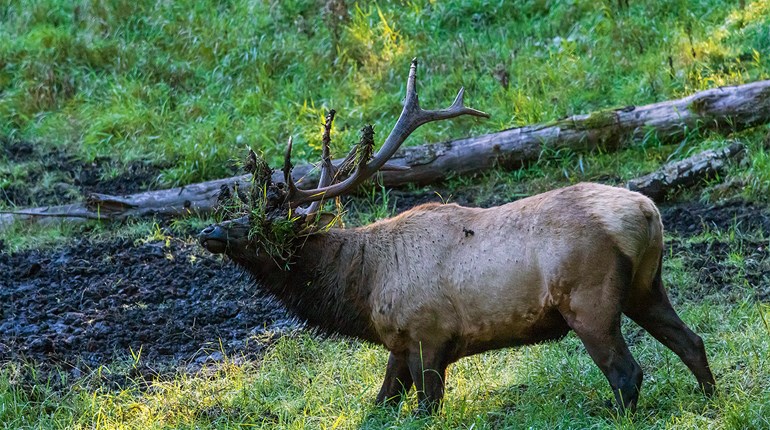
Minutes before darkness consumed the canyon, the bull went ballistic, bugling and chuckling at my every call. Finally, with only minutes left, the big 6x6 emerged. The 305-yard cross-canyon shot was straightforward. The pack out was not.
It was Oct. 15, the rifle opener. Daytime temperatures eclipsed 70 degrees. I could have shot five legal bulls that day, all thanks to calling.
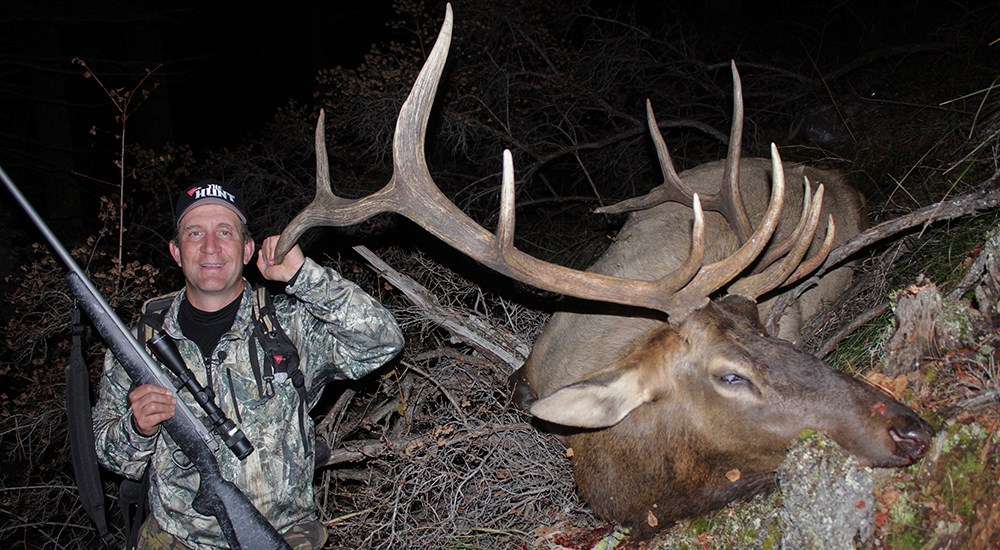 The author got this bull to bugle at first light. Though it wouldn’t come out of the timber, Haugen kept bugling, which kept the bull answering all day. With daylight waning, the bull finally emerged.
Two weeks later I was in another state, hunting elk at 9,500 feet in the Rockies. A buddy and I ran across an outfitter who’d been in the ravine for five days. He was leaving. He’d not seen or heard a single bull. Thirty minutes later we made it to the top of a ridge. I slid out of the saddle, grabbed a bugle and let it rip. A bull immediately replied in a ravine, 2,000 feet below.
Minutes later the bull stepped out, another bull prodding it. They sparred, bugled and the bigger bull rub-urinated. Two hours later the big bull was dead. Calling not only got the bull to announce its whereabouts, but it spurred a rut-like behavior not many rifle hunters witness.
Calling elk in October and into November is an overlooked approach. In recent years, with higher temperatures and extended rutting activity, the bulls seem to be getting even more aggressive this time of year.
Thirty years ago, I bugled in rifle season just hoping a bull would answer. The objective was to solicit a bugle, then set off on foot to find it. Today, calling in bulls, or at least getting them to hold so I can move into shooting range, is the goal.
There’s no doubt in my mind elk behaviors have shifted with the change in climatic conditions throughout the West. Bulls are more vocal, and rutting behaviors are carrying over well into fall. Capitalizing on this boost of testosterone can swing the odds of getting a shot in your favor during rifle season.
Late one October I hunted the Snake River Breaks. A herd of cows poked out of a draw early in the morning. A nice bull was with them. When the morning sun struck, they began an uphill climb into the rimrock. It resembled sheep country with no trees in sight. I couldn’t keep up with the herd, so I bugled. The bull immediately responded. This went on for over an hour. I climbed, pausing a few brief times to catch my breath in the thin mountain air. The bull never left the cows but it hung far enough back that I closed the gap. When the bull began dry wallowing in yellow grass and dust, my pace quickened. The shot came inside 300 yards. I had bugling to thank for that bull.
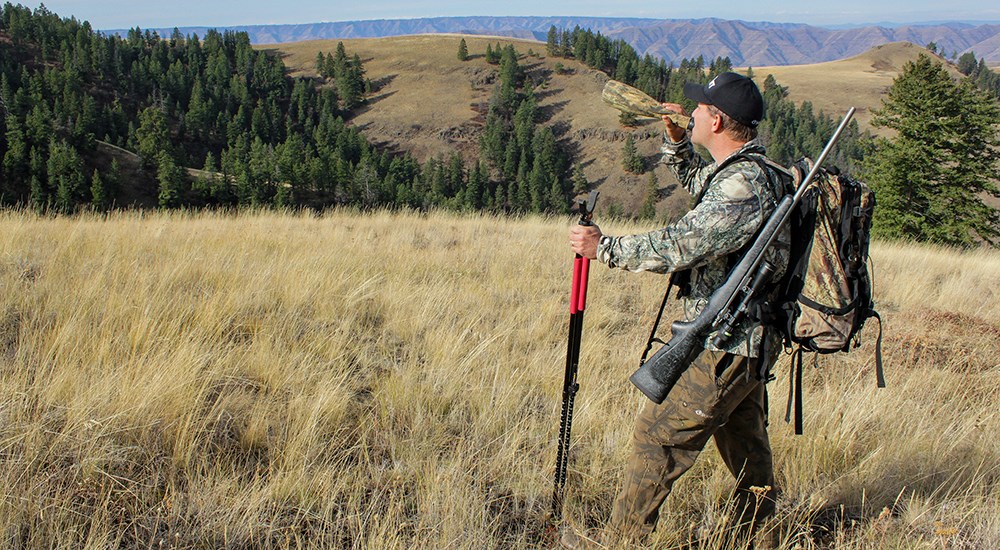
When calling in timber, a mix of bugles and cow calls can get bulls fired up. This time of year, cows can be vocal in cover as they communicate with calves that have spread out to feed and bed. This is a safe approach, as you have the vantage point on anything that comes your way.
If moving through timber to reach a bugling bull, use cow calls to mask your sounds and keep the bull’s interest. Be cautious using this approach when fellow hunters are in the area. You don’t want to catch someone by surprise. Then again, in all my years of calling elk in rifle season, I’ve never encountered another hunter, nor have I heard one calling.
Unlike calling bulls in September, be careful not to get too aggressive. Let the bull’s behavior and communication dictate the sounds you offer. Too much bugling can send bulls in the opposite direction or shut them up. Then again, get one or two bulls excited with aggressive bugles, even cutting them off mid-sentence, and they might come in on the run.
Wear hunter orange when calling elk in rifle season, and set up in the open so intrigued hunters can see you. Do not use an elk decoy in rifle season, as there are cow hunts often taking place.
While calling late-season bulls doesn’t offer the consistent results archery hunters experience, it can be effective. If you can at least locate a bull then make a move, that’s good. It’s great if you can slow a bull’s progress by calling. But it’s a showstopper when a bull comes charging in, bugling and frothing at the mouth.
*Scott Haugen is a full-time freelance writer of over 25 years. Signed copies of his many books can be ordered at scotthaugen.com.