When Beretta introduced the Xplor A400 Unico, many anticipated the company would expand the line much as it did with A391, and now it has done so. Although some would argue with me, I believe the A400 platform is, in fact, a better shotgun in many respects than the A391. Lighter, even less recoil, and faster cycling are only some of the features that drive this opinion. So what's new about Beretta's Xcel A400 Sporting?
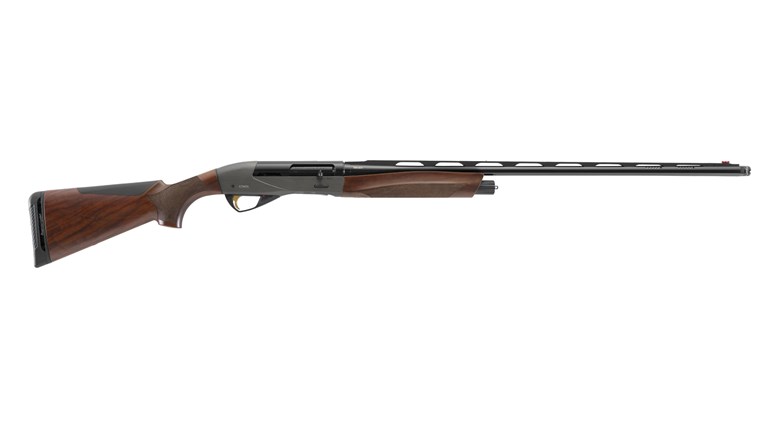
As it's chambered for 2 ¾- and 3-inch shells, this a versatile shotgun that is not only suited for clays but the field. However, the bright-blue anodized receiver is hardly camouflaged for the marsh. There is little reason to have a hunting shotgun set up differently from a sporter, since sporting clays was originated to duplicate field shooting. To this end the Xcel comes with Beretta's familiar shim kit that allows setting the stock for different comb drops, cast-off and cast-on. The A400 Xplor—the field version of the Xcel chambered for 3½-inch shells—has similar lines. However, the Xcel weighs nearly 8 pounds, about a pound and a half heavier than the Xplor's svelte 6 pounds, 6 ounces.
For those unfamiliar with Beretta's A400-series shotguns, let's take a little tour, beginning at the business end—the butt. I say that because recoil is the shooter's adversary. To tame recoil, Beretta has developed a system combining hydraulic shock absorbers and springs it calls Kick-Off (and it really takes the kick off). At the introduction of the A400 in Italy, we shot clays with the entire range of shotshells from 2-ounce, 3½-inch magnums to very light 24-gram shells with very little difference in felt recoil. Aiding the hydraulics is Beretta's new Micro-Core pad made of a soft synthetic material. Mounted in the butt stock is the Kick-Off³, an oil-dampened buffer that absorbs the secondary recoil of the bolt striking the rear of the receiver, while also preventing the bolt from battering it.
Beretta's Blink operating system is claimed to be 36 percent faster than any other semi-auto. I don't know about that, but I do know that the new mushroom-shaped gas piston is much smaller than previous pistons, and the gas seal is a steel gasket that serves the dual purpose of sealing the piston and scraping clean the inside of the gas cylinder as it cycles. To the piston's rear is a sleeve to which the action bars and bolt carrier are welded. Those familiar with the A391 will recall the difficulty of reassembling the bolt and action bars into the action following cleaning. The A400 effortlessly slides together. Connected to this sleeve is the action-return spring. The bolt locks into the barrel extension by means of a heavy-duty rotating head, a la Benelli (Beretta owns Benelli). Disassembly of the bolt for cleaning and lubrication is simplicity itself. I shot an A400 Xplor extensively while hunting and experienced no malfunctions. I had the Xcel for a limited time, but in shooting clays with it found it to be equally trouble free.
The barrel is made of nickel-chromium-molybdenum steel that Beretta calls Steelium. Barrels begin as a short billet that is deep drilled then hammer forged into the barrel. Following cold forging the barrels are "vacuum distended" to relieve stresses. The chrome-plated bores guard against corrosion and make cleaning much easier.
The choke tubes on all A400s and the Beretta UGB are of a new design. Named Optima Bore HP, the location of the threads has been changed from other Beretta Optima Bore tubes. Randy Bimson, Beretta's technical group manager, says, "The threads are moved farther toward the muzzle to place them in an area less prone to pressure. In that location they are less likely to become stuck from neglect, and are easier to remove for cleaning or choke change."
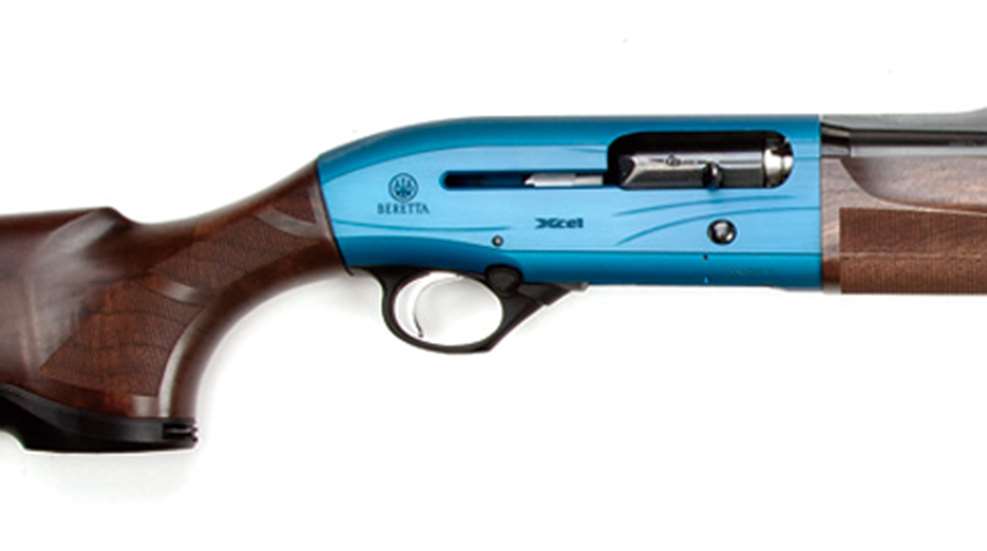
The A400 Xcel's receiver is a bright blue aluminum alloy to designate it as a sporting model. On the left side of the receiver is the familiar magazine cutoff. Not really necessary on a clay gun, it's there if desired. Located in the pistol-grip cap is the unique Gun Pod digital read-out system. By pushing the activation button, it will scroll through the ambient temperature, the recoil of the last shell fired and the number of rounds fired.
Bimson says, "The readout for recoil is a number, but it's not precise. If you fire a given shell it will provide you with a baseline number against which you can compare other loads." Basically, you can see what shell recoils more.
Crowning the magazine tube is the Beretta Balance Cap that allows the use of three differently weighted caps to adjust the balance to personal taste (two are sold as separate accessories).
The A400 Xcel is a fine shotgun that ought to become common on the clay fields. Its functioning is excellent and recoil attenuation is significant, which will be a major selling factor among serious competitors. The only strange thing was that, although I'm right handed, the test gun was set up with ⅛-inch cast-on for a left-handed shooter. Instructor, sporting clays champion and Beretta Team member Bruce Ney also received a gun for evaluation, and it, too, was set up with cast-on. The gun I received for evaluation had been around for a while and had no choke tubes other than the improved cylinder in the barrel, and no shim kit, so I couldn't change the cast. I just cheeked it a little harder, and I broke plenty of targets.
Specs:
301-283-2191, berettausa.com
Type: semi-automatic shotgun
Gauge/Chamber: 12; 2¾", 3"
Barrel: 30" (test gun); nickel-chromium-molybdenum; Optima-Bore HP chokes
Trigger: chrome-plated; 5 lbs., 11 ozs. pull weight avg.
Magazine/Capacity: tubular, 3 rounds
Sights: ventilated rib; white front bead
Safety: trigger-blocking cross-bolt
Stock: select oil-finished walnut, adjustable for drop and cast w/supplied shim kit; LOP, 147/16"; drop at heel, 2⅜"; drop at comb, 1½"; cast on, ⅛"
Overall Length: 50⅝"
Weight: 7 lbs., 12 ozs.
Metal Finish: blue-anodized receiver, highly polished blued barrel
Accessories: shim kit, 3 choke tubes, wrench, hard plastic case
MSRP: $1,725