Ready to launch your shiny new Mother’s or Father’s day drone to locate that trophy buck hideout? Doing so nearly anywhere in the U.S. makes you a poacher. There is, however, a growing roster of states that allow the use of drones to locate downed game.
Ohio hunters gained the ability to launch an eye in the sky for that purpose during the 2023/2024 season. Kentucky, Texas and West Virginia followed suit in 2025. South Dakota and Iowa are currently considering similar legislation, and the list is growing. Louisiana is finalizing its regulation for this season.
Consult your state hunting regulations before sending an unmanned aerial vehicle aloft. Restrictions change, so double check and keep in mind it’s not unusual for some hunt units to have regulations that preclude their use. Areas near an airport or sensitive military installation’s “no fly” zone are good examples.
Better-Than-Standard Drone
Nearly all of today’s standard drones come equipped with a camera that feeds real-time video back to the operator. Their “vision,” limited to the same wavelengths of light the human eye sees, makes them less than optimal for recovering game, according to the experts. They agree an airborne thermal camera is the ideal choice.
“Thermal changes the whole game for recovery,” according to Lucas Merriman, owner of Covert Drones. “A wounded deer that bedded down 200 yards into thick brush is basically invisible to the naked eye, especially at night. With a thermal drone you’re picking up the heat signature in seconds. What used to take a recovery team three hours on foot, and a tracking dog, can take fifteen minutes from the air.”
“Thermal imaging is significantly better than traditional tracking methods for deer recovery because it allows you to quickly and accurately detect a deer’s heat signature from the air, even in thick brush, tall grass, or at night—without spooking the rest of the herd or trampling through the woods,” said Mike Yoder, founder and owner of Drone Deer Recovery. “This makes the process much faster, more ethical—reducing lost game and unnecessary suffering—and less disruptive to wildlife and the environment. That said, it’s not perfect in every situation: in early season when the tree canopy is thick with foliage, thermal performance can be reduced, though it still outperforms ground searches in most conditions.”
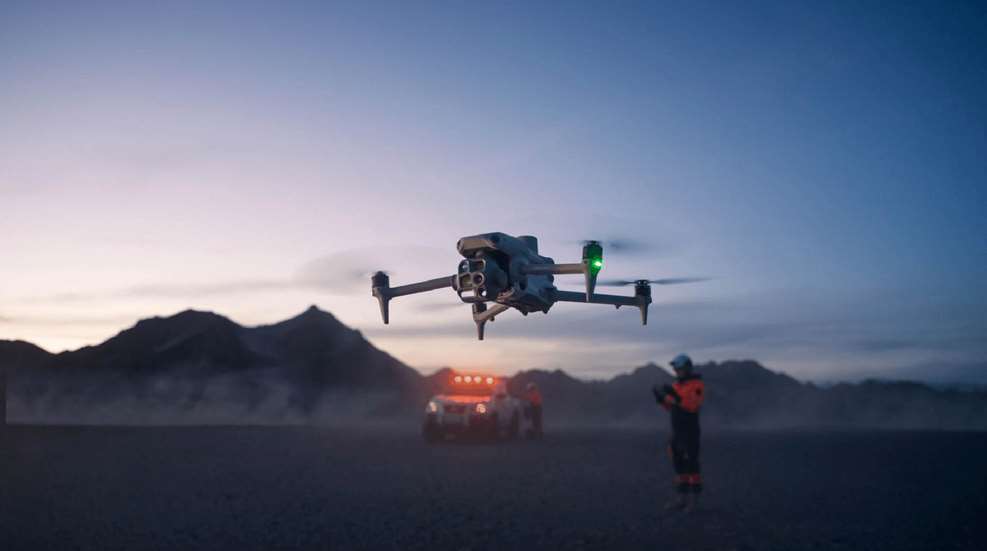
Both companies offer drones designed for the mission with thermal cameras. You can’t just unbox any drone, read the manual and take flight, however. The FAA rules the sky, after all.
License and Registration, Please
The FAA doesn’t have a fleet of F-16s ready to pull you over and ask for paperwork, but it does need you to know and adhere to rules for safety reasons.
“Here’s where folks get tripped up,” Merriman warned. “Even if you’re flying recreationally on your own land, you still have to register the drone with the FAA and pass the TRUST test, which is a short online quiz that takes about twenty minutes. That part applies to everybody. Where Part 107 comes in is the second money changes hands. If you’re charging hunters to recover their deer, that’s a commercial operation and the FAA wants you Part 107 certified. Most of the guys running recovery as a business are licensed. Landowners flying for themselves on their own ground usually aren’t. Either way, register the drone and take the TRUST test. That’s the baseline.”
“No, hunters and landowners do not need an FAA Part 107 Remote Pilot Certificate if they are using the drone strictly for personal use on their own property, such as scouting, herd monitoring, or game recovery,” Yoder agreed. “However, if the drone is used in any way for compensation—for example, offering paid recovery services or commercial land management—then the pilot must hold a Part 107 Remote Pilot License. Always register any drone over 0.55 pounds and complete the free TRUST safety test.”
The current price for taking the Part 107 test is $175 per attempt.
Overly Complex?
Anyone can fly either of the company’s drones with ease, the pair said. With a little practice advanced skills are mastered in a weekend or two, not months.
Drone Deer Recovery has been in operation since 2022. “Our most popular drone models right now are essentially tied between the DJI Matrice 4T and the DJI Matrice 4TD,” according to Yoder. “Both are excellent in the hunting industry for research and recovery purposes, and they are also highly effective for land management thanks to their advanced thermal imaging, long flight times, and reliable performance in the field.”
At Covert Drones, which Merriman established with his wife in 2017, “The DJI Matrice 4T is the one we move the most for hunting, recovery, and land management,” Merriman said. “The reason it’s the go-to is the camera payload. You’ve got a wide angle, a zoom, a thermal, and a laser rangefinder all on the same drone.”
As for the future, he added, “…this is a booming business. We’re seeing deer recovery turn into one of the next big opportunities for folks who want to get out, work outdoors and run their own thing. And it’s not just deer. It’s year-round work now. We’re seeing the lost pet recovery side grow fast too. Family pays you to find their dog that ran off into the woods, same skill set, same equipment, different season. The guys getting in early on this are building real businesses.”
Before Flying Off
Shed hunting is possible with a drone, although it’s probably not the ideal thermal camera application. Doing so is also not legal in all states and locations. Check regulations before using one for that pursuit, or any other, and always adhere to FAA requirements and regulations.