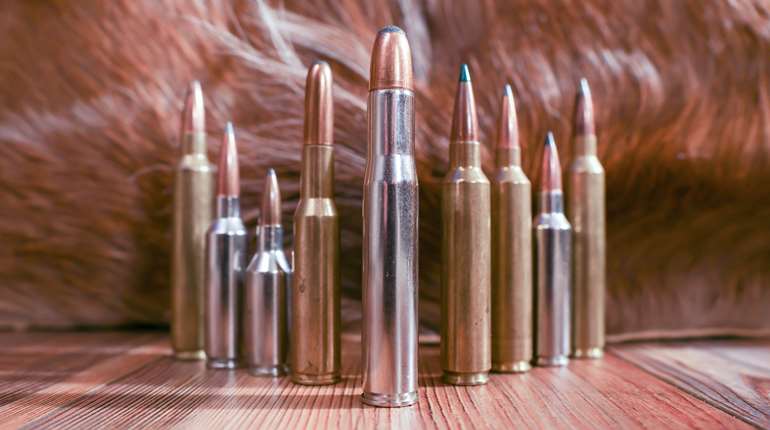
Winchester’s excellent Model 1895 rifle was a revolutionary design, in that unlike all its lever-action siblings to bear the Winchester name, it did not have a tubular magazine. Using a non-detachable box magazine, the rifle could be chambered for cartridges which used a spitzer bullet, without the danger of a possible magazine detonation, as is the case with a tubular magazine. While chambered for a number of classic blackpowder era cartridges, as well as seeing military service when chambered for the .30-40 Krag (a.k.a. .30 US Army), for the hunting community it was made famous in the hands of President Theodore Roosevelt.
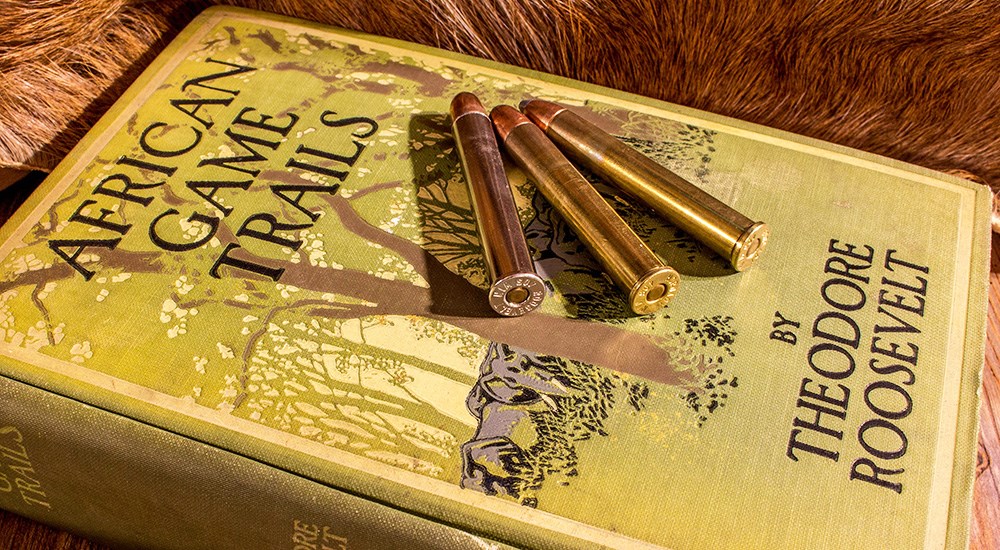
At the conclusion of his second term, Teddy and his son Kermit packed up a store of guns, ammunition, books and sundry, and headed off to East Africa for the safari that would give us African Game Trails; if you haven’t read that yet, I highly suggest you remedy that soon. Among his battery of rifles was an 1895 chambered in the relatively new .405 Winchester cartridge; Roosevelt referred to this combo as his “‘medicine gun’ for lions” and forever cemented the cartridge’s place in hunting history.
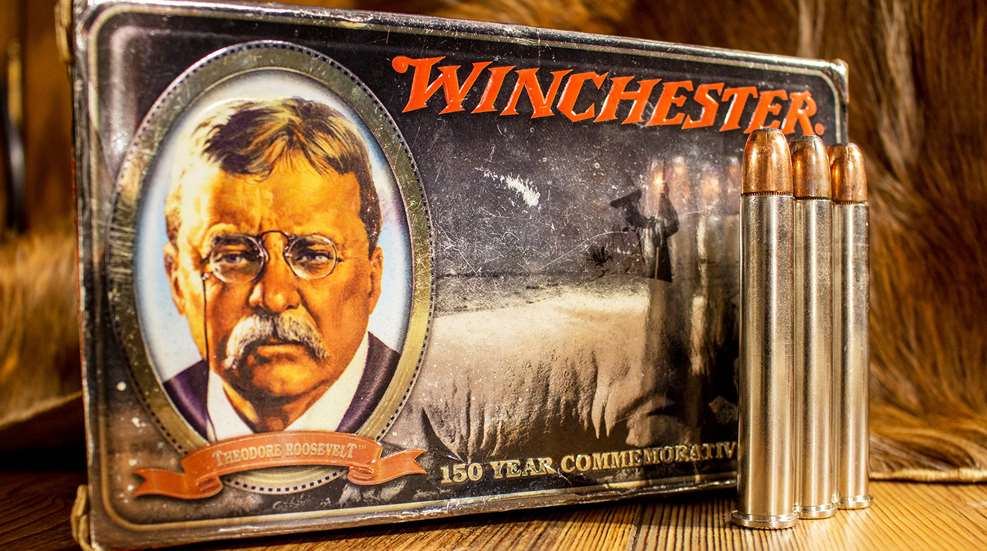
Released in 1904, the .405 Winchester is a straight-walled, tapered, rimmed case, using a 300-grain bullet of .411-inch-diameter at a muzzle velocity of 2200 fps. Generating just over 3,200 ft.-lbs. of muzzle energy, the .405 Winchester was—at the time of its release—the most powerful lever action cartridge available. The case length comes in at 2.583 inches, with a cartridge overall length of 3.175 inches. Barrels for the Model 1895 in .405 Winchester use a 1:14-inch twist rate. Both softpoint and solid (full metal jacket) bullets were loaded in factory ammunition, and remained in the Winchester catalog until 1955.
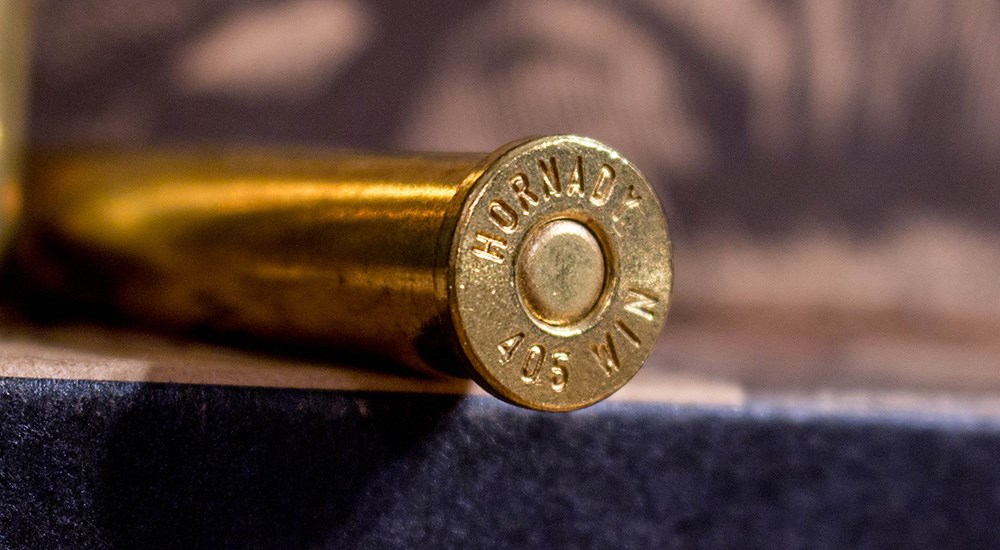
Now, a 300-grain bullet at 2200 fps isn’t exactly the recipe for hellacious recoil, but in the Model 1895 Winchester—John M. Browning’s last design for Winchester—it sure does ring your bell. I believe it is the geometry of the rear stock, specifically the drop of the comb and the surface area of the butt, which leads to the enhanced felt recoil. I haven’t shot that combo more than a few times, but I distinctly remember the sharp recoil of that rifle. And despite the fact that Theodore and Kermit Roosevelt used that cartridge for not only lions, but for rhinoceros and elephant, I personally feel that there are much better tools for those jobs, especially the latter two. Both rhino and elephant are notoriously thick-skinned, and a 300-grain bullet of .411-caliber isn’t the best choice for dangerous game animals, where penetration is paramount.
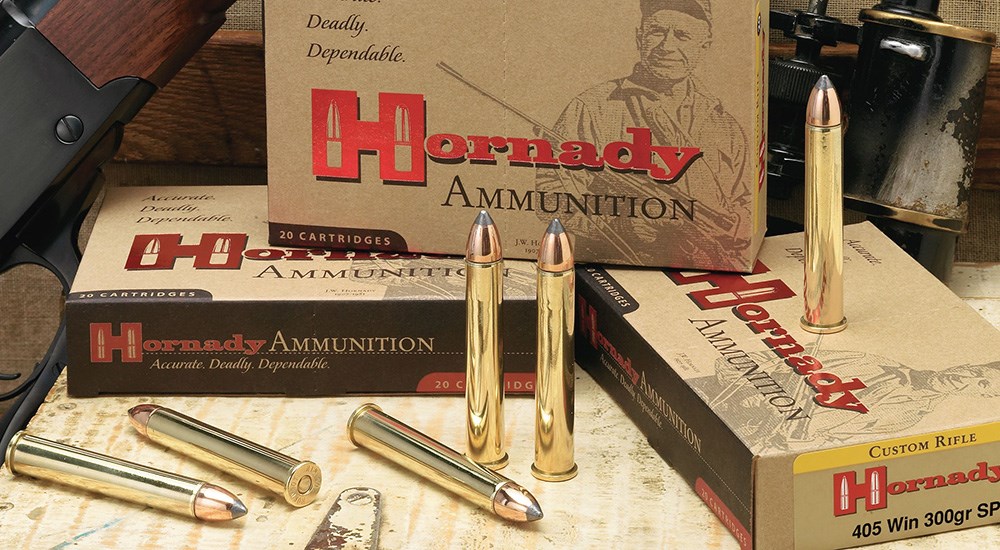
Generally speaking, projectiles with a sectional density (SD) value of .300 or better are considered best for delivering reliable penetration when it comes to those animals which can kill you as soon as not, as they have enough length to reach the vitals from nearly any angle. The .405 Winchester’s 300-grain bullet comes in with a SD value of .254, and even in a full-patch design, won’t penetrate as well as the .375 H&H Magnum with a 300-grain bullet, nor any of the 416s with a 400-grain bullet. When it comes to the African cats—surely the smaller, thin-skinned leopard, but even the large lion—this bullet should suffice if properly placed. The .405 Winchester would be enough gun for any of the antelope hunted in Africa, including the eland. Here in North America, it will handle just about any of our game species, including brown bear and bison, but again there might be better tools for those two species. It is perfect for black bear, will handle any wild hog that ever walked, and it well-suited for moose and elk at sane hunting ranges.
The year 2001 saw Winchester revive the Model 1895 in .405 Winchester, along with a 300-grain softpoint ammo, commemorating the centennial of Roosevelt’s first year of presidency. Hornady followed suit, loading their 300-grain InterLock bullet in the .405 Winchester, and it is this load that remains on the market, though in limited runs. And therein lies the rub with the .405 Winchester; finding ammunition is a real problem. Projectiles are still made by Barnes, Hornady and some of the boutique bullet makers like Hawk Bullets in New Jersey. Sparked by a large rifle primer, powders like IMR 4064 and IMR 3031, Hodgdon’s H322 and Varget, and Reloder 15 will all deliver good results, but sadly, unless you reload, keeping your 1895, Ruger No. 1 or any other rifle chambered to .405 Winchester consistently fed will be a problem.
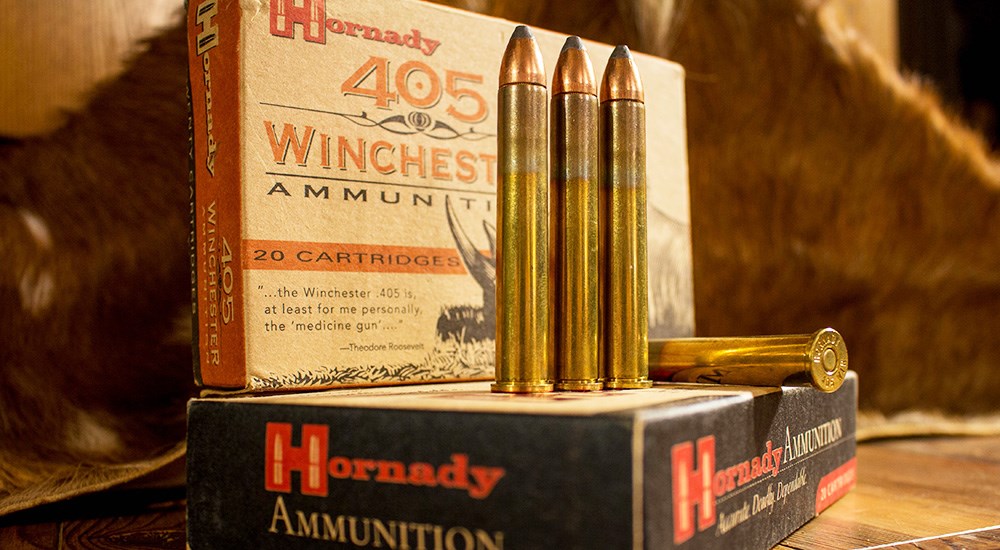
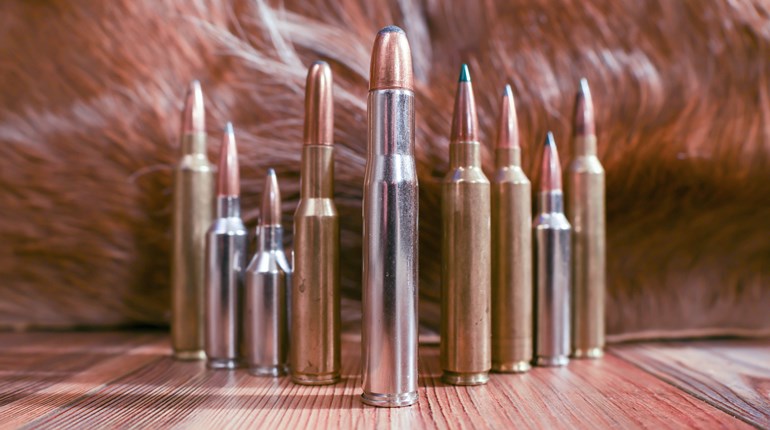
The Hornady load offers a spitzer bullet, and if you’re zeroed at 100 yards, that bullet will drop 8.3 inches at 200 yards, where it still retains over 1,700 ft.-lbs. of energy, making the cartridge one of the better choices among lever-action cartridges. The Roosevelt connection is probably the single factor keeping the .405 Winchester alive. The Model 1895 is still listed on the Winchester website, and Hornady still lists the .405 Winchester in their Custom ammo line; let’s hope that this grand old cartridge hangs on for a while longer, and continues to make great hunting memories. I’d like to extend a special ‘thank you’ to Marty Longbottom for the use of his excellent .405 Winchester ammo collection.
Looking for previous installments of our "Behind the Bullet" series? We've got you covered.
• .350 Remington Magnum
• 400 Legend
• .17 Winchester Super Magnum
• 350 Legend
• .303 British
• 26 Nosler
• 6mm Remington
• .270 Winchester Short Magnum
• 360 Buckhammer
• 30 Nosler
• 7-30 Waters
• .370 Sako Magnum
• .17 HMR
• 6.5 Weatherby RPM
• .327 Federal Magnum
• .450 Bushmaster
• 7mm PRC
• .275 Rigby
• .340 Weatherby Magnum
• .416 Ruger
• 27 Nosler
• .257 Roberts
• 7mm Weatherby Magnum
• .300 PRC
• .350 Rigby Magnum
• .450 Nitro Express
• .17 Hornet
• 7mm STW
• 6.8 Western
• .375 Ruger
• .223 Remington
• 6.5x55 Swedish
• .416 Remington Magnum
• .300 Winchester Short Magnum
• 28 Nosler
• 6.5 PRC
• .22 WMR
• .458 Winchester Magnum
• .22 Hornet
• .280 Ackley Improved
• .240 Weatherby Magnum
• .458 Lott
• .264 Winchester Magnum
• .348 Winchester
• 33 Nosler
• .260 Remington
• .30-30 Winchester
• .416 Rigby
• .358 Norma Magnum
• .22 LR
• 7mm-08 Remington
• 8mm Remington Magnum
• .338 Federal
• .224 Valkyrie
• .338-06 A-Square
• 9.3x62mm Mauser
• .257 Weatherby Magnum
• .45-70 Government
• .300 H&H Magnum
• .25-06 Remington
• .30-06 Springfield
• 6.5 Creedmoor
• .300 Remington Ultra Magnum
• 7mm Remington Magnum
• .470 Nitro Express
• .280 Remington
• .300 Winchester Magnum
• .270 Winchester
• .222 Remington
• .45 ACP
• .404 Jeffery
• .44 Remington Magnum
• .41 Remington Magnum
• .243 Winchester
• .338 Winchester Magnum
• .357 S&W Magnum
• 6.5-284 Norma
• 8x57 Mauser
• .38 Smith & Wesson Special
• 7x57mm Mauser
• 9mm Luger
• .35 Whelen
• .454 Casull
• .375 H&H Magnum
• .45 Colt
• .22-250 Remington
• 10mm Auto
• .308 Winchester