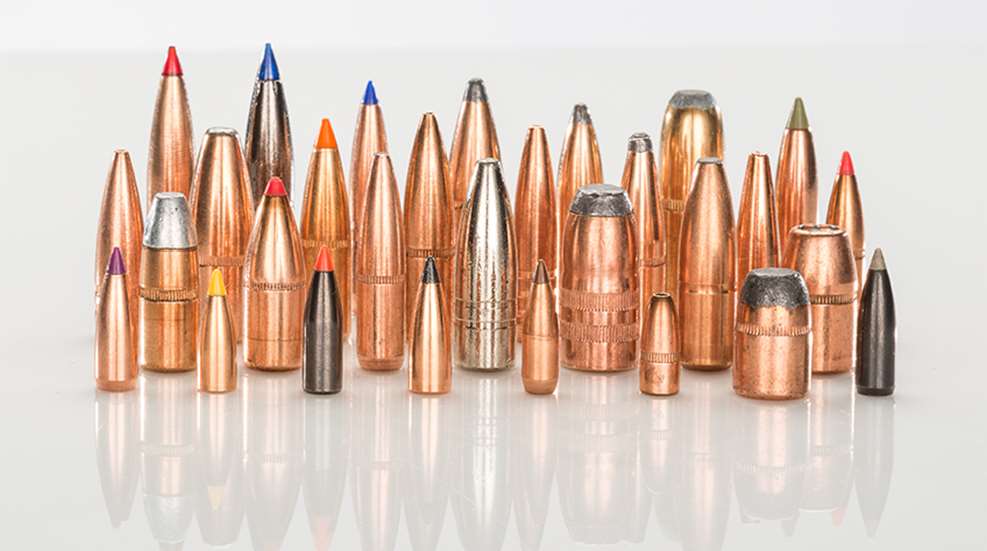
Ballistic coefficient (BC) is a numerical value indicating a bullet’s ability to slip through the atmosphere, or how its aerodynamic profile dictates downrange velocity and energy retention. Round-nose or short-for-caliber bullets are typically less streamlined and therefore have low BCs, while sharp-pointed, heavy-for-caliber bullets have high BCs. Yet a lot of confusion persists regarding BC, and how it affects bullet trajectory and wind drift. Following are five of the most common BC fallacies and the truths about each.
Myth 1: Bullet weight alone resists wind drift.
This is one I hear even from folks who should know better. Time in flight, not bullet weight, largely dictates wind drift. The less time a bullet spends en route to the target, the less wind push it’s subjected to. High-BC bullets that retain velocity efficiently arrive on target faster at longer ranges, equaling less wind drift, even if they’re lighter. Easy example: A 150-grain .308 Hornady InterLock with a BC of .338 (shot from a .308 Win.) drifts noticeably more than a 103-grain 6mm Hornady ELD-X with a BC of .512 (shot from a .243 Win.) when subjected to an identical 10 mph crosswind and 2700 fps muzzle velocities.
Myth 2: Light bullets always shoot flatter.
This is true to a point—say 250 yards for 40-grain .224 or 125-grain .308 bullets—but beyond that range heavier, more streamlined bullets retain more speed and thus shoot “flatter.” Flat trajectory, then, is range and BC dependent. A low-BC bullet might start its journey at a higher velocity, but act like a parachute, decelerating quickly.
Myth 3: High-BC bullets are inherently most accurate.
Flat-base, low-BC bullets are capable of exceptional accuracy, even one-hole groups. But only to a certain range, depending on the bullet. Higher BCs allow bullets to maintain velocity across greater distances. When a bullet slows below supersonic velocities (lower than about 1100 fps), accuracy deteriorates considerably. This occurs with low-BC bullets at much shorter ranges. High-BC bullets are more accurate, but only at longer ranges.
Myth 4: BC is a concrete value.
We tend to take manufacturers’ BC numbers as gospel, when in fact these numbers are averages taken across the overall effective range of cartridges commonly loaded with that bullet. BC changes with velocity, plus atmosphere-density elements like barometric pressure, temperature and humidity.
Myth 5: Larger bullets and cartridges are better for long-range shooting.
When many hunters contemplate long-range shooting they usually gravitate toward larger cartridges. For example, a hunter may choose a prairie-dog rifle in .220 Swift instead of .204 Ruger. However, a 40-grain .22-caliber bullet (BC .200) shot from a .220 Swift sheds velocity and energy faster than a similarly designed 40-grain .20-caliber bullet (BC .275) from a .204 Ruger, due entirely to BC. Bullet efficiency in flight, not size, is what dictates ballistic performance at long-range.