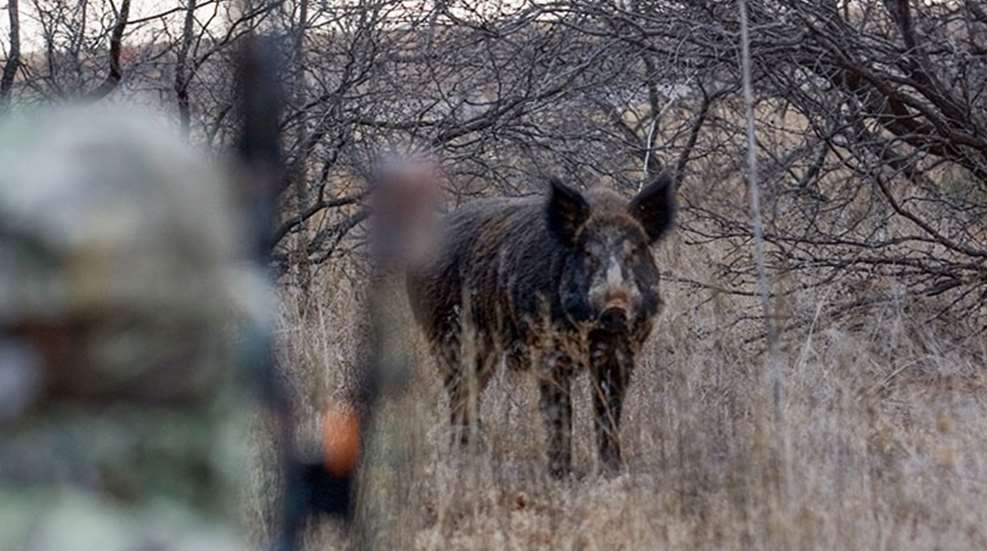
I often remind my Western buddies that Eastern bowhunters sit motionless in trees for hours on end not because they love acting like statues, but because it’s the most effective tactic in dense terrain. Still, that doesn’t mean most Easterners don’t love the idea of spot-and-stalk hunting.
What if I told you there’s a way to hunt from your stand effectively and also be successful stalking on the ground? I’m not talking about magic moccasins here, but rather simply having a willingness to take what the woods provide. If it provides wild hogs, then don’t just sit there—go after them! Oftentimes, you don’t even have to spot pigs first to stalk and arrow one. You only have to hear them.
Pigs in family groups make tremendous amounts of racket as they go about their daily lives. They constantly quarrel, squeal, oink and chatter. On a still day you can hear them at 100 yards or more. Hoofed animals, they are naturally loud walkers, and the noise they make while moving through leaves is exacerbated by their rooting. While their noses are second to none, they don’t see well. And when their heads are down rooting for food, the noise created by their feeding can help negate their otherwise keen ears.
If you hear pigs, make sure the wind is favorable to take an angle to them. Then lower your bow and climb down. If you have a good idea of where they are going—perhaps there’s a food plot or wallow nearby—consider looping ahead of the pigs (if the wind allows) to ambush them there.
If the pigs are feeding randomly, stalk in behind them, moving when most of their heads are down. Pigs rank somewhere between a monkey and a Labrador in smarts, so use natural cover and your best ninja impression to close the distance. But don’t be afraid to take chances while moving on them. Even if you’re unsuccessful, I guarantee you’ll have fun trying.
On the other hand, solitary old boars are some of the wariest animals in the woods. They feed only while constantly scanning for danger, and they don’t often rush out from cover. They are notoriously nocturnal, and if you spook them they’ll vanish for weeks if not forever. But their Achilles’ heel is their poor eyesight: If you get the wind right, you can stalk within bow range.
Killing a big boar with a bow by stalking is one of North America’s greatest hunting feats. Frankly, however, I prefer taking young, 30- to 100-pound females. They are better to eat, easier to drag out, and killing sows does more for population control than taking boars.
For the majority of pigs your whitetail archery tackle will do splendidly. Trouble is, you never know when you’ll run into a tank that can weigh 350 pounds. The hide on a big boar can be five times thicker than a whitetail’s, and I’ve dulled knives in seconds while skinning them. Therefore, if hogs are a possibility in your area, consider going with a slightly heavier arrow that has a front of center of about 15 percent to lend more penetration. If you’re currently shooting a 100-grain broadhead, a simple solution is to move up to a 125-grain head. Strongly consider tough, fixed-blade broadheads with chisel tips or monolithic construction, like those from Muzzy, G5, Thunderhead and Wasp.
A wild pig’s heart and lungs are positioned slightly forward in the chest compared to a whitetail, so its vitals are guarded by its shoulders and forelegs. While a broadside shot tight behind the shoulder is always fatal, a quartering-away angle lends a greater margin of error and is preferred. Avoid quartering-toward, neck and shoulder shots on boars due to the tough, armor-like tissue that surrounds their shoulders.
If you’re a deer hunter who occasionally gets bored on a stand, do your cold feet and dulled mind a favor and go after wild hogs if you sense them. Sure, there’s always the possibility you’ll bump that buck you’ve been hunting all year while stalking pigs, but hey, there’s no free lunch. But there are free hams. You just have to go get them.
Practice for Pork
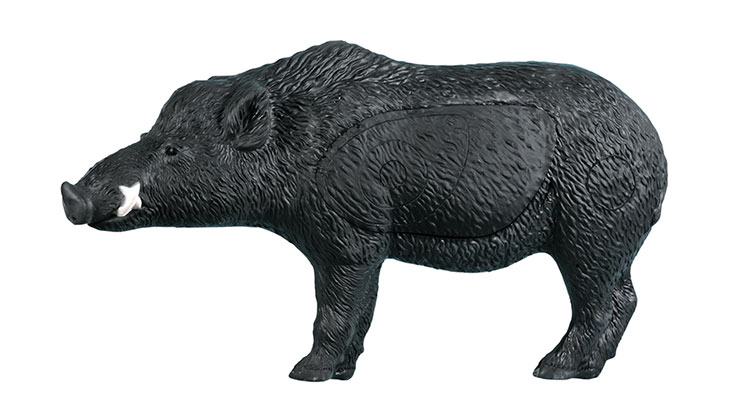
Not that shooting at deer ever gets old, but sometimes it’s fun—and beneficial—to focus on another quarry. That’s why I own the Razorback Boar 3-D target from Rinehart. Full-sized 3-D targets are beneficial because they help archers to visualize proper shot placement from any angle. Quite simply, they promote more realistic practice. Subtle scoring rings force archers to “pick a spot” but can be used for evaluation afterward. I believe this doppelganger’s startling appearance may even help condition hunters to avoid freaking out on a real boar at the moment of truth. Like all Rinehart targets, the Razorback is made from self-healing foam that can be shot with broadheads or field points. The vital zone is replaceable. At the very least, it’ll add a porky new dimension to your backyard range. MSRP: $399; rinehart3d.com.