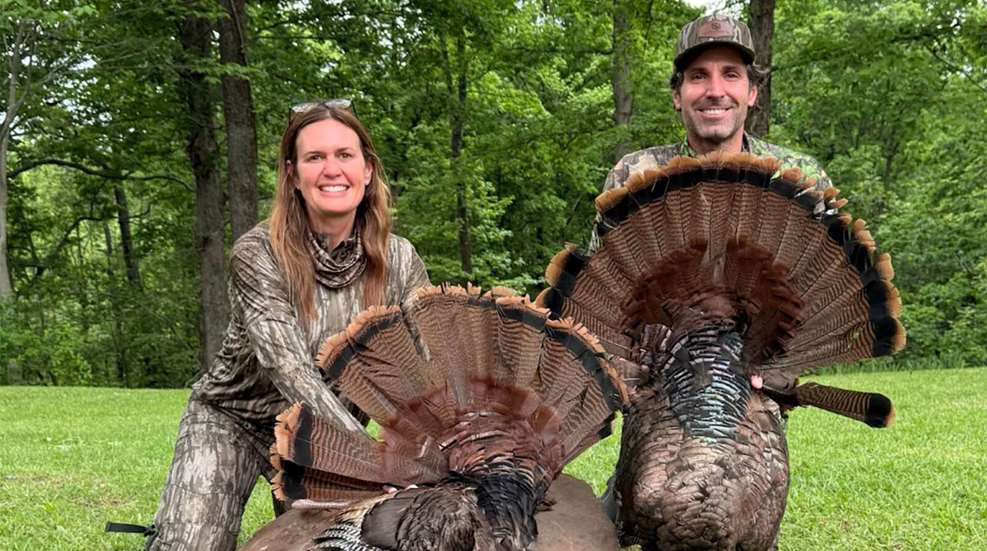
Arkansas turkey hunters checked 13,591 turkeys during this year’s season, which ended May 10. It was the highest spring turkey harvest since 2006.
“Arkansas had a good amount of mature gobblers on the ground this year, thanks to conservative seasons during the last few years promoting high gobbler carryover,” said Allison Fowler, assistant chief of wildlife management for the Arkansas Game and Fish Commission. “This was complemented by good weather two years ago that enabled the birds to take advantage of improved habitat in many pockets across the state. We also saw a change in our season structure this year that offered split opening weekends, and we’re analyzing those results to see if it played a large role in the harvest.”
The state’s all-time record turkey harvest was in 2003, when hunters checked 19,947 birds. This year’s harvest isn’t too far off that mark when a few differences in season structure are considered.
In 2003, hunters shot 4,610 jake turkeys, nearly a quarter of the harvest was made up of the young birds. Only 15,225 mature gobblers were taken that spring.
“We established the ‘No Jakes Rule’ in 2011,” Fowler said. “Since then, only youth hunters can legally harvest an immature gobbler, and they may only take one per season.”
Despite that ability, most youth hunters most still opt for a mature bird. This year’s harvest of just over 300 jakes is proof.
“We had a good amount of mature birds out there gobbling, and the youths have the first shot at the birds, so we saw less than three percent of the harvest made up of jakes this year. That hopefully translates to decent numbers of adult gobblers available for hunters next year.”
The remaining 112 turkeys counted in the 2003 harvest were bearded hens, which were also legal to harvest at that time. That opportunity was eliminated in 2021 to maximize reproductive success.
“Hunters really self-regulate themselves when it comes to hens, so the hen harvest never was very high, but the elimination of the bearded hen harvest reinforces the idea for hunters that their decisions in the woods matter to the population,” Fowler said. “2003 also had an earlier and longer season. Hunters had 37 days to take a bird in most of the state in 2003. This year, Zones 1 and 2 were open for 21 days each, while our more restrictive zones were only open for nine days. The previous liberal structure was not favorable when poor weather during the nesting and hatching time period saw decreased reproduction success.”
The state suspended fall seasons in 2009 due to declining bird numbers. Again, this year there is no fall turkey season in Arkansas.