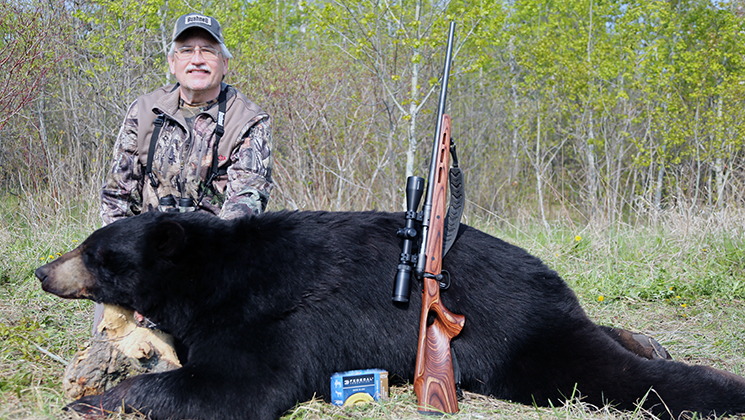
It’s happened to many a black bear hunter, especially those hunting over bait. That black, furry mass of bear comes ambling in, your heart races, and the bear proceeds to tear into his or her meal. You pull the trigger or launch your arrow. Bear down! But once you get to your kill, that huge, burly blackie—the next entry in the Boone & Crockett record book, you were sure—is actually about the size of a large German shepherd. What gives?
“I’ve seen far too many hunters tell me they shot a monster, only to recover a yearling bear,” says Anthony Stone of Mt. Peyton Outfitters, near Bishop, Newfoundland.
Beyond simple hunter excitement, Stone adds, the fact is that black bears are among the hardest animals to judge for size, especially for the newbie hunter. So I asked Stone and another veteran bear guide what their advice to clients is, especially when hunting over bait in the spring.
Here’s a sample of what they came back with.
Pay Attention to Your Surroundings
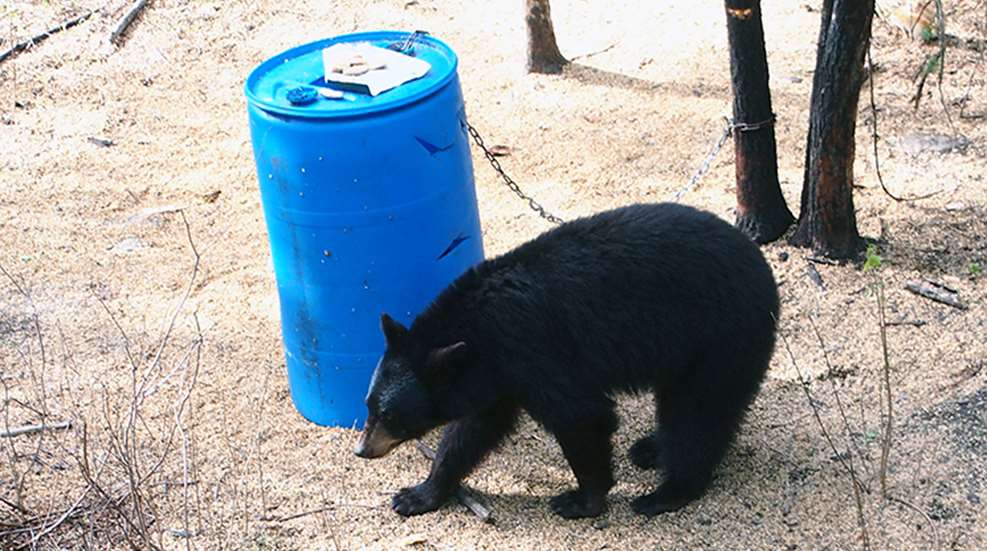
Many guides use 45-gallon blue plastic or poly barrels to hold bait, and Stone and others usually tell hunters that if the bear comes up to the last line, near the top of the barrel when the bear is on all fours, he’s a potential shooter. And if the bear's back goes beyond the barrel, it's a shooter, for sure.
Big Belly, Big Bear
That said, even a three-year-old black bear can have a lot of growing—and filling out—to do. So if you want to make sure you bag a mature, adult bear, take a good look at the bear’s belly, says Wally Mack, co-owner of W&L Guide Services. Watch the ears, too. “We always tell our hunters, see if the belly is close to the ground,” says Mack. “And if he seems to waddle in? That’s a sign of a good-sized, older bear. If his ears look small and too far apart on the head? That’s a bear with some age, too. You got yourself a good one!”
Mack knows big bears. He guides mostly in far Northern Alberta where a trophy-sized black bear starts at about seven-feet in length. “And we get several eight-footers every year, too!”
Have a Cheat Sheet
“I place different color ribbons on the trees around the bait site at different heights,” says Stone, “so that when a bear walks in and his back is up to any particular ribbon I know then if I have a shooter or not. Obviously, a two-foot marker-height bear is not a shooter. But I will have three-, four- and even five-foot markers.”
Stone says a bear with a back at the three-foot ribbon is what he considers a “decent” bear to harvest, right around five feet in length and, for a sow 150 to 200 pounds, a male at the 200 to 250 pound mark.
But if you want a hefty black bear? Wait for one that touches or betters the four-foot ribbon, says Stone.
“A sow at the four-foot ribbon will go about 5½- to 6-feet in length, and weigh up to 300 pounds,” says Stone. “A boar can be up to seven feet long, and up to 350 pounds. That’s a heck of a bear, and our clients bag a decent number of these every spring and fall.”
A bear at the five foot ribbon? He’s rare, says Stone, but it does happen and he’s a toad. Don't hesitate to knock a bear that size down.
Understand Behavior
And what if you have a couple of smallish bears hanging around at your bait site, eating and playing—and all of a sudden they high-tail it out?
“You won’t necessarily see him right away, but something a lot bigger’s on the way in, and the little guys got the message,” says Mack. “So you better get ready!”