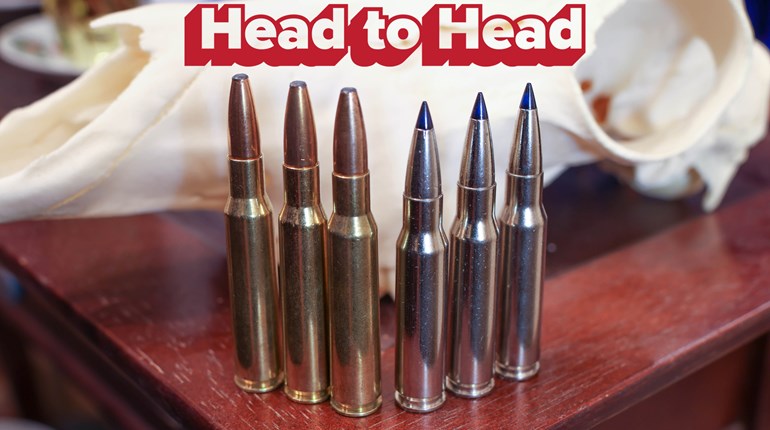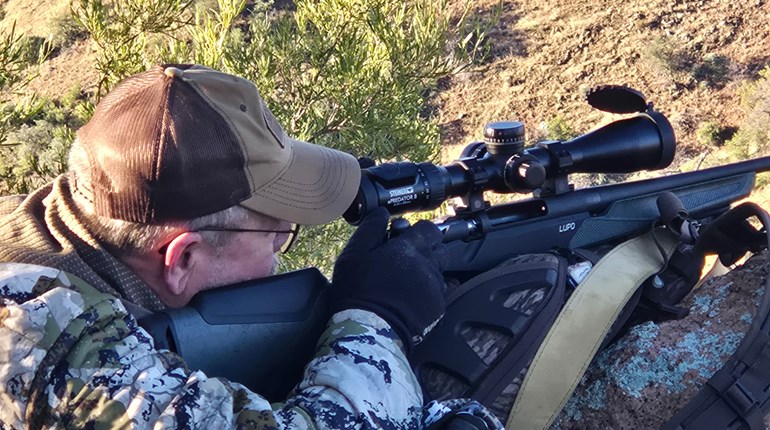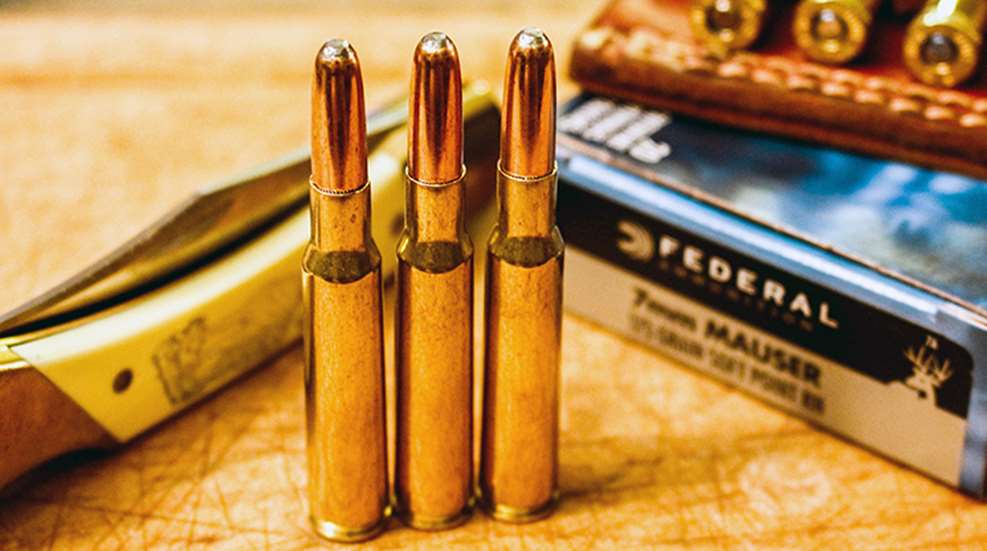
Few cartridges, in the history of modern firearms, have influenced our shooting world as much as the 7x57mm Mauser. Designed by Peter Paul Mauser in 1892 to serve in the military, the 7x57 Mauser showed the American soldiers what a cartridge should be on the slopes of Cuba’s San Juan Hill, and inspired the development of our own revered .30-’06 Springfield. In the hunting world, it made an immediate transition—as so many military cartridges have—and to this day remains a favorite among the African hunters. In its British guise the 7x57mm Mauser was known as the .275 Rigby, and in the hands of some talented hunters like W.D.M. Bell and Col. Jim Corbett, the cartridge would go on to inspire the world in the classic hunting tales like “Wanderings of an Elephant Hunter” and “The Man-Eaters of Kumaon.” Driving a 173 or 175-grain bullet at a muzzle velocity of 2,300 fps, it had enough Sectional Density for the early copper-jacketed soft points to behave properly, and enough velocity to drive the full-patch ‘solids’ through an elephant’s skull. With the lighter bullets, it made a flat-shooting rifle, perfect for longer shots at antelope on the plains of Kenya, or for the mountains of India. It accounted for many of Bell’s 1,011 bull elephants, as well ending the careers of dozens of man-eating lions, leopards and tigers throughout Africa and India.
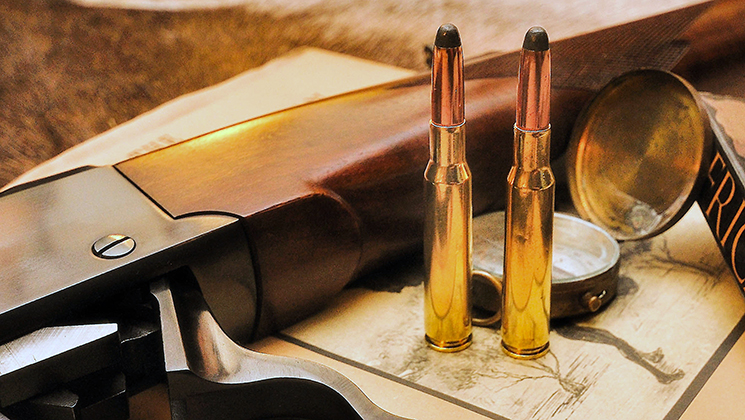
 Here in the States, it never really had the following that it did across the British Empire, though there have been some loyal fans. Renowned gun writer John Wooters praised it as one of his favorite deer cartridges, and Finn Aagaard brought one with him from Kenya to Texas; he felt he could take any animal in North America with it. Even Jack O’Connor—the huge champion of the .270 Winchester—recognized the merits of the 7x57, outfitting his wife with a rifle so chambered for their safaris across Africa.
At any rate, the 7x57 Mauser makes a good all-around choice for just about any hunting, shy of the great bears of Alaska and western Canada, or the African heavyweights. With a good 160- or 175-grain bullet, elk, moose, lesser bears and even the bigger antelope of the Dark Continent can easily be handled, at a much lesser recoil level that the 7mm magnums. Load a good 120- or 140-grain spitzer boat tail, and you’ve got a great combination for lighter big game, like deer or pronghorn. There are good factory loads, like the Hornady Superformance load, using the monometal 139-grain GMX at a muzzle velocity of 2,740 fps, as well as the Norma 156-grain Oryx bullet—a semi-spitzer with the rear portion of the jacket bonded to the core—at 2,608 fps. Loads like these take the 7x57 to a new level, provided you’ve got a rifle that will handle those pressures; many of the older vintage rifles aren’t as strong as those constructed of modern steel.
The 7x57 uses a 20˚-45’ shoulder, so it will give good headspacing off the shoulder; and it shares the same rim diameter as the .30-’06, .308 Win. and their descendents. I’ve found that a well-tuned 7x57 can be as accurate as you'd want any hunting rifle to be, and many of them have showed the ability to give good accuracy with a variety of different bullet weights. However, it does suffer from a lack of choices for factory ammo, with most manufacturers offering just one or two loads. That said, being 7mm is a good thing, and there are all sorts of component bullets that can make this venerable case shine, like the 175-grain North Fork, 160-grain Woodleigh, or the 150-grain Swift Scirocco II.
The 7x57 Mauser is the parent of some rather successful children, including the .257 Roberts and the 6mm Remington—two wonderful cartridges that seem to have done their best to outshine dear old Dad. In addition, it shares a lineage with the older 8x57mm Mauser; and if you think about everything this family has done, I think you’ll have to admit that there are some impressive genetics here. If you think about it, the 7x57, and the multitude of projectiles produced for it, has influenced many of our favorite American cartridges as well. We probably owe the existence of the .280 Rem., 7mm Rem. Mag., and 7mm-08 Rem. to the success of those 7mm bullets in the 7x57 Mauser.
My pal Marty Groppi has a Winchester Model 70 Featherweight in 7x57, which will put three Federal 175-grain softpoints into ½ MOA at the 200-yard mark, at a muzzle velocity of 2,325 fps, and this is his go-to bear load for the Catskills and Adirondacks. That same rifle will drive the 140’s and 150-grain bullets into sub-MOA groups, depending on the type of bullet. In the nice, compact bolt-gun, the whole package is both a pleasure to carry and equally pleasant to shoot. That’s one of the beauties of the Seven Mauser: it’s a lot of performance in a little package. While it requires a longer action than that of its modern counterpart—the 7mm-08 Rem.—the Mauser case can make better use of the long 173 and 175-grain bullets that have earned their way in the hunting world for well over 120 years. If you’re in the market for a sweet shooting, yet highly effective and flexible cartridge, don’t pass over the 7x57; you just might make a friend for life.
Looking for previous installments of Behind the Bullet? We've got you covered.
• 9 mm Luger
• .35 Whelen
• .454 Casull
• .375 H&H Magnum
• .45 Colt
• .22-250 Remington
• 10mm Auto
• .308 Winchester