By Mark Todd, Salem, Va.
I took my first spring gobbler in 1989 and have been hooked ever since. So it was natural that I would get my son, Jackson, interested at an early age. I took him on his first hunt on our family’s farmland in southwestern Virginia when he was 11, with Jack carrying a borrowed single-shot 20-gauge with a cut-down stock. We heard a gobbler over a ridge and hustled to get closer to the bird. The next time we heard him, he was only 50 yards away over a small knoll.
We set up quickly and didn’t have time to get our decoy out. Jack had his shotgun pointed at 12 o’clock toward the knoll. I had preached to him that he would have to be totally still when we had a turkey coming in on us. So when two gobblers came around some bushes at 10 a.m. and only 20 clear yards away, Jack stayed stone-still while the birds looked and gobbled for the hen they had heard. But they quickly got antsy, moved back on their trail and then were gone. I yelped softly and they answered, coming around to our right. But they never came in for another shot.
I told Jack later that I was very proud of him. He had stayed so still that he had given us a second chance to call them in for a good shot. It didn’t work out, but it still was a great hunt and apparently made an impression on him.
Between his school and my work schedule, we only made it out a couple of times over the next two years and couldn’t get any gobblers to close the distance. We were excited when good weather was forecast for Virginia’s 2012 “Youth Day” hunt. Jack was now 13 years old, carrying a 20-gauge Remington 870 with an extra-full turkey choke, loaded with 3-inch magnum No. 6 shells. We struck out trying to roost a bird the evening before, so at daylight we listened from the same ridge the gobblers had come over two years prior. We were disappointed when we didn’t hear anything, and I was concerned that it might be too early in the season for the birds to be gobbling. But it was the Youth Day hunt, so we were going to give it a chance.
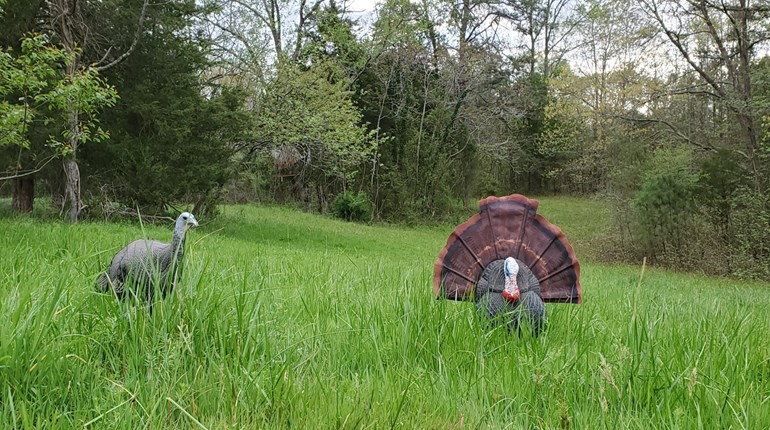
We moved to another area where I had experienced good luck over the years. I yelped with my diaphragm, and a bird bellowed 250 yards away. We set up at the edge of a large field, against a big hardwood. This time I set out a feeding-hen decoy about 5 yards behind us in the field.
The bird was about 100 yards away in a tree line when he saw the decoy. He gobbled and strutted for about 15 minutes, but when the “hen” didn’t respond to his love talk, he slowly moved into the field toward us. He came to about 90 yards, then strutted and gobbled for another 10 minutes. At 80 yards he did his dance once again. Jack’s arms had tired from holding his shotgun at the bird all this time, so when the tom turned away from us, Jack let the gun down a bit. The gobbler hit 70 yards and continued without stopping.
There was open field between us and the bird, so Jack couldn’t move, his tired arms leaving his shotgun out of position once more. I thought Jack would hyperventilate and give us away as the bird came very slowly to within 5 yards and started strutting again. Then the tom did something I had never seen before: Twice he came halfway out of strut and started stomping his feet. It seemed he was saying to the decoy, “Come on, here I am! Stop feeding and get down!” But she continued to give him the cold, plastic shoulder.
The gobbler kept moving farther down the field showing off his stuff. Jack was on my left, the bird on my right. When he was turned away in strut, I quietly grabbed Jack’s gun and laid it over my lap toward the bird. Jack understood and slowly moved into the prone position, using my legs as his shooting bench. He had to freeze when the bird turned back around, but he finally made it into position.
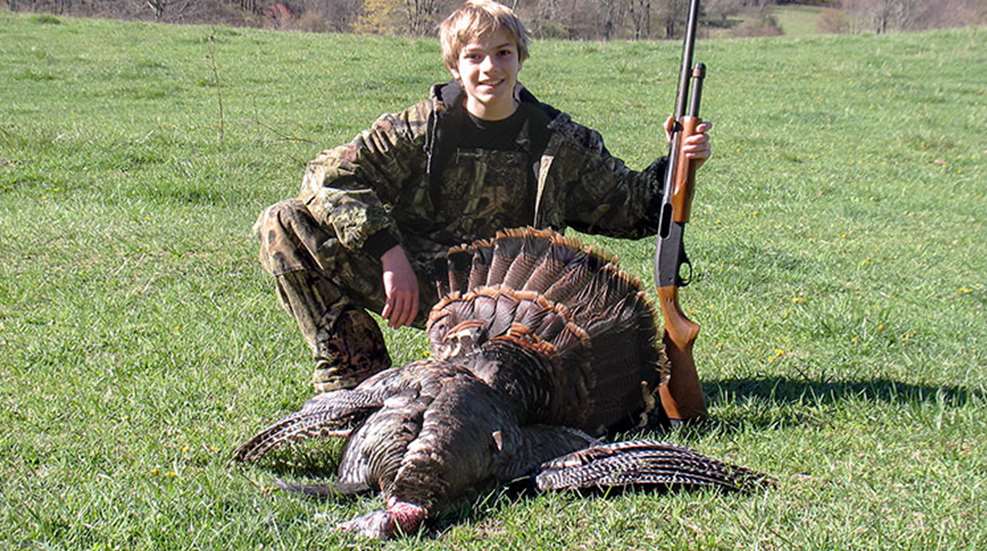
I waited, willing Jack to calmly put the bead halfway down the bird’s neck and press the trigger. Finally the Remington roared, and we both jumped up to find the 19½-pound gobbler with a 9-inch beard down at 25 yards. We high-fived and went back to our cabin to take pictures of the prize from my best hunt ever. And I didn’t even pull the trigger.
Do you have an exciting, unusual or humorous hunting experience to share?
Send your story (800 words or less) to [email protected] or to American Hunter, Dept. MH, 11250 Waples Mill Road, Fairfax, VA. 22030-9400. Please include your NRA ID number. Good quality photos are welcome. Make sure you have permission to use the material. Authors will not be paid, and manuscripts and photos will not be returned. All material becomes the property of NRA.