By Peyton Spencer, Bradenton, Fla.
In May 2015, thanks to a high-school graduation gift from my parents, I had the opportunity to travel to Alberta, Canada for a black bear hunt. I live in central Florida, so my hunting experience up to that point had been limited to pursuing hogs, deer and turkeys, making this hunt particularly exciting for me. My dad also accompanied me on this dream hunting trip.
We were hunting in the Swan Hills region, guided by Al Schulz of Excell Outfitters of Alberta, where the temperature in May rises enough to allow clover and other grasses to sprout alongside the roads. The area we were hunting—a heavily forested, hilly region with an average altitude of 3,800 feet—provided entry into the forests via dirt or gravel roads that had been built to allow access to the oil wells that dot the landscape. The roads are also used in some of the clear-cutting forestry operations. By this time of year, bears have begun to stir from their winter hibernations and are looking for grass to eat to cleanse their digestive systems. As a result, the bears venture from the safety of the thick forests into the clearings surrounding oil wells and the sides of roadways to eat the grasses and clover. So, naturally, after flying into Edmonton and arriving to the Swan Hills area around 9 p.m., we immediately drove into the forests to look for bear.
After about 20 minutes, we spotted a beautiful blonde bear weighing what we estimated to be around 500 pounds. Because it was a sow accompanied by two cubs, we passed on that bear. The sighting did, however, start the adrenaline flow that would keep us in high hopes over the next four days.
The next morning, after a hearty breakfast in town, we climbed into the pickup truck and began riding the roads once more. This consisted of driving down the dirt road at approximately 30 mph and glassing for a bear on either side of the road or in some of the areas where the trees had been clear-cut. Checking the clearings was particularly difficult because a stump could easily be mistaken for a black bear from a distance. That day, we saw several bears that were too small to shoot. Our guide, reminded us that you never could tell when you would see a bear, so you had to put in the miles in order to give yourself the best chance. Using this method, we logged an average of about 240 miles a day searching for black bears.
The following day, we began riding the roads once again, and in the afternoon my dad spotted and shot a black bear that weighed about 350 pounds. After several hours of skinning the bear, we were exhausted but pressed on in our search for my own bear.
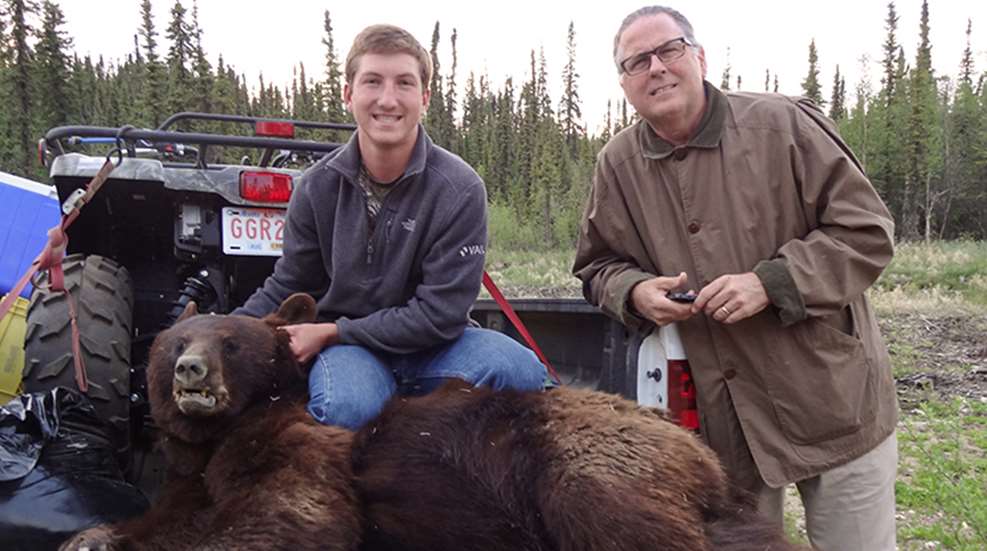
After another half-hour, I spotted a chocolate-colored bear near a bend in the road. The bear had a beautiful two-toned brown coat. I quietly exited the truck and used a simple homemade tripod of tree limbs to stabilize my Ruger 7mm rifle. I calmed my breathing for 30 seconds to control the adrenaline rush I was currently experiencing. The bear was approximately 150 yards away, munching on grass. I was waiting for a broadside shot so I could hit the bear right behind his shoulder. Neck shots may be more lethal, but they also raise the risk of a miss and the bear bolting into the thick woods.
It seemed like an eternity before the bear finally turned to give me the shot I wanted, but when he did, I immediately squeezed the trigger and fired the gun. The shot knocked the bear down, but it was not fatal. He rose to his feet and began to run toward the woods. I took quick aim and fired again, this shot dropping the bear instantly to the ground. I could hardly contain my nerves as we approached the bear and realized how large it was. He had a beautiful coat and measured 6 feet 11 inches, and was estimated to weigh between 480 and 500 pounds.
As I calmed down, I realized that we had a lot of work ahead of us in skinning the bear. The air had turned cold, but it could not wipe the smile from my face as we began the two-hour process of cleaning the bear.
Finally, we finished our job, climbed back into the truck and headed to the motel. As we approached the main highway, I was able to watch the sun drop over the western ridge and realize what a special day we had experienced.
Do you have an exciting, unusual or humorous hunting experience to share?
Send your story (800 words or less) to [email protected] or to American Hunter, Dept. MH, 11250 Waples Mill Road, Fairfax, VA. 22030-9400. Please include your NRA ID number. Good quality photos are welcome. Make sure you have permission to use the material. Authors will not be paid, and manuscripts and photos will not be returned. All material becomes the property of NRA.