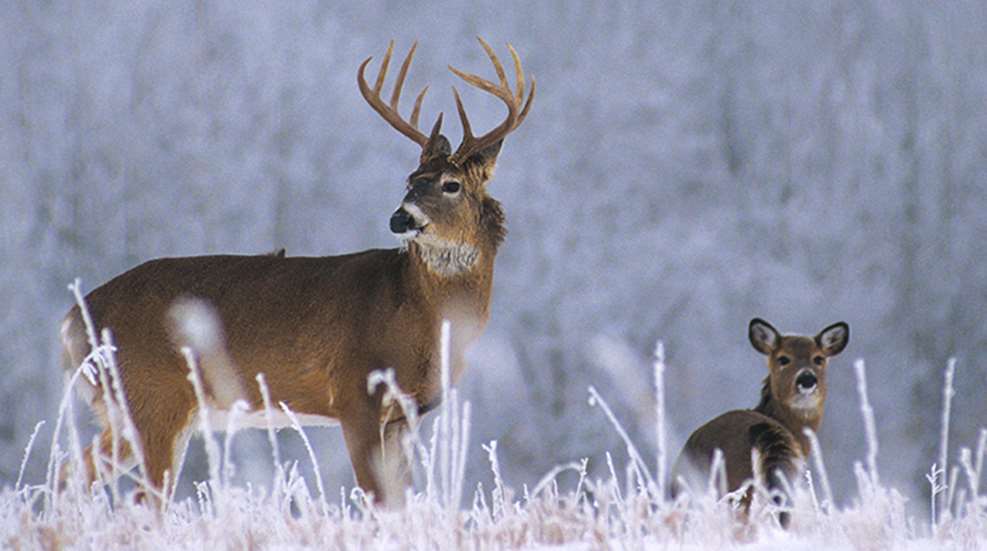
The big hoof prints were half-buried in still softly falling snow. The track left an overgrown orchard and meandered into a cutover thick with briars and saplings all white with powdery snow. A machete would have helped fight my way into the 3-acre thicket. The buck’s bed, just vacated, was there. I followed his track out. He crossed a logging road into another thicket by a beaver pond and then circled back to where I’d bumped him out of his bed. I backed off. The season was over. I just wanted to see where the elusive buck slept. Another season was gone and he’d won. But in the leafless winter forest I could see an opportunity, a spot where I could use the beaver pond to slip in low-impact to hunt his bed-to-feed routine before or after the rut. Such things warm you with hope for next season.
These are the insights post-season tracking gives us. The renowned deer biologist Dr. Grant Woods recently told me: “The older I get the more I come to the conclusion that what drives older bucks more than anything is fear.” I agree. We all know mature whitetail bucks can be elusive, even nocturnal, but when you track them just after the season you find how simply neurotic they can be.
Then you realize you have to rethink your stand locations. At least that’s what happens to me after each season—especially in the first few years of hunting a new place. Tracking deer now is so useful I think you should scout now even if your region doesn’t give you snow to track with, as what really happened during last season’s rut will never be clearer than right now. When you do, here are four things to look for.
1. Safe Zones
If a big buck’s tracks don’t lead to his bed on your hunting property you have a problem. You can get by without safe bedding cover on your property if the deer have safe zones nearby and are comfortable traveling on your land during daylight, especially if you have a pinch-point between such places. If the deer don’t have safe zones on your land, you either need to get access to those other properties—and then scout and hunt them smartly—or you need to make yours more favorable to deer during daylight hours.
To do this you need to give them security cover. Food and water are important, but deer can get them at night. During daylight they need to feel safe from the likes of you. If you have a 100-acre property at least 20-30 acres of it should be off limits to people year round. You might hang a stand in there and hunt it one or two days a year when the rut and wind are perfect, but that is the only time you should ever go in there. These off-limits areas should be thick and overgrown. If you don’t have such a place on your property you should, if possible, use a chainsaw or other means to make such a place.
2. Big-Woods Escapes
A big, solitary deer track took me from the edge of a farm up onto public land in New York’s Catskill Mountains. I thought I knew where it would go. It had taken me a few seasons in those big woods to learn that if you’re not hunting up near the mountain laurel then you’re not going to see a mature deer in daylight. But the track took me through one mountain laurel-covered bench up to another. It wound under bur oaks and climbed through rock outcroppings until it finally stopped in a bed on the southeast side of the mountain so high up it took me more than two hours to climb to it. There were big rubs on cedars above it. There was deep, soft moss under the snow. There was a view of hardwood mountains descending like steps white with snow. There was a feeling of cold impossibility. How could I kill a buck up so high in such a tight spot? After following his fresh and days-old tracks the answer was there. Three hundred yards below is a bench between laurel thickets that’s covered with tracks and rubs.
This buck sought out the same thing suburban mature bucks do: security cover. He just found it on top of a mountain. The tracks told me I was hunting too low.
3. Other Hunter Sign
As you track, the leafless woods will reveal last season’s rubs and other deer sign. A binocular and sharp eye will also expose deer stands on neighboring properties and public lands. These other hunters might kill the bucks you’re after, but more likely they’ll pressure them into shifting their patterns. If you don’t know where this pressure is pushing them, you risk your stand site being cut off by another hunter on another stand. The deer tracks will also show how the bucks that survived avoided those other hunters.
4. Travel, Escape Routes
On places with even moderate hunting pressure, mature bucks won’t brazenly march through open woodlots to fields or other feeding areas. To ambush them you need to find what many call “secondary” routes and places where a buck might “stage” as it waits for darkness before entering a feeding area or trolling for does. Nothing shows this like tracking just after the season ends. Later in the winter deep snow might force deer farther down mountainsides or, in the northern woods, even to yard up. Also, months of no hunting pressure might make them relax and bed closer to food sources in the places they never would have during the season. This is why the best time to scout is in the weeks just after the season.
As you do, don’t be afraid to bump deer. Now is the time to learn and you can’t do that if you’re afraid to spook deer off your property. But only track deer and scout post-season enough to learn how to better hunt your property. Mark your stand sites and back off to make them feel secure—until you slip in next season with last season’s tracks leading you to the season of your dreams.