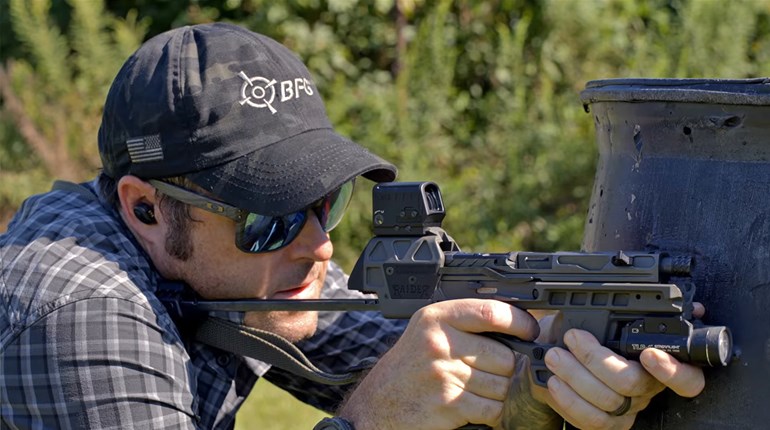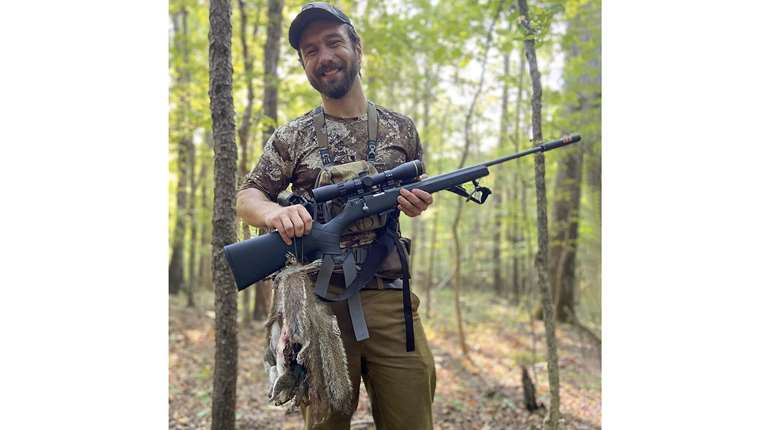
It wasn’t until the last 15 years or so that shotguns with drilled and tapped receivers became common, and hunters started putting red-dot optics on them to hit more turkeys, coyotes and other game at which a scattergun is precisely aimed and not hastily pointed. From the standpoint of a turkey hunter, I consider it the best thing to happen to shotguns since the extra-full choke tube.
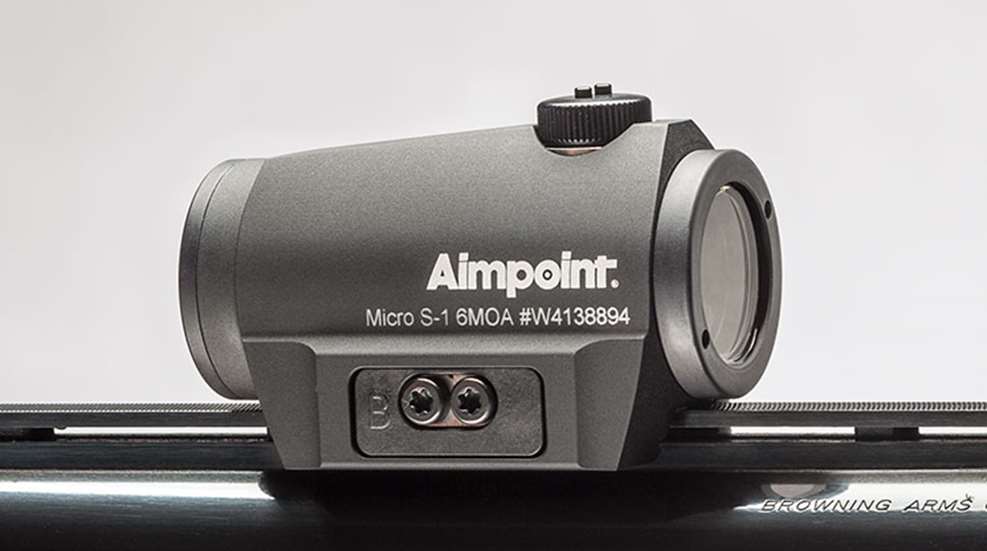
Thing is, there were a lot of good shotguns made before then. Attaching a red-dot sight to these can range from mildly frustrating in the case of a pinned “saddle” mount to all but impossible if your go-to shotgun happens to be an over/under. But now Aimpoint is spreading great joy among those who wish to aim their undrilled, untapped shotguns like rifles. It comes in the form of the Micro S-1, a red-dot reflex sight not much larger than a shotshell that mounts to the barrel’s ventilated rib. No drilling, tapping or disassembling required.
Aimpoint equips the Micro S-1 with an interchangeable mounting system that fits most vent ribs 6-12mm wide and 1.3-3.6mm thick. It consists of a pair of base plates that form a clamp around the rib. You’ll need to carefully measure the rib with a caliper, have a gunsmith or machinist do it or track down these specs from the shotgun’s manufacturer (good luck with that for older guns). Once you have the measurements, consult a chart provided with the S-1 that specifies which plate combination fits the rib. One of six configurations will fit most shotguns, and mounting the sight consists of tightening four screws, so it’s not that complicated. Ten minutes of work should do the job.
At first I doubted the sturdiness of the mounting system, but after trying the Micro S-1 on five shotguns and firing 20-some magnum turkey loads with it aboard, I came to trust it. Aimpoint optics and mounts have a reputation for being tough and reliable; military and law-enforcement contracts bear this out. Part of the mount is the sight housing itself, anodized aluminum, while other components are polymer reinforced with carbon fiber. I didn’t notice undue wear on either of the materials during testing; the polymer seemed just as rigid as the aluminum. Follow the measuring instructions, select the correct size mounting plates, tighten them to the sight and then to the shotgun rib with the tool provided by Aimpoint, and the sight shouldn’t move.
While the mounting system is new, other features of the Micro S-1 are similar to the company’s field-proven Micro H-1 sight. (I’ve hunted with an H-1 for six years in sun, rain and snow. It’s never failed to present a highly visible dot, and it’s never lost its original zero.) Foremost on most hunters’ minds, battery life of the S-1 is 50,000 hours or about five years of continuous use. I have no idea how many hunting seasons this equates to—depends on how often you make it out—but one battery could very well last you the rest of your lifetime.
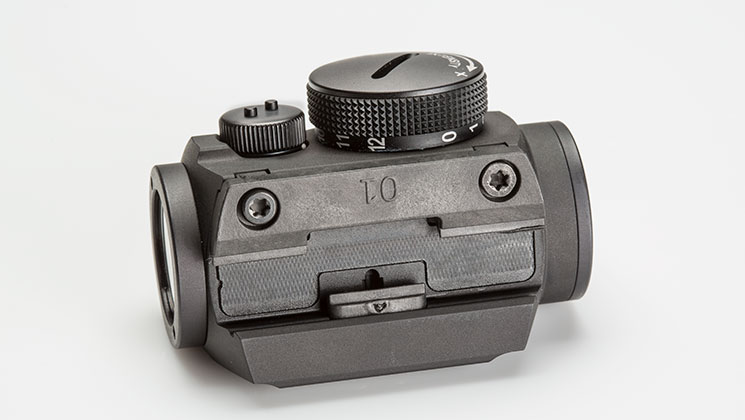
The intensity of the LED-produced red dot is controlled by an easy-to-turn dial located on the right side of the sight housing. Although Aimpoint shows the S-1 mounted mid-barrel in much of its photography, I prefer to mount it closer to the receiver so I can reach the dial while seated with the shotgun shouldered. If there’s a big swing in lighting conditions (or I forget to turn on the sight), I can quickly make adjustments without a lot of movement.
A 6-MOA dot may seem large, but think about the S-1’s primary use. Even with the heaviest load squeezed through the tightest choke, most turkey and predator hunters aren’t willing to shoot past 50 yards. At that range, the dot covers up only 3 inches of target. There will be plenty of bird or beast left outside the dot for reference, and the shotgun’s effective pattern at that range will be many times the aiming point. The dot’s size makes it easy to see even on a low setting, while the sight’s absence of magnification and unlimited eye relief lead to quick aiming with both eyes open.
Elevation and windage adjustments come in .5-inch increments at 100 yards. Considering many hunters will adjust the pattern center’s point of impact at half that distance, where each crisp click effects a .25-inch adjustment, this is more than fine enough. The caps on the elevation and windage turrets serve as tools for making adjustments and are marked for direction of rotation, so don’t lose them.
Together the Micro S-1’s features enable both speed and precision with a tight-choked shotgun; the sight will help you swing on a charging coyote as well as smash the beak of a longbeard. Aimpoint says the S-1 is just as effective for wingshooting, but I’ve yet to try that. My next use for it may be on a sweet little 28-gauge for squirrels. With the S-1 mounting to just about any shotgun’s barrel rib, it opens up a bunch of new options.
Technical Specifications
• Type: reflex optic
• Magnification: 1X
• Objective Lens Diameter: 18mm
• Eye Relief: unlimited
• Exit Pupil: 18mm
• Reticle: 6-MOA illuminated red dot
• Adjustments: 72″ @ 100 yds. in .5″ increments
• Coatings: fully multi-coated
• Dimensions: length 2.48″; width 1.69″; height 1.61″; weight 3.53 ozs.
• Construction: anodized aluminum housing w/carbon-fiber-reinforced polymer mount; waterproof; side-mounted intensity control w/12 brightness settings
• Accessories: 8 mounting plates, tool, lens cover, CR2032 battery
• MSRP: $812; aimpoint.com