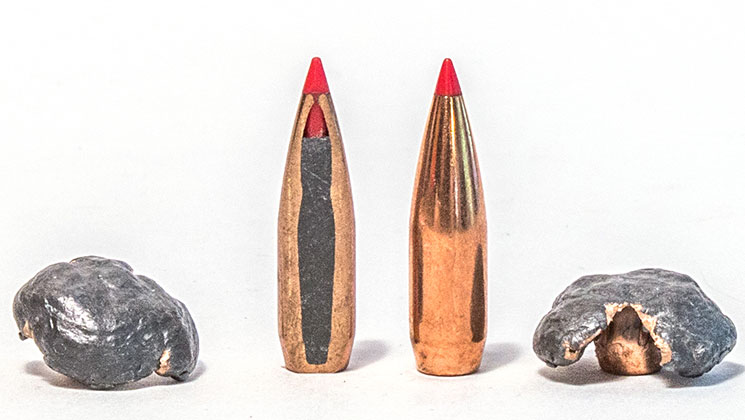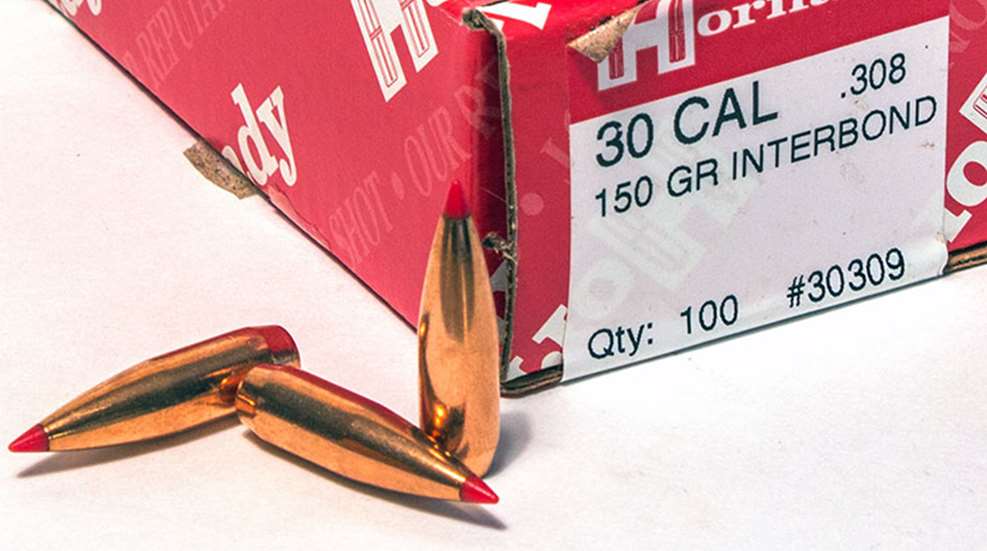
 A bonded bullet has its core locked to its jacket. It is done to prevent the bullet’s jacket (gilding metal or copper) and core (lead or a lead alloy) from separating. Core and jacket separation are thought to be a very bad thing with bullets. This is not necessarily true. Whether it’s bad or not depends on when, why and how they separate. That said, there are advantages to bonding bullets. They can be made to penetrate deeper because they retain their weight better, and they can be made to expand wider because they hold together. Hornady’s InterBond, introduced in 2003, is a bonded bullet that does a little of one and a lot of the other.
One of the few proprietary secrets bullet makers still keep under lock and key is their bonding process. Some cores and jackets are essentially welded together, while others are electrochemically merged. Regardless how they are manufactured, the purpose and result is the same: They stay together. Hornady’s InterBond bullet uses a gilding metal jacket that’s formed from a sheet of copper. By jacketed bullet standards, it is very thick, and it’s filled with a lead core. By volume, there is more gilding metal in an InterBond than lead. The InterBond is different than most bonded bullets because when it deforms it gets very wide, generally expanding to more than twice the original bullet diameter.
The result on game? A tremendous energy dump during the first several inches of penetration. InterBonds do not penetrate as deep as most bonded bullets, but they will leave a wider wound cavity and damage more tissue. This is due to the wide mushroom the InterBond forms into as it penetrates. Another positive feature of the InterBond is that it only needs to impact at about 1700 fps to initiate measurable expansion. Hunters can use them with confidence at longer ranges.
I’ve tested a number of InterBond bullets in various medias, enough to convince myself that they perform consistently. But I’ve only shot one big game animal with an InterBond. It was a young whitetail buck I whacked with a 150 grainer from a .308 Winchester. He was chasing a doe when I shot him and, after the InterBond found him, he staggered forward for about 20 yards before nose-diving into the dirt. The bullet liquefied his lungs and it was recovered just under the hide on the offside. That'll do.