Once upon a time, there was a little cartridge that was the epitome of accuracy. It was a happy cartridge, perfectly content to be the king of the woodchuck fields and the prairie dog towns. This little cartridge was a loner, having no family, though being thrust into the post-WWII firearms market and displaying a natural gift for accuracy, the little cartridge soon gained many friends.
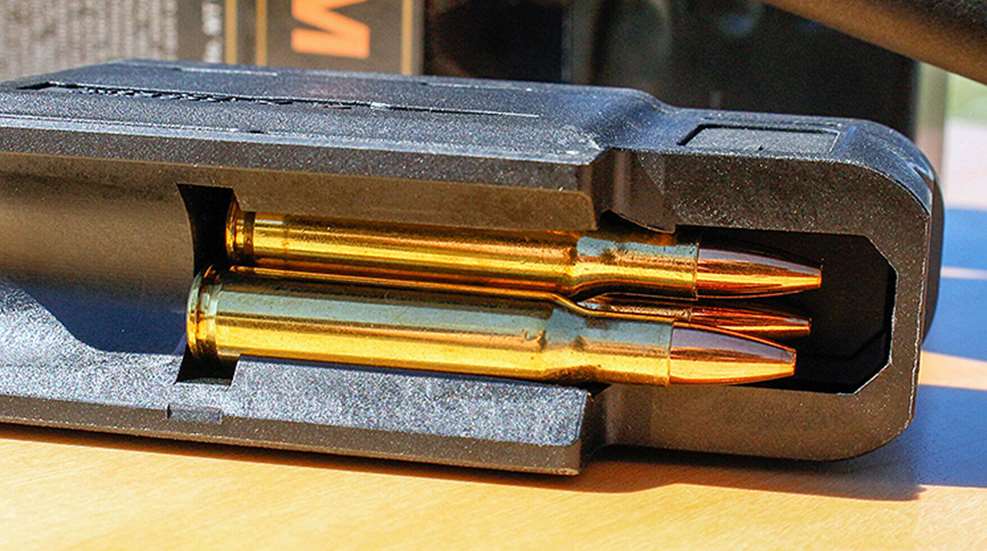
In 1950, Remington released Mike Walker’s creation—the .222 Rem. Chambered in the Model 722 Remington, this cartridge was a rimless design, which would feed perfectly from a bolt-action magazine, offer a huge velocity increase over the .22 Hornet, and considerably longer barrel life and less throat erosion than the speedier .220 Swift. Using a case length of 1.700”, with a 23˚ shoulder, this short-action gem drove a 50-grain bullet at just over 3100 fps, making a lethal combination for the small-bore aficionado. The Triple-Deuce uses a case head diameter of 0.378”, and is sparked by a standard small rifle primer. With a neck length of 0.313”, the .222 gives good neck tension, and allows for excellent bullet concentricity, which just might be part of the accuracy magic.
While the .222 Rem. was an immediate hit among the varmint and predator hunters, it also came into its own in a new type of shooting competition: Benchrest. Mr. Walker was among the founding fathers of the modern era of this competition, and the .222 dominated the scene for more than two decades. On 23 September 1973, Mac McMillan used the .222 Rem. to print a 100-yard, five-shot group that was certified at 0.009”—as close to a one-hole group as any of us could ever imagine. This record would stand for 40 years, until it was dethroned by a group measuring 0.0077”, with the wildcat .30 Stewart.
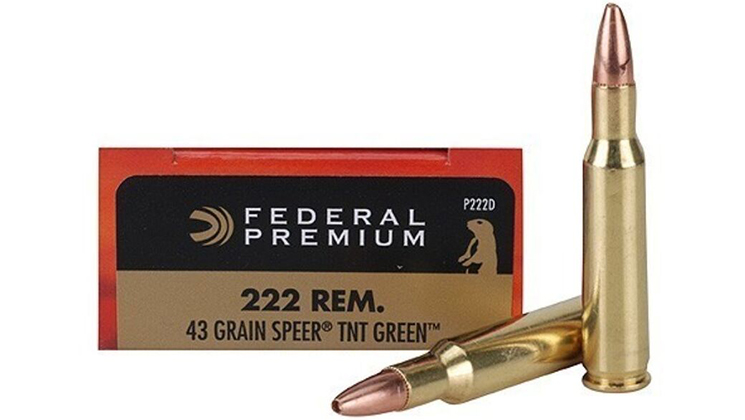
The .222 went on to become the head of a large, successful family. Most notably, it was the basis for the U.S. Army’s work in developing the 5.56 NATO/.223 Rem., though the list is much longer than that. The .222 Rem. Mag., the .17 Rem., .221 Fireball, .17 Fireball and .300 Blackout can all trace their lineage back to Mike Walker’s design, and that’s quite an impressive legacy.
Is the .222 Rem. still relevant? That may be a loaded question, considering the sheer volume of .223 Rem. ammunition available to the hunter. Combine that availability with the velocity advantage of the younger cartridge, and the knee-jerk answer would be no. Additionally, the .222 Rem. suffers from slow-twist-syndrome; like the .22-250 Rem., it won’t stabilize bullets any longer than 50 or 55-grains. With a 1:14” twist rate, even some of the lighter bullets—if designed with a long, sleek ogive—will give stabilization issues. The .222 will give the best accuracy will the lower B.C. bullets, but for most hunting situations, that won’t pose a huge issue, unless the long range game is your passion.
Yet, the .222 hangs on, with ammunition produced by Hornady, Federal, Remington, Nosler and HSM. It is a popular cartridge in Europe, mainly due to the fact that hunting with military calibers is prohibited in many countries. However, there are still many good rifles chambered in .222 Rem., and an opportunity to own one should not be shunned.
I recently had an opportunity to put the Triple-Deuce to the test, in a new Sauer Model 100 Classic XT, on the Wyoming prairie dog towns. The Sauer was fed with HSM ammunition, driving the 40-grain flat base Berger hollowpoint at a muzzle velocity of 3350 fps. The accuracy was certainly there, with this gun easily printing subMOA groups, and easily creating the red mist at ranges out to 300 yards, and even a bit beyond. Considering that type of performance, there’s no good reason I can think of to be upset if you own a good .222, especially if you consider the hunting ranges here in the northeast, where most of my shots are inside of 250 yards.
Though the .223 Rem. has stolen the limelight—military adopted cartridges tend to do that after all—we owe a debt of gratitude to Mike Walker and his development; without the .222, there would be no .223. Trends change, technology advances, and time marches on, but there’s no denying the fact that a skilled marksman with a .222 Rem. is the bane of varmints and predators everywhere.
Looking for previous installments of Behind the Bullet? We've got you covered.
• .45 ACP
• .404 Jeffery
• .44 Remington Magnum
• .243 Winchester
• .338 Winchester Magnum
• .357 S&W Magnum
• 6.5-284 Norma
• 8x57 Mauser
• .38 Smith & Wesson Special
• 7x57mm Mauser
• 9 mm Luger
• .35 Whelen
• .454 Casull
• .375 H&H Magnum
• .45 Colt
• .22-250 Remington
• 10mm Auto
• .308 Winchester