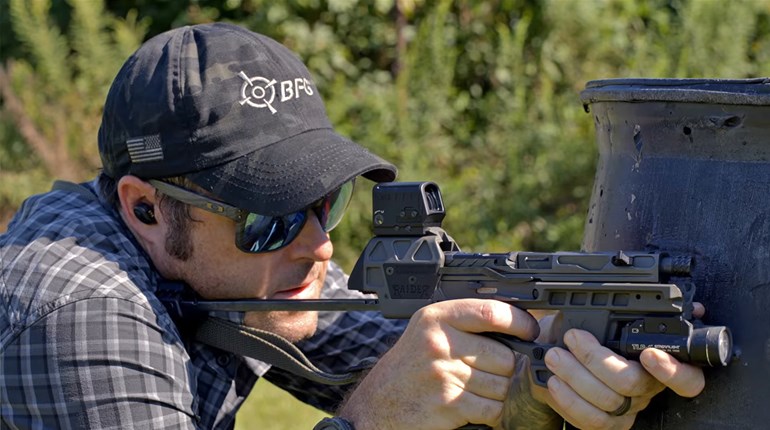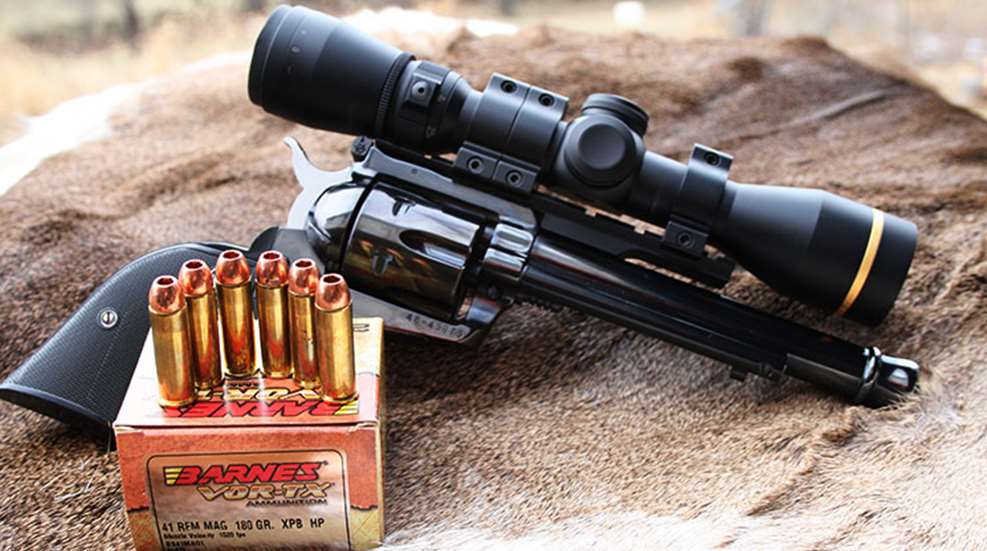
Tired of bagging your bull, buck or boar with a long gun, but not quite ready for the stick-and-string challenge? Then, my friend, handgun hunting could be for you. Not unlike hunting with archery tackle, the pursuit requires relentless practice, patience and persistence to succeed; however, it’s especially gratifying when you do.
Like most topics, the subject of handgun hunting is substantial enough to fill a volume—if not several. As such, the information below is meant to be a guide—not a tome—to get you started.
Selecting a Handgun
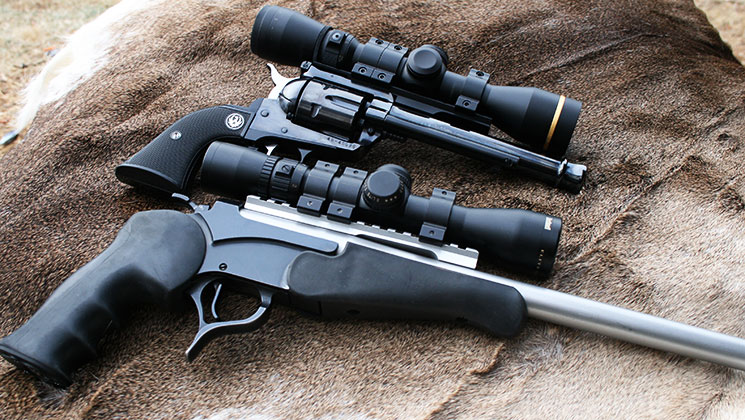
Handguns are available in an array of configurations; however, those employed for handgun hunting are: revolvers; semi-automatics; single-shots; and bolt-actions. Each design has advantages and disadvantages. Here’s a rundown.
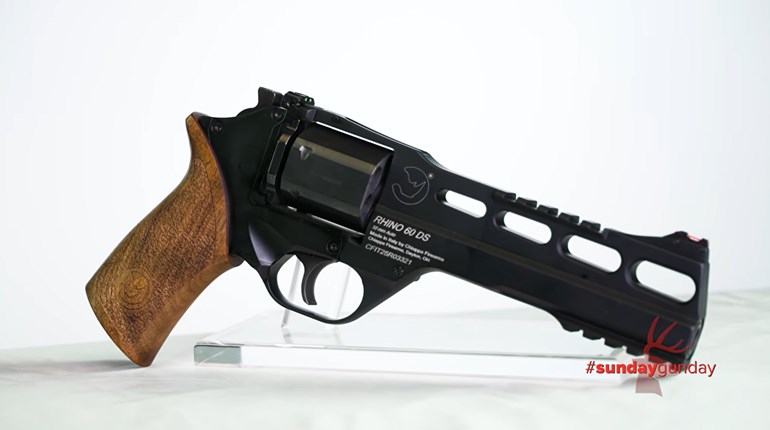
Revolvers: Offered in single- or double-action configurations, the former requires the hammer to be manually cocked for each shot, while the latter offers the aforementioned action and cocking (and firing) with the trigger pull. Subsequent shots with double-actions are faster—a benefit for the hunter. Regardless of their design, the majority of revolver hunters still opt to shoot using the single-action mode. Outside of top-end models, the trigger pull characteristics of most revolvers leave much to be desired; often they’re heavy, gritty, and/or long, all of which will negatively affect accuracy. Get a gem, though, and you’ll be surprised with its accuracy. Don’t skimp when purchasing a revolver for hunting!
With the exception of large-frame models—i.e. Smith & Wesson Model 460XVR and Model S&W500—which are bulky and heavy, revolvers are relatively easy to transport—that is, given the use of a quality holster. Unless using open sights, it’s likely that you’ll need to use a rest when shooting your revolver. If an optic is desired, be sure to select a revolver that’s factory equipped to accept scope bases/rings, otherwise gunsmithing will be needed (if it’s even possible). Best of all, depending on the caliber, you’ll have access to from five to eight magnum rounds in short order.
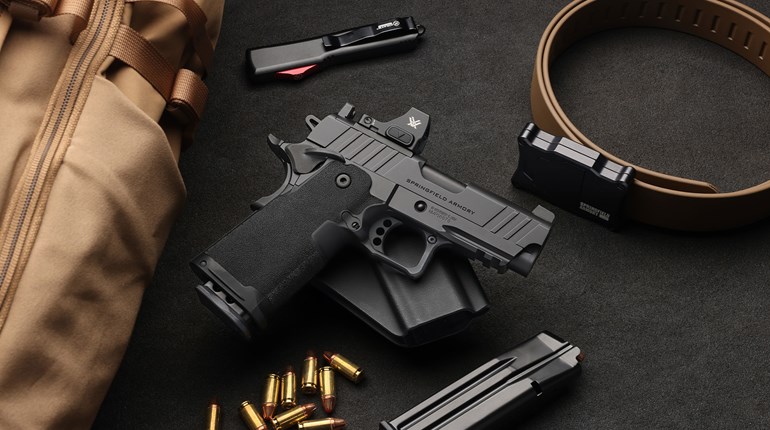
Semi-Automatics: By virtue of their design, semi-automatics offer immediate access to unparalleled firepower when compared to other handgun types on this list. But, with the exception of a 10mm Auto, the Coonan .357 Magnum Classic, or the Magnum Research Desert Eagle chambered in .357 Magnum, .44 Rem. Mag. and .50 AE, those extra rounds will probably be less powerful than ones from a revolver. That being said, the Glock 20 (in 10mm Auto), for example, uses magazines with upward of 15-round capacity.
Polymer-frame, semi-automatic pistols are very limited in big-game-suitable calibers. While the .357 SIG and .40 S&W will kill feral hogs and deer-size game, for most hunters, 10mm Auto should be viewed as the minimum for big-game hunting. That doesn’t leave many options. Some M1911s are chambered in potent hunting rounds, such as the .45 Super and .460 Rowland, and there are less common pistols available housing such rounds as the .475 Wildey Mag. and .45 Win. Mag.
Optics can be difficult to add, and the trigger pull on most striker-fired “polymer” pistols isn’t conducive to top-notch accuracy, though many companies have vastly improved them over the past decade. Given their light weight, semi-automatic “polymer” pistols are easy to transport and maneuver in tight spaces, such as a smallish ground blind or treestand. They’re also easy to shoot without the aid of a rest.
Single-Shots: True to their name, single-shot handguns give you access to one round—flub it and you might not get another opportunity. The tradeoff is more versatility in cartridges (revolvers and semi-automatics almost exclusively use straight-walled rounds), some of which are traditionally used in rifles. Moreover, the combination of lacking the barrel-cylinder gap of revolvers and lengthy barrels, single-shot handguns can generate impressive velocities, thus furthering your effective range. Case in point: in previous testing, when comparing a Hornady 140-gr. XTP .357 Mag. load in a 4-inch revolver and 14 ¾-inch T/C Encore single-shot, the latter had an increased velocity of more than 500 fps. That results in a flatter shooting and harder hitting bullet.
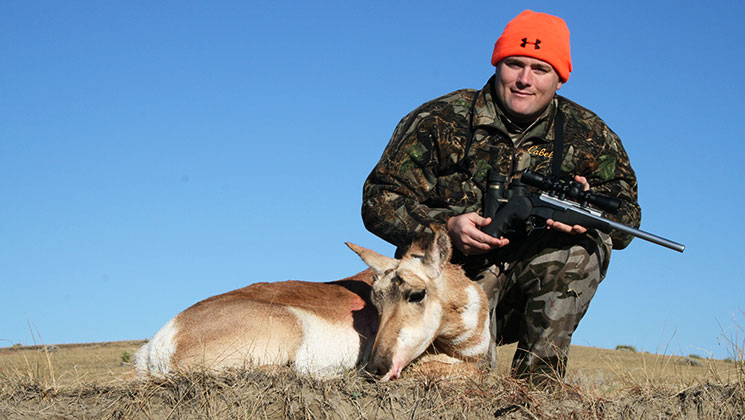
When teamed with a quality barrel and a smooth, lightweight trigger pull, single-shot pistols are remarkably accurate and effective. In fact, I used the aforementioned T/C Encore with a SSK Industries .250 Savage Ackley Improved barrel and 100-gr. Nosler Ballistic Tip to kill a Wyoming antelope doe at 301 yards.
An attribute of the single-shot design is that an optic can be easily added. There are no free lunches, though; when added to the weight of the gun and its extra-long barrel, transport can be cumbersome and fatiguing. A good holster or sling is imperative. Given the handgun’s weight, shooting offhand (especially when using a scope) is extremely difficult. You’ll need to shoot off some sort of rest.
Bolt-Actions: Outside of access to additional rounds, bolt-action pistols have the same advantages and disadvantages as single-shot pistols. There are fewer calibers from which to choose, and fewer of the handguns are available. Found on the used-gun market, the best are the Savage Striker, Weatherby CFP, and Remington XP-100.
Calibers/Ammunition
Before purchasing a handgun for hunting, consult the game regulations manual (or website) of the state that you’ll be hunting for the minimum caliber or muzzle energy—sometimes both—allowed for handgun hunting. You don’t want to purchase what you can’t use afield. Beyond regulatory allowances, suitable caliber will generally depend on the type of handgun you’ll be using.
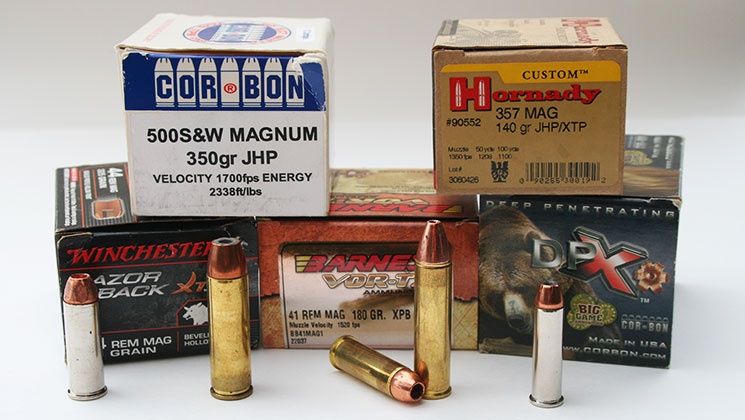
When pursuing deer, antelope and feral hogs with a revolver, the .357 Magnum should be viewed as the minimum. A still better choice is the more versatile .41 Rem. Mag., which is equally effective on said game as the larger .44 Rem. Mag. Of course, the .44 Rem. Mag. and larger revolver cartridges (i.e. the .454 Casull, .460 S&W Magnum, etc.) are best for experienced shooters, or for when game is large, tough and/or dangerous. As previously mentioned, although the .357 SIG and .40 S&W will take deer-size game, 10mm Auto is a better choice if you’re comfortable shooting it.
Options abound in single-shot handguns—particularly T/C's Encore and Contender pistols. Nearly every centerfire rifle cartridge is available in the aforementioned models, but don’t think that shooting the round in the handgun will be the same as a rifle—it won’t. For example, in a rifle the .308 Win. is mild-mannered, but for the novice handgunner, it’ll be unpleasant. If your budget allows, work your way up in caliber—start with something mild, such as the .250 Savage, 7-30 Waters, 6.8mm SPC or .30-30 Win., and practice as often as possible. You might find that if you’re hunting deer-size game you don’t even need a larger caliber. If you do, you’ll be experienced. Bolt-action handguns offer fewer cartridge choices, though they can be re-barreled to whatever round you desire.
When using handgun rounds, such as the 10mm Auto, .41 Rem. Mag. and .44 Rem. Mag., use premium-grade bullets—the extra assurance they afford is well worth the cost. Even on not-so-perfect shots, tough bullets—such as the Swift A-Frame, Speer DeepCurl and Gold Dot, Barnes XPB, Winchester Dual Bond and Razor Boar XT, Hornady XTP and others—will penetrate deep to reach vital organs and, hopefully, offer an exit for faster hemorrhaging. As for single-shots and bolt-actions, you can use loads marketed for rifles; however, keep in mind that the muzzle velocities will be significantly lower in the abbreviated barrels of pistols—pressure barrels used for testing rifle ammunition are 24 inches in length. Be mindful of the minimum velocities necessary for proper bullet expansion.
Preparation Makes Perfect
Like traditional archers, becoming proficient with a handgun comes only through practice—a lot of practice. In my opinion, the most important component of shooting a handgun is establishing a consistent, uninterrupted trigger pull; jerk the trigger and the shot will go really wide at distance. There’s no margin for error—even a small movement of the barrel translates to a large shift of impact downrange. That’s why it’s so important to practice.
Beyond using snap caps in your handgun, I like using a CO2-powered pellet pistol to practice trigger pulls (and maintaining sight alignment). Best of all, it’s quiet and inexpensive and, if you can master the horrible triggers typical of them, the trigger on your firearm will seem wonderful in comparison.
Next, if you’re using a .357 Magnum revolver, you can use lower-recoil .38 Special rounds to practice, and the .44 Special can be used in the .44 Rem. Mag. Ironically, a lower-recoil option for the .460 S&W Magnum is the .454 Casull. Though they won’t be as accurate, .45 Colt and .45 Schofield can also be used in .460 S&W Mag.-chambered pistols. Once you’re finished shooting, though, be sure to thoroughly clean your cylinders to remove the fouling.
When practicing, hold the gun solidly with both hands, but not a with death grip. Whatever you do, if you’re using a revolver, please don’t let your fingers or hands align with the barrel-cylinder gap or an injury will occur. I prefer tacky shooting gloves when shooting big-bore revolvers and single-shots to aid purchase.
Regardless of the solid object you’re resting the gun on, rest the frame of the gun on it, not the barrel, which can affect accuracy. And, if your gun is a double-action revolver, try shooting from the double-action mode. I fought doing so for years until a friend (and ardent handgun hunter) urged me to do so. The benefit is a surprise break—you don’t know when it’s going to fire, so you can’t anticipate it like you can a single-action pull. You’ll find it will improve your accuracy—it did for me.
Try shooting from various positions that you’ll be encountering in the field. You might have to rest on a fence post, shooting sticks or daypack (don’t burn it from the barrel-cylinder gap or muzzle). After shooting, you’ll determine your maximum effective range, which is the furthest that you can accurate place a killing shot every time. Stick to that range when hunting! And, the more you practice the faster you’ll be at getting on a game animal. It’s a lot more difficult to break a shot on a rutting buck with a handgun than with a rifle. It’s a lot more fun too.
Odds are, if you’ve read to this point you’re already contemplating handgun hunting. What are you waiting for? Go ahead and start planning. You’ll be glad that you did.