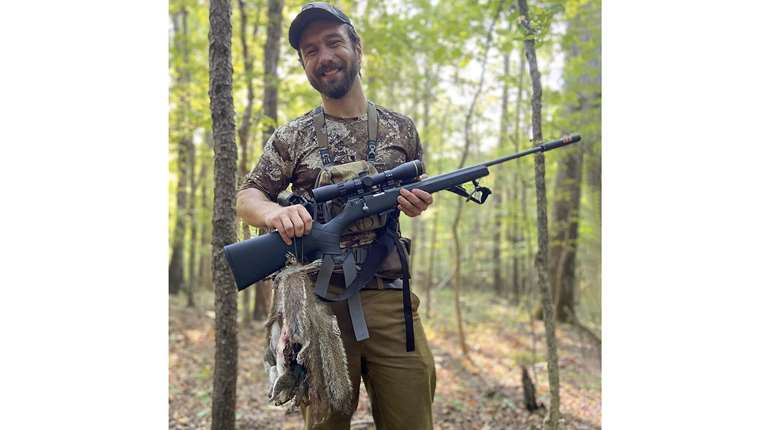
“What day is it again?” I repeated the question for the 10th time, grasping the Weatherby between my legs, a smile plastered to my face. The feeling of “sticking it to the man” had been coursing through my body since I woke that morning. I was giddy. I knew the answer: Sunday. And while most hunters won’t realize the significance of this day, those from my home state of Virginia know it all too well. In Virginia, there is no hunting on Sunday. Luckily, I had 360 degrees of pure Wyoming surrounding me. We exited the truck and I loaded three rounds into my rifle. Glassing out past the waterhole, where an unknown species of duck seemed to taunt me, we saw the buck crest the hill a few hundred yards off and Casey, my guide, said, “You ready?”
Two months ago, while booking the hunt, I was feeling overwhelmed at the notion of sending lead at game possibly 400 yards away. History had proven I could shoot accurately at that distance, but something about flesh rather than paper targets had me second-guessing my skills. Donning the gear I would have with me in the field, I zeroed the rifle at 200 yards off the bench then switched to the sticks and spent the remainder of my time shooting from the prone and sitting positions until I could consistently hit the 9-inch steel plate at 375 yards. This would be my shooting limit. I should have stuck a few needles in my rear to simulate the cactus that would find its way into more than one hunter’s rump on this trip.
Day one of the hunt found me over a hearty plate of biscuits and gravy in a restaurant aptly named “Breakfast” in Glenrock, Wyo. The scene was not unlike other Sundays back home, with one major exception: Instead of churchgoers in their Sunday best filling the tables, there were hoards of disheveled looking characters sporting faded camouflage and orange hats. Hot coffee was guzzled by the pot, requiring the staff to literally run around collecting empties to be refilled. As protein was devoured the topic of discussion was, of course, who would take the first shot. This being my first Western hunt, the boys wanted to break me in right. Gratefully accepting the honor forced upon me (trust me, I tried my hardest to literally “pass the buck”), I spent the remainder of the meal trying to forget the last thing my old man told me before I left: “Good luck and don’t disgrace the family name.” No pressure here.
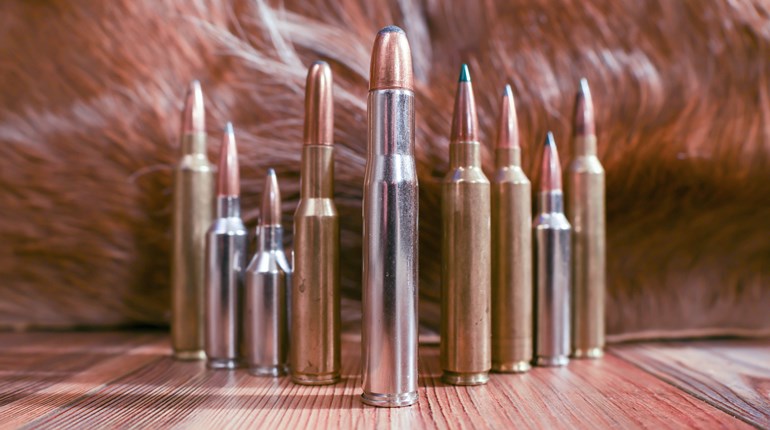
Thankfully, the morning’s rifle check wouldn’t leave me cursing the airline staff as a quick stop at the range proved my .257 Wby. Mag. was shooting like it did back home. With all the hunters now on target, we piled into the two trucks: Guns, gear, binoculars and cameras, check. It wouldn’t be long before we were spotting game.
The style of this hunt was something with which I was unfamiliar. Honing my skills in the woods and waters of Northern Virginia doesn’t allow for much more than a treestand, bow and 12-gauge—and certainly no Sundays to do it. So the idea of driving around and glassing from trucks with high-powered rifles was, to say the least, exciting. A mile into the ride I’d already seen more than 100 antelope across vast tracks of land that are nonexistent back East. Rolling hills deceivingly hid draws and arroyos where pronghorns would appear seemingly out of thin air. Game was abundant. Finding the speed goats would be easy; judging their trophy status, on the other hand, would be impossible without someone in the know. Through the binocular everything looked like a trophy, which explains why it took me a while to get the joke when every buck we glassed was followed with a declaration of “management buck, that one’s definitely limping,” from another young hunter who shall remain nameless. Truth be told, it would turn out to be harder than we thought to locate each hunter’s second “management” buck. The Tillards know what they’re doing.
Sitting in the truck, glassing and discussing each animal as it was spotted, I was reminded of duck hunting. Our truck was a roving blind, complete with snacks and a collection of fine humor that would make even my diehard ducking pals back home blush. Yeah, it was just like duck hunting, only the “X” was the 80,000-plus-acre Tillard Ranch, and I wasn’t slinging steel with a maximum 45-yard range. Did I mention it was Sunday? I was going to enjoy this hunt.
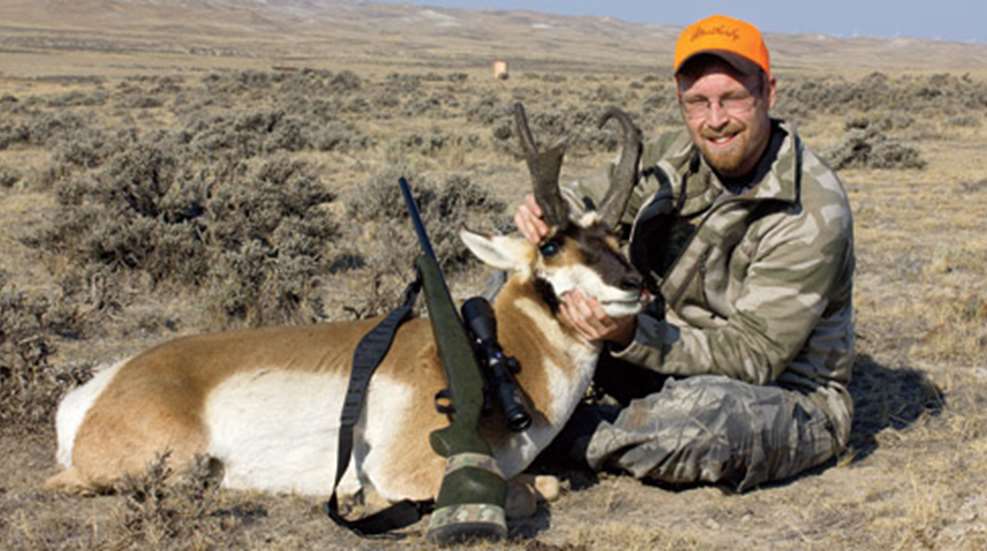
While 375-yard shots are not uncommon, as it turned out my longest poke would be a hair less than 100. It wasn’t overly stimulating; there were no dangers lurking behind the sage brush to fear and the 70-degree temps kept me from battling the elements. So as we trekked the 200 yards to get a better look at this animal my nerves were calm. But when Casey said, “You’re gonna want to shoot this buck,” then quickly set up the sticks that all went out with the breeze. I could tell by his voice he was excited. And when a man who guides pronghorn for a living gets excited you don’t question him. The calm, easy feeling that had been governing my thoughts departed faster than Road Runner escaping a falling anvil. I was a mess in a hurry. Firmly planting my butt on some cacti, I peered through the scope and, for the first time, was up close and personal with a pronghorn antelope. Had Casey thought I was nervous before, he must now have thought I was about to keel over. The trembles in my heavy breathing could be heard from back at the truck. Taking my head off the rifle for a moment allowed me to regroup and avoid hitting the dirt. Out of the corner of my eye I could see Casey staring at me, a not so subtle hint that my trophy wasn’t going to literally stand around forever. I took the hint, came down on the rifle once more and whispered, “I’m gonna take him.” My 100-yard shot dropped the animal instantly.
By noon the first day, our gang of misfits had taken an impressive five antelope. As we finished lunch, knowing I had another day to hunt and a management tag left to fill, my plan was to glass and spot for my fellow hunters. But bumping along the dirt roads in this cowboy’s paradise, noticing the abundant game all around, it was an easy decision to make when the possibility of a second Sunday goat was floated my way. Three hours later in the fading Sunday sun, I pressed my rifle to the sticks, watched my second buck show himself then laid it low with a single shot at 62 yards. The family name was safe.
Until now, I really had no idea what I was missing. It’s not as though the sun shines differently on Sunday, but it felt... I don’t know... satisfying. I was given the opportunity to do something that until now was off limits. It’s like a 21-year-old’s first legal drink—nothing different about it, just satisfaction to the core. It was as if they had lifted the ban on Cuban cigars and I had the first box. Cubans are by no means the only top quality cigar but for some reason, when possessing the prohibited stogies we tell ourselves they taste better. The truth is, while growing up where Sunday hunting was not an option I just assumed it was the same across the country. It never crossed my mind that I was being deprived of something the rest of the country was allowed to do. I have spent many a good Sunday playing ball, going to church or hanging treestands and scouting duck holes. But a trip out West, where the deer and the antelope roam, gave this Virginia boy the greatest Sunday of his life. Ignorance was bliss. Football never really did it for me anyway.