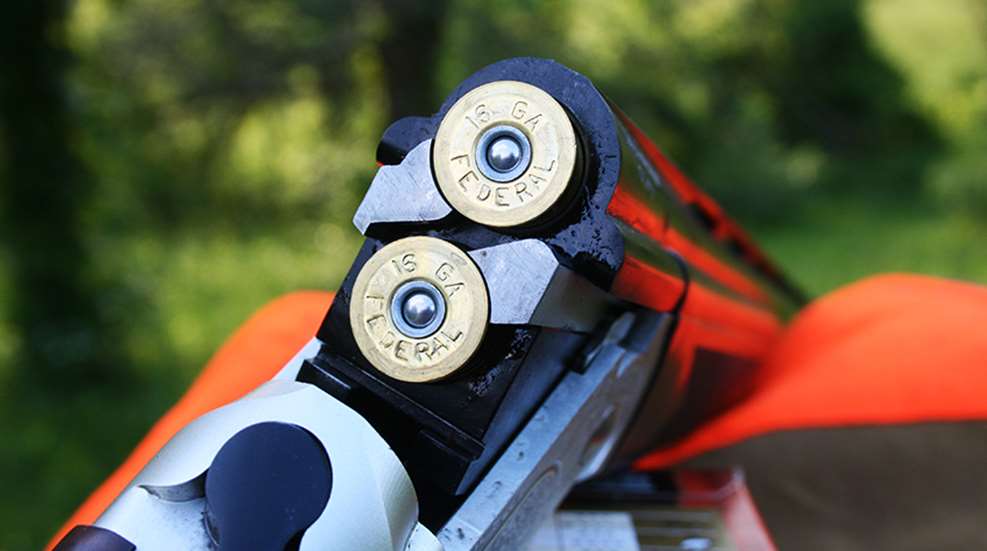
Underappreciated, underestimated and misunderstood are apt verbs used to describe the 16-gauge shotgun. It’s unfortunate, as the midsize shotshell offers real advantages over other gauges when afield.
Fortunately, there’s a small cadre of dedicated shotgunners and handloaders who truly understand the 16-gauge’s forte and capabilities, and have been its advocate and protectorate through the years. Among them are aficionados espousing the shell’s virtues on websites and forum threads, such as the 16 Gauge Society. Their toil hasn’t been fruitless; there now appears to be a mild resurgence. This is most evident in the diversity of new 16-gauge shotguns and ammunition entering the marketplace recently, and the momentum doesn’t appear to be slackening.
Should you join the 16-gauge bandwagon? Here’s what you need to consider.
Surviving, Not Thriving
Identifying an exact date and location for the introduction of the 16-gauge is an exercise in frustration, as there’s minimal penned about its origins, and it’s mostly oversimplified material. Nonetheless, according to Cartridges of the World, 13th Ed., “In 1866, a rebated-reloadable-steel, 16-gauge shell was patented by Thomas L Sturtevant. Revolving magazine four-shot guns chambered for this shell were offered by the Roper Sporting Arms Company, until the 1880s.” Ballistic Products, Inc., attributed its development to the Europeans, and in particular, Germany. The Sixteen Gauge Manual, 6th Ed. states, “In Germany, where the 16 was first developed and given an identity ... .” Suffice it to say that, regardless of its heritage, the adage “time-tested” is especially applicable to the 16-gauge.
What is well established is that the Europeans have long had an affinity for the 16-gauge. To find evidence, one need not look any further than the prized, high-dollar drillings and side-by-sides from top makers, such as Merkel, Heym and Krieghoff. Moreover, we know that the decline of the 16-gauge in the United States is linked to the post-World War II era. The 16 Gauge Society reported, “For the first half of the past century, a 16-gauge was the gun of choice for experienced upland shooters here in America and on continental Europe as well.”
Corresponding to the aforementioned idea, Ballistic Products, Inc., wrote, “The post-World War II demands for the 12-gauge shotgun forged long-lasting, unbreakable habits of production and marketing into American ammunition manufacturers. Shooters didn’t have many options in the years following World War II; therefore, ammunition offerings were mainly confined to the shotguns that were available. Utilitarian loads begot utilitarian bore sizes. It took effort and patience to acquire a proper 16-gauge shotgun.” The demise of the 16-gauge hastened.
America’s ebb-and-flow relationship with the 16-gauge can primarily be attributed to the popularity of the 12- and 20-gauge—especially the latter, due (recently) to the external and terminal ballistics afforded by new, ultra-dense, tungsten-based shot. There’s considerable crossover in performance, uses and quarry, too, which causes some hunters to dismiss it—more on that topic soon.
Still, others decry there not being a 3-inch, 16-gauge shell (just buy a 3-inch, 12-gauge), as well as rules about its use for registered clays events. Concerning the latter, the National Sporting Clays Association (NSCA) lists the 12-, 20- and 28-gauge, as well .410-bore, in its rulebook, but not the 16-gauge. What does that mean for 16-gauge shooters? It doesn’t qualify for use in sub-gauge events, and therefore, must compete in the 12-gauge events. Some shooters see that as an unacceptable handicap, but in reality you can do quite well with a quality 16.
The Allure of the 16-Gauge
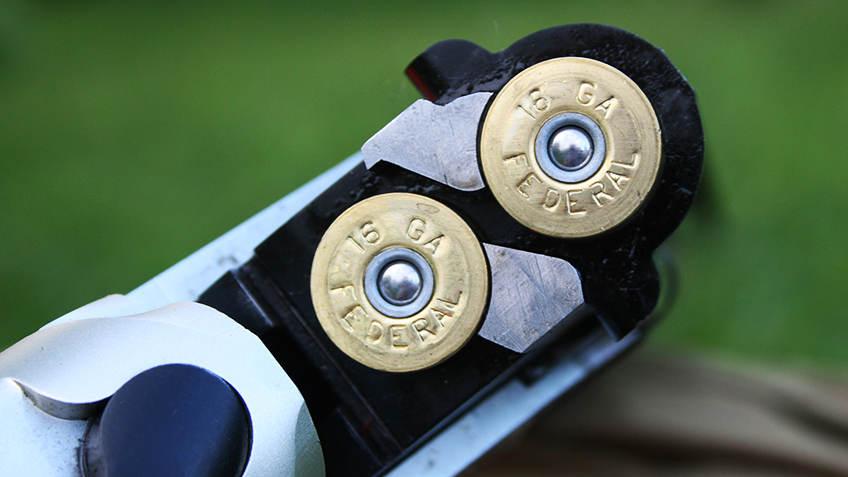
Perhaps the most-used adjective to describe the omnipresent 12-gauge is “versatile,” and it’s fitting—to an extent. Sure, 12-gauge shells are available in seemingly endless configurations in their 1¾-inch to 3½-inch lengths, but the “do-it-all” shotguns themselves are the proverbial monkey wrench in the works.
For instance, to chamber the mammoth 3½-inch shotshell, a 12-gauge must have a lengthy receiver, and when the barrel and buttstock are added, the result is a big gun that’s perfect in the blind for geese, but not necessarily a long day side hilling for grouse or chukar, or walking lengthy fields of CRP chasing pheasants. On the other hand, an especially-lightweight, 3-inch-chambered 12-gauge suitable for the aforementioned hunts would likely be uncomfortable to fire frequently with heavy field or magnum-type loads. So, is the 12-gauge versatile? Yes, but it has limitations.
The same can be said of the 3-inch, 20-gauge shotgun. While it offers similar payloads and performance of the 16-gauge, 2¾-inch, many 20s are really exceedingly lightweight for a steady diet of heavy loads—too much of a good thing. My ultralight 20 gauge Benelli M1 Super 90 is a prime example. It’s fun to carry long distances, but not to shoot a lot. Besides, the 3-inch, 20-gauge is famous for producing extra-long shot strings, though the real-world effect of this is a hotly debated topic for another article.
In reality, the 12-, 16- and 20-gauge share much common ground, and that’s why the 16 loses. For example, a 3-dram, 1 ounce game load in the 16 can easily achieve up to 1300 fps, and the same shot and propellant charges can do virtually the same in the 12-gauge. But for the average shooter or hunter, it’s far easier and less costly to purchase the easier-to-find and inexpensive 12- and 20-gauge shotguns and ammunition than it is to get 16-gauge items. In fact, 16-gauge shells are typically twice as expensive.
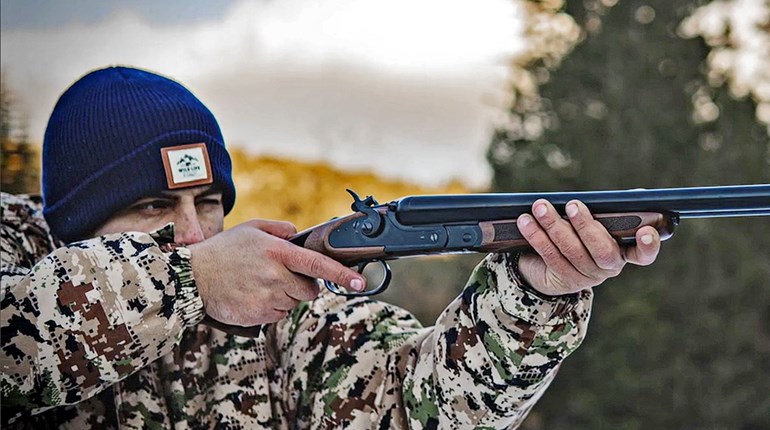
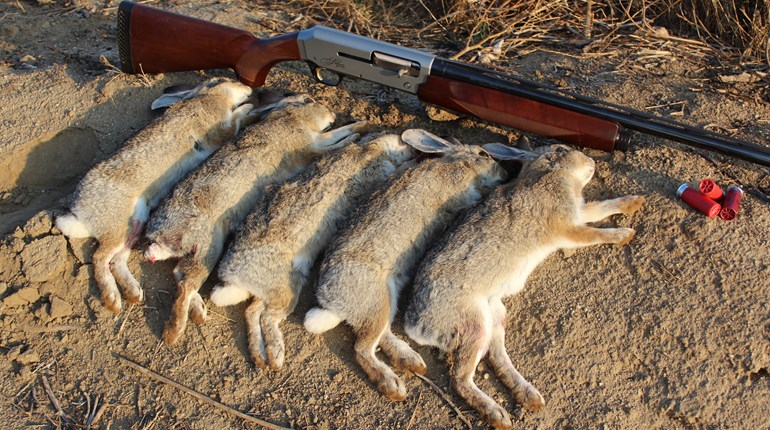
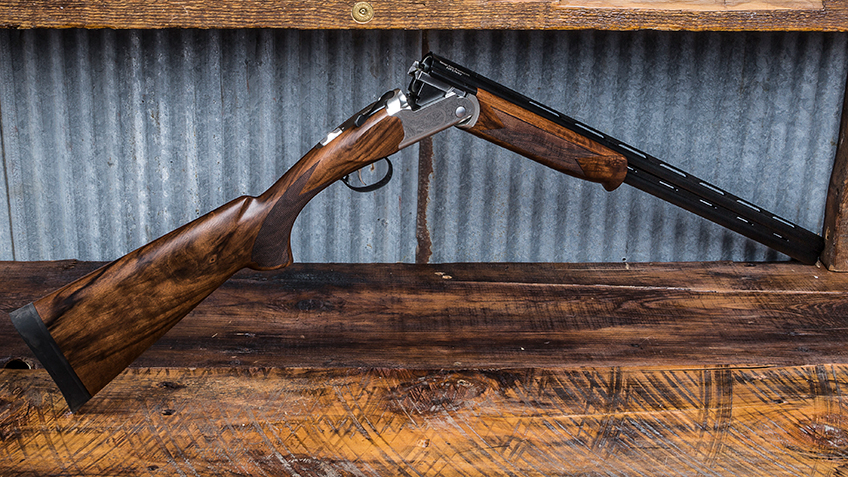
This is a shame, because when properly scaled to size—not a 16-gauge built on a larger, 12-gauge frame—the svelte, 16-gauge, 2¾-inch-chambered shotgun is lightweight to carry for long treks, and it’s fast, intuitive and lively in the hands. And yet it can deliver an equivalent payload of the “all-mighty” 12-gauge to a fleeing pheasant, grouse or chukar. In other words, it’s perfectly suited for upland hunting. Optimized 16-gauge shotguns will typically weigh around 6 lbs. Perfectly matching this criteria is the 28-inch-barreled Stevens Model 555 over-under shotgun, which weighs 6.2 pounds. With a long sighting radius (due to barrel length), scaled-to-gauge frame and archetype weight, the Turkish import is well-suited for pursuing upland game from coast to coast, as well as most species of waterfowl.
What’s Available?
Affordable, 16-gauge shotguns are available from Savage Arms, Browning (new for 2019 Citori 525 Field, and the A5 Sweet Sixteen Feather Superlight 16-Gauge), TriStar and CZ-USA, among others. New, old stock of the Browning Gran Citori Lightning or BPS Hunter Grade III may be also found, as well as past runs of the Remington Model 870 and others. The used market on gun auction sites will have everything from Merkel and Parker side-by-sides to Winchester Model 12s pumps and Krieghoffs. There’s no shortage of available used early- to mid-20th Century 16-gauge shotguns.
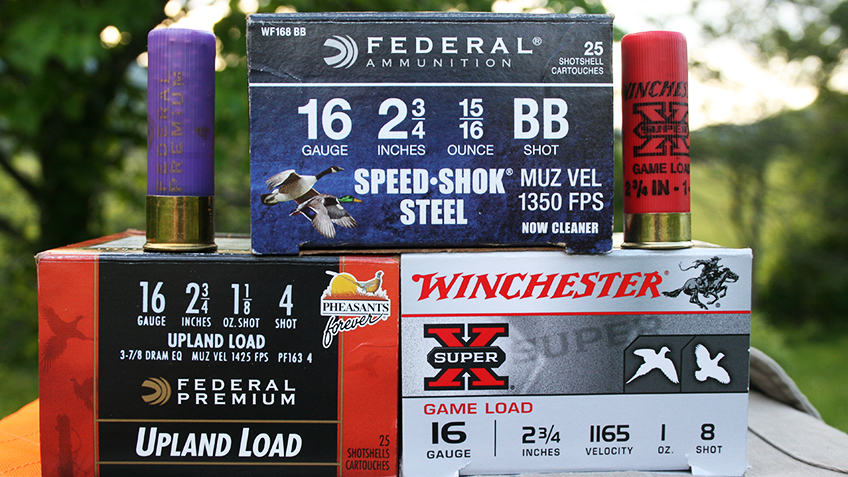
Companies such as Remington, Winchester and Federal have maintained a small selection of hunting-specific 16-gauge, 2¾-inch loads through the years, but they’re now diversifying. Some of the eye-opening options of the latter include the Wing-Shok Pheasants Forever load, which feature 1⅛ oz. of No. 4, 5 or 6 copper-plated lead shot propelled to a scorching 1425 fps, and Speed-Shok Steel with 15/16 oz. of No. 2, 4 or BB shot at 1350 fps is a top choice for waterfowl. The company has 1⅛ oz. of No. 4, 6 or 7½ lead shot in the Game-Shok Upland Hi-Brass series. Remington has the excellent Pheasant load featuring 1⅛ oz. of No. 6 shot at 1295 fps, as well as Express Extra Long Range loads with 1⅛ oz. of No. 4, 6 or 7½ shot at 1295 fps. In steel loads, Big Green has Nitro-Steel featuring 15/16 oz. of No. 2 or 4 shot at 1300 fps. Winchester has three options in the Super-X High Brass Upland and Small Game series; each load propels 1⅛ oz. of No. 4, 6 or 7½ lead shot at 1295 fps. Each of the companies above has upland/game loads that can pull double-duty for clays.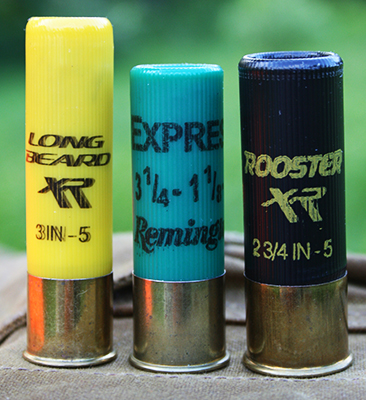
Those individuals hunting areas (or species) that prohibit lead shot can utilize those steel options mentioned previously, as well as some of the tungsten-based loads mentioned here. Turkey hunters can rejoice, as Apex Ammunition loads 1⅝ oz. of extra-dense No. 9 TSS for dropping toms at distance. In HEVI-Shot’s Classic Doubles offering, the low-pressure and recoil load propels 1 oz. of No. 4 shot to 1150 fps, while the HEVI-Shot Duck option generates 1300 fps with 1¼ oz. of No. 4s or 6s. Kent also loads 1 oz. of No. 5 bismuth shot to 1300 fps in its Bismuth Upland line.
A counterpart leaded load is Kent’s Ultimate FastLead options, which push 1 oz. of No. 6 or 7½ Diamond Shot to 1220 fps. Other companies with lead 16-gauge game and/or target loads are: Rio, Clever and Fiocchi, among others.
For hunters desiring to press their 16-gauge into service as a deer or feral hog gun, Federal also offers a Power-Shok load with a 4/5 oz. lead slug at 1600 fps, as well as Power-Shok buckshot load with 12 pellets of No. 1 buck at 1225 fps. Remington’s Slugger load has the same specifications as Federal, while Brennke’s Classic Magnum 1 oz. slug travels 1580 fps for 2,309 ft.-lbs. of energy. Clever also has a slug option in its Mirage line.
Few shotshells benefit from handloading as much as the 16-gauge does, as you can load everything from ⅝ oz. target loads up to hard-hitting 1¼ oz. HEVI-Shot. You can even load the 1 oz. DGS-16 slug. Perhaps the greatest benefit of handloading the 16-gauge is increased diversity in lead-free shot types; you’ll have the ability to use HEVI-Shot, bismuth, steel, ITX Original-10, ITX-13, SpheroTungsten Original-15, and SpheroTungsten Super Max-18 in myriad sizes and payloads to match the quarry and hunt. Bismuth and ITX Original-10 shot types are particularly advantageous to users of thin-barreled and older 16-gauge shotguns, as due to the pellets’ softness, they’re unlikely to damage the guns. Meanwhile, SpheroTungsten Super Max-18 maximizes the payload and reach of the 16-gauge. With a target density of 18 grams/cc, No. 7 Super Max-18 pellets weigh as much as magnum No. 5 lead shot but pattern tighter and penetrate much deeper. It’s ideal for turkeys, waterfowl and late-season pheasants.
Taking up the 16-gauge is a real commitment; in general, its ammunition is less varied and notably more expensive than that for the 12- and 20-gauge, and outside of a few “low brass” game loads, it’s uncommon to find them at popular big box stores. Additionally, new shotguns chambered in 16-gauge are comparably few in number. But the scaled-down 16s deliver performance akin to most 12s, and they’re quick to acquire a target. Not to mention they’re a joy to carry on long jaunts. If you give the 16 gauge a try—especially if you’re a handloader—you’ll likely be hooked for life. There’s a reason so many hunters worldwide have used them for more than a century—they work.