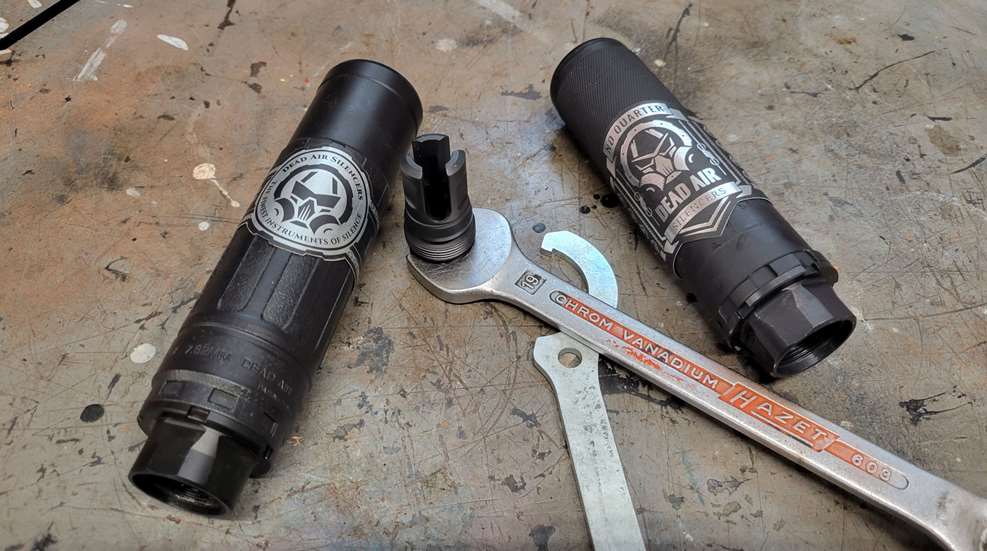
Getting federal and state agencies out of the way of the citizens who wish to use suppressors to make their guns more polite to their ears and to their neighbors’ is an ongoing, complex and multifaceted effort. There is, however, progress being made thanks to the Trump administration.
Robert Cekada, the director of the Bureau of Alcohol, Tobacco, Firearms and Explosives (ATF), recently came on to the NRA’s The Armed Citizen Podcast to explain how hunters and other gun owners can now purchase short-barreled rifles (SBRs), short-barreled shotguns (SBSs) and suppressors (silencers) and how hunters and others can travel with these items on out-of-state trips.
On August 5, the U.S. District Court for the Northern District of Texas ruled on the consolidated cases of Jensen v. ATF and Silencer Shop Foundation v. ATF. Judge Wesley Hendrix held that National Firearms Act (NFA) registration and approval requirements exceeded Congress’ constitutional authority once the $200 tax was removed by Congress.
Then, on October 9, the ATF issued guidance (via an Open Letter with a fact sheet) stating that, as a matter of enforcement discretion, the ATF will no longer enforce key NFA requirements for SBRs, SBSs and suppressors. This guidance applies nationwide to everyone (not just the plaintiffs in the lawsuit).
In the states where this is legal, hunters who wish to better protect their hearing can now purchase suppressors from federally licensed firearms dealers. These citizens can choose to register the suppressor under the NFA or they can fill out ATF Form 4473 and wait as their details are called into the FBI’s National Instant Criminal Background Check System (NICS). In either case, they’ll need to wait until they are cleared.
ATF Director Cekada also mentioned a process designed to make it easier for, say, traveling hunters to take their suppressed firearms on out-of-state hunting trips.
“The only thing [a traveling hunter is] still required to do is file Form 20 with the Bureau of Alcohol, Tobacco, Firearms and Explosives (ATF) regarding the interstate transfer of that weapon or silencer,” said Cekada. “That is one of the regulations I put forward earlier this year. A proposed rule would change the process of waiting for ATF approval to simply notifying the ATF, thus providing you with legal cover while you make this interstate transfer. That list is currently under review. We review all comments. Therefore, we expect that regulation to be adopted and finalized in the coming months. This will change the process and reduce some of the burden on American gun owners who are trying to go hunting and take their silencer to another state.”
This will be an online form and an electronic notification to the ATF. On May 8, 2026, the ATF published a Notice of Proposed Rulemaking titled “Interstate Transport and Temporary Export of National Firearms Act Firearms.” It would allow for short-term interstate travel (365 days or less) of covered NFA firearms. Cekada said that the ATF expected the regulation to be finalized in the coming months.
Until it is finalized, however, the current Form 20 process still applies to SBRs, SBSs and other NFA-regulated firearms. For suppressors, the October 2026 non-enforcement policy already provides substantial relief federally, but state law remains the bigger practical constraint.
This issue is still evolving, however, and could change with a new Congress or administration—elections matter, which again is why gun owners must vote on November 3.
When asked about this, ATF Director Cekada said the following:
“Okay. So, I’ll start with the coverage that people currently have. Therefore, the injunction issued by the District Court for the Northern District of Texas does not apply nationwide. It applies to a very specific group of people, namely the plaintiffs and the plaintiff states… . That was very limited. This included Texas and Louisiana, along with members of organizations that were among the plaintiffs. That injunction can be cancelled. Based on my understanding from briefings with the Department of Justice and my senior legal advisors, this could be reversed in the future. It is not easy to cancel it, but it can be done … . What could also happen in a future administration … is that a future administration … might reimpose a tax on the elements of the National Firearms Act we are talking about. Silencers, short-barreled rifles, short-barreled shotguns … . A one-dollar tax levied on those firearms might be what will cancel the injunction. Now, people who purchased firearms either under the restraining order or under the protection provided by the ATF’s non-enforcement policy will now be in violation of the National Firearms Act. The only way to bring them back into protection … is to establish a period of amnesty… . I have full confidence in this attorney general that if this is the path we need to take … he will do it … . As for the injunction … it’s a document that people can refer to in the future and say, ‘Hey, this isn’t something I decided to do on my own. This is a director of an office who issued a directive to the American people that had the support of the Attorney General in this Department of Justice.’ I think it’s not as simple as people think … . We are doing the best we can within our powers so that Congress has the opportunity to make what we have done permanent.”
Clearly, this is an issue the NRA will stay involved in the legislatures and courts. Clawing freedom back from government requires a motivated and educated electorate.