Perhaps nothing firearm-related is as symbolic of the Great Depression’s hardships as Karl Foster’s shotgun slug. Developed in 1931, Foster’s handmade, all-lead slug was designed to diversify a family’s diet by increasing the reach of the fixed-choke, smoothbore shotgun—typically a household’s only game-getting tool. Foster-type slugs have maintained their appeal to the single-shotgun hunter, resulting in most major ammunition manufacturers offering them. The latest to do so is Hornady.
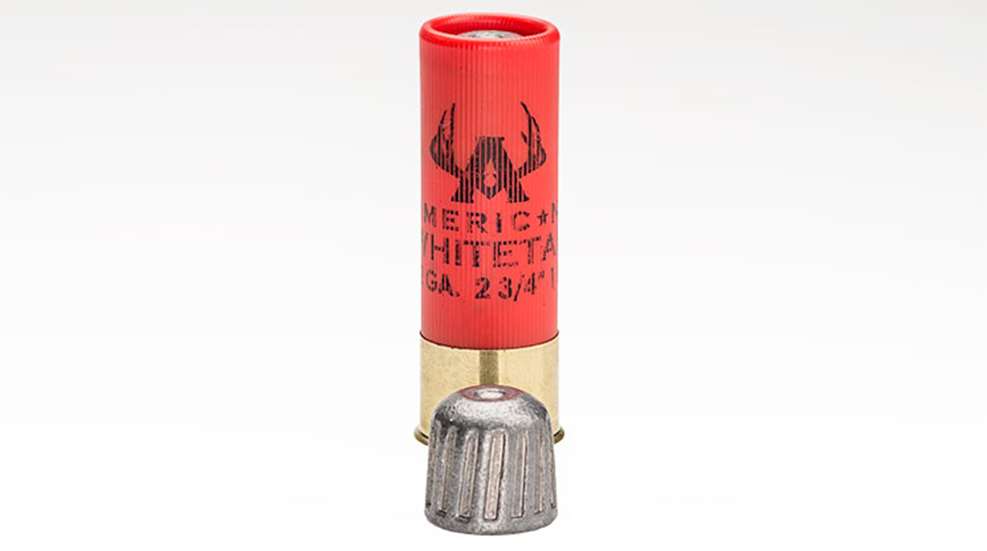
An offering in the company’s new American Whitetail-series ammunition, the 12-gauge, 2¾-inch load features a 1-ounce slug similar to Foster’s design. As with the original Foster slug, Hornady’s projectile is homogeneous in composition; however, instead of pure lead, which Foster purportedly used, Hornady’s version is made from lead alloy—a tougher material. From the tip to the base the slug measures .700 inch, while it increases in diameter from .633 inch to .733 inch along its length. Such tapering and forward-of-center mass, the latter of which is made possible by a cavernous base and a hearty front, produces a badminton shuttlecock effect.
Despite the slug’s poor aerodynamic qualities, it should remain nose-forward and otherwise stable in flight. But, the short, fat design greatly diminishes the projectile’s ballistic coefficient (BC), which, when combined with a low muzzle velocity and hefty weight, relegate it to close-range hunting. Projectiles with low BCs shed velocity (and thus energy) quickly and are especially susceptible to wind deflection.
The large, hollow base of Foster’s slug would obturate when exposed to high-pressure gases to form a seal; however, in the Hornady load propellant gases are captured by a multi-tiered, one-piece, compression-style plastic wad. Examining spent wads revealed an interesting phenomenon: A portion of the wad’s front section deformed and entered the base of the slug, while some of the wad material in this area flared outward. The front sections of recovered wads had an outside diameter of .800-.830 inch. It’s safe to assume gas won’t bypass both the gas seal and the expanded front end of the wad, and the gas seal is sufficiently sized to contain gases even in over-bored barrels.
Like the original Foster slug, Hornady’s version features “rifling.” A misnomer, the diagonal grooves don’t impart appreciable (if any) rotation to the slug, but they are important nonetheless. The grooves, as well as the hollow base, provide avenues to which material displaced by choke-induced swaging can migrate. That’s why Foster-type slugs can be fired in chokes ranging from cylinder to full without barrel or choke damage. Generally, the best accuracy will be found with a cylinder, improved cylinder or modified choke. The grooves also reduce bullet-to-bore contact and thus friction.
Technically a hollow-point projectile, the slug features a shallow, .170-inch hole at its front. Due to the use of a lead alloy, however, the hole isn’t needed to ensure expansion. You can count on the material expanding widely upon impact for maximum energy transfer.
According to Hornady’s data the slug attains 1600 fps from a 30-inch barrel, but seldom is a shotgun with a 30-inch barrel encountered anymore. Since shorter barrels are common, I chronographed the load in a 24-inch-barreled Savage Model 24 with an improved-cylinder choke. The average velocity for five consecutive shots was 1561 fps—only 39 fps slower than with the longer barrel employed by Hornady. A deer won’t notice the difference.
Using the Savage topped with a Burris 3X-9X scope and rested on sandbags, I fired the American Whitetail slugs for accuracy at 75 yards. Despite an unpredictable breeze (remember, low-BC bullets are especially susceptible to drift), the average for three consecutive, three-shot groups was 2.68 inches. The largest group measured 3.27 inches, while the smallest went an impressive 1.77 inches. With this level of accuracy, 100-yard shots are achievable with a scoped smoothbore; account for 3 inches of drop at this distance when zeroed at 75 yards. Function-testing in the Model 24, as well as a pump-action Mossberg Model 500 and a semi-automatic Winchester Model 50, revealed no problems with feeding, firing or ejecting.
Sold in five-count boxes, the suggested retail price of the slugs is $10.51. However, I found them online for $8. It’s especially fitting that the original American shotgun slug for deer hunting has found a place in Hornady’s aptly named and U.S.-made American Whitetail ammunition. The company’s offering reveals just how capable Foster’s innovative slug continues to be.
Technical Specifications:
• Gauge: 12
• Length: 2¾"
• Weight: 1 oz.
• Slug Material: lead-antimony alloy
• Ballistic Coefficient: .070
• Muzzle Velocity (Advertised): 1600 fps
• Muzzle Energy: 2,484 ft.-lbs.
• MSRP: $10.51 (per 5-rnd. box)