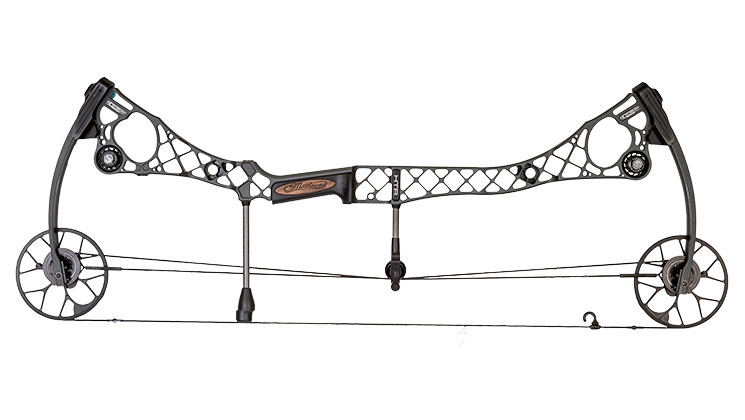
Mathews Archery proprietor Matt McPhearson has never stood idly on past merits. He’s a natural innovator, as seen in his once-revolutionary Solo Cam bows that dominated the hunting market for nearly two decades. His company’s new bow, the No Cam, aims to correct perhaps the Solo Cam’s only flaw—notably a relatively new term created by Mathews competitors called nock travel. For hunters it may not be important, but for the evolution of the archery industry—and for NRA members who are contemplating a new bow purchase—here’s the scoop.
Nock travel is the vertical and side-to-side movement of the nock when the bowstring is released. If the nock doesn’t move straight forward, the arrow can fishtail horizontally and porpoise vertically. While arrow fletching works to correct these shortcomings in flight, a bow’s accuracy potential is higher if the arrow flies perfectly from the start.
On single-cam bows, the cam’s rotational axis is different from that of the idler wheel and vertical nock travel occurs. On dual-cam bows, if cam timing isn’t exact the string is pulled up or down during the powerstroke, resulting in vertical nock travel. And if the force placed on the cams or wheels during the draw makes them lean even a millimeter to either side, horizontal nock travel occurs.
As daunting as all this sounds, however, the issue is more of a quest for engineers and a selling point for marketers—not a big deal for bowhunters. At bowhunting distances, a millimeter of nock travel is negligible, especially if it’s consistent. But for the advancement of bowhunting as a whole, don’t we want bows that are as accurate as they can possibly be? That’s why McPherson invented the No Cam.
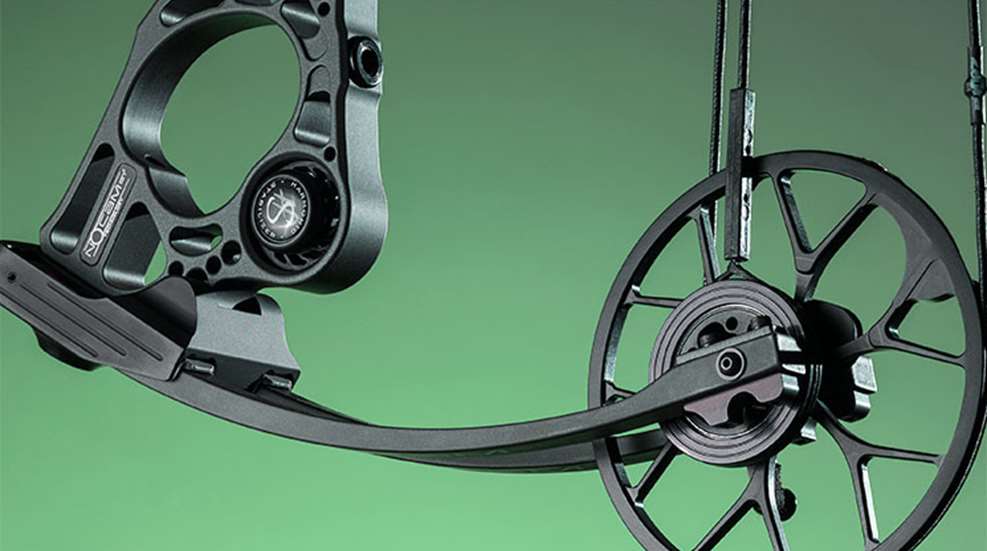
Befitting its name, the No Cam utilizes two large wheels 4.28 inches in diameter to deliver the powerstroke. Because both are perfectly round and rotate on axles in their exact centers, they exhibit three traits. First, their rotation is concentric. Second, their rotation is always synchronized. Finally, the string remains at the same radius from the center of the wheels’ rotation during the entire stroke. These things mitigate timing issues and therefore vertical nock travel. Because the string remains in one channel, or track, cam lean is also minimized. Simple, right? Wrong.
If the bow used only these two round, concentrically mounted wheels, it wouldn’t afford the mechanical advantage necessary to flex and load the limbs—resulting in power—or to achieve let-off. The No Cam’s secret is its two smaller AVS (Advanced Vectoring System) wheels that are pinned alongside the large main wheels but in a non-concentric manner. They provide camming action to power the bow and are responsible for the draw-force curve the shooter feels. These wheels are slaved to a let-off module that also rotates, rather than to the limbs, so they stay synchronized. The shooter can choose 65, 75 or 85 percent let-off “RockMods.” Just know that the higher the let-off, the slower the speed. My test unit came with 85 percent let-off and a brace height of 65/8 inches.
The HTR features a slew of typical Mathews technology that enhances the bow’s effectiveness, such as a Geo Grid machined aluminum riser, two Harmonic Stabilizer riser inserts, Roller Guard, string stop, Monkey Tails to damper the string and cable, finish options and other whistles. The story here, though, is the innovative new eccentrics system.
I’ve read multiple reports that say the No Cam is Mathews’ smoothest bow ever. While it is silky smooth in terms of lack of friction, its draw stroke isn’t Mathews’ smoothest. Rather, it’s fairly aggressive and has notable “snap-over” just before entering a short valley. The No Cam is amazingly quiet, though, and inherently accurate.
I was initially skeptical of Mathews’ claims of nock travel elimination, but this is very tough to test scientifically and bow companies don’t reveal proprietary data. So I called Joe Marzullo. Joe is retired from manufacturing and engineering and is named on 37 U.S. patents. His passion is archery and, specifically, pushing the industry by developing his own testing devices. He’s often critical of manufacturers’ claims. “To date,” he said, “the No Cam is the best bow for lateral bow torque and nock travel that I have tested.”
The No Cam is not a speedster. My 60.2-pound, 26.5-inch test bow shot a 376-grain arrow 244.1 fps. (For comparison, last year’s Creed XS from Mathews shot 257.) But I’m a hunter and I’ll take the quietest bow over the speediest any day. I commend Mathews for trying to build the perfect hunting bow as most others push for speed.
I shot 2.1-inch groups at 30 yards with my No Cam—very good for me. The bow was as quiet as bows get. There was little vibration, and it was fun to shoot, especially as I stacked arrows in the bullseye. I love the simple Focus grip and the very firm back wall of the draw. All told, it’s a wonderful hunting and target bow, as it should be for $1,100.
Will other companies follow suit, or at least push the archery envelope to keep pace with Mathews? We’ll see. For now, the No Cam is convincing hunters because it’s quiet, easy to tune and, most importantly, supremely accurate. After all the hype, accuracy is what puts venison in the freezer and bucks on the wall.
Type: compound bow
Riser: machined aluminum Geo Grid
Limbs: parallel split
Let-Off: 65%, 75%, 85% (tested)
String and Cable: Zebra Trophy X
Grip: Focus Grip
Dimensions: axle-to-axle length 32"; weight 4.3 lbs. with two Harmonic Stabilizers
Brace Height: 6 5/8"
Draw Lengths: 24"-30" in .5" increments (26.5" tested)
Draw Weights: 50, 60 (tested), 70 lbs.
IBO Speed Rating: 330 fps (65% let-off)
Finish Options: Black Anthem, Tactical, Stone Tactical, Lost Camo, Lost Camo OT
MSRP: $1,099