One of the best parts of being hunters and shooters is getting to share our passion. For years we have been dissed by many in the mainstream, but during the past decade or so hunting and shooting have enjoyed something of a renaissance. No longer do we have to hide what and who we are. Perhaps because of that falsely based stigma, we have become a more friendly and inclusive group, eager to show newcomers and returning sportsmen the ropes of modern hunting and shooting. One group of folks who we take a lot of pleasure in including are those with physical disabilities. While it can be challenging to get them into the field, the rewards of success make those challenges well worth engaging.
So what does it take to help someone with a physical disability have an enjoyable day in the field? Heath Gunns, a former police officer and firearms trainer from Washington, now works as an outreach manager for the Honored American Veterans Afield (HAVA) and arranges hunts for wounded veterans all over the country.
“It comes down to having a frank interview with the hunter or shooter in order to understand his or her individual capabilities and restrictions,” Heath said. “People who have not been around disabled people are often intimidated by them. They are uncomfortable trying to talk to them about their physical limitations and needs. You need to get over that in order to get enough info to have a good hunt.”
Randy Routier, of Buffalo, S.D., agreed that a thorough interview is critical to accommodating any special needs. Randy has a particularly unique perspective. He grew up on a ranch hunting, shooting and cowboying. A crack shot with a keen game eye, Randy suffered a broken neck during a saddle bronc riding clinic and has been a quadriplegic for several years. He now operates an outfitting business from his family’s ranch, so he intimately knows both sides of the challenge.
“The three biggest questions usually have to do with transportation—not only in the field, but to and from the field—terrain restrictions and shooting ability,” said Randy. “Since I am operating with disabilities, I can usually get through an interview with a disabled client quickly and accurately.”
Even those whose disabilities seem identical may have completely different needs or restrictions. Heath sees the full gambit, from guys who can do just about anything, to others that require their own full-time caretaker. His police officer background means he isn’t shy about getting down to nitty-gritty specifics.
“Some quads have to take drugs in order to go to the bathroom. That means at a certain time each day they need to go, and there’s no if, ands or buts,” he said. “It also means that they may have some special privacy needs because it takes more time for them to go.”
In urban areas handicap facilities have become the norm, but out in the country it isn’t always so. Access, bath and toilet facilities are the primary challenges. Make sure you understand exactly what your disabled hunter or shooter requires. Randy also mentioned that some disabled folks need a softer mattress than normal to prevent bed sores.
“I always like to know what kinds of temperatures a client can tolerate,” said Randy. “It gets cold up here, and sometimes we have to have some auxiliary heat for the blind.” And when it comes to blinds Randy added, “Make sure the windows are low enough and big enough to handle a wheelchair hunter.”
When it comes right down to it, facilitating a hunt for a disabled hunter isn’t all that different than facilitating for someone without apparent difficulties. Ask the right questions to gather their needs and simply make it happen. Is it worth it? Just take a look at someone’s face right after his or her first shot on game.
Action Trackchair
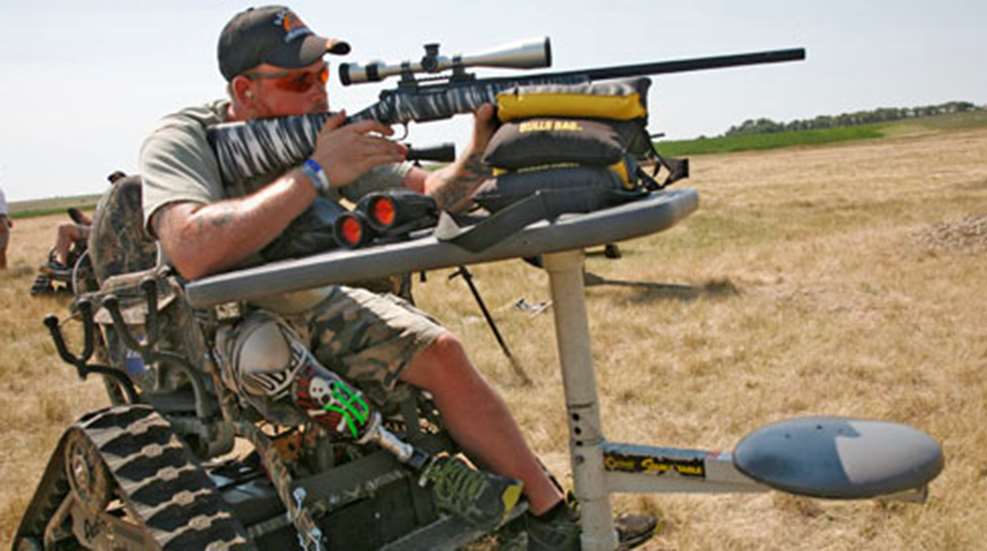
At one time mobility-impaired hunters had to depend on the good graces of family and friends in order to get around in the field. But Action Manufacturing now has an all-terrain chair that provides safety and independence for these hunters. The Trackchair propels the user via a pair of 6.5 x 90-inch rubber tracks instead of wheels. A pair of 12-volt wheelchair batteries and a 24-volt, high-torque DC motor allows the Trackchair to cover ground in some pretty rough country. I know this because I had an opportunity to play with a couple of these chairs recently on a prairie dog shoot with a wounded vet.
We climbed hills pocked with prairie dog mounds, ran them through the mud, deliberately got one stuck just to see how hard it would be to extract the 350-pound unit and generally gave them a pretty good workout. And, of course, being guys, we raced them. The chair is run via a joystick and has five speeds. Because of the tracks, it has a zero turning radius. Battery life is excellent, and a full charge should last nearly all day, depending on the outside temperature.