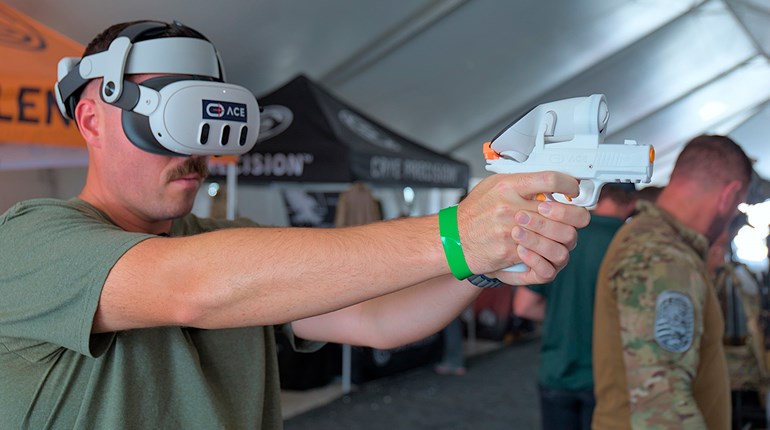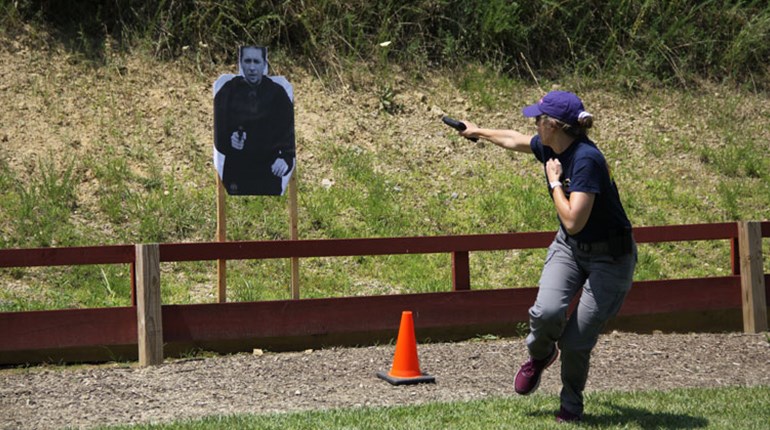
Training can be boring—and often is. Whether you are a TO responsible for getting a group to a certain level of expertise, or you are an individual working toward sharpening your skills, if the training bores you, it isn’t going to be effective. Training for professional operators and enthusiasts now often includes integrating physical fitness training with shooting.
One of the best training aids is a training partner or partners. A training partner offers some built-in competition, another source of twists to the training regimen, help in setting up and tearing down targets and a source of analytical criticism when problems arise or one of you plateaus.
Another training aid—one that is an absolute must if you have to train alone—is a shot timer. Like a lot of things in life, I found this to be true years later than I should have. But in order to improve your shooting skills—be it tactical or field shooting—you need to put some pressure on yourself. Without the built-in competition factor of a shooting partner, the only way you can get that improvement stimulus is to shoot against a clock. I confess that I do not train as much as I used to, or should, even today. But unless the shooting is for testing and evaluating a gun or load, or I am in the field, I always have my PACT shot timer with me. Like paper, which records each shot permanently and without excuse, a shot timer will undoubtedly depress you with its readings. However, using it as a stimulus to better one’s self by continuously trying to improve your time in a particular drill will help take you to the next level of shooting competency.
One thing I like to do is to take about a half-hour walk in the desert. I am fortunate to have several thousand acres of BLM land within a mile of my place. Normally, I’ll have a handgun of one sort or another on my belt and a pocket full of cartridges or spare magazines. It’s a simple matter to draw and shoot clumps of grass or other safe targets of opportunity. Even better is when I can find a field with ground squirrels or prairie dogs. Take each shot as it is offered—timing, range, still or moving—it’s all real life. And it’s far more difficult that it sounds.
Too often we train to a specific scenario or drill, and once we achieve what is considered success by others we often plateau. That means in reality that we decay, because shooting is not a static skill. Shooting is a dynamic skill, which means it is affected by lighting, weather, what you are wearing, what you had for a meal prior to shooting and a cornucopia of other factors both subtle and not so subtle. An example: Say you have honed your skills so that you can consistently hit the 8-inch center of an IDPA target from the holster in less than two seconds at 7 yards. Great! Congratulations! But supposed you are confronted by a bad guy wearing some form of body armor? Eight inches is useless here. You must seek and shoot at much smaller targets in order to curtail the threat. It may be a one-inch seam in the armor, the threat’s face, its hands or lower extremities, and it is likely moving. See how fast you can put a bullet to within one inch of a called mark. Work on improving that time and train under various light conditions, weather and any other distractions that come to mind.
And yup, training is always expensive, both in time and ammo—and sometimes targets as well. And, yes, it can become boring and repetitive. But it is the only way we can improve our skills and allow us to be prepared for what may come.