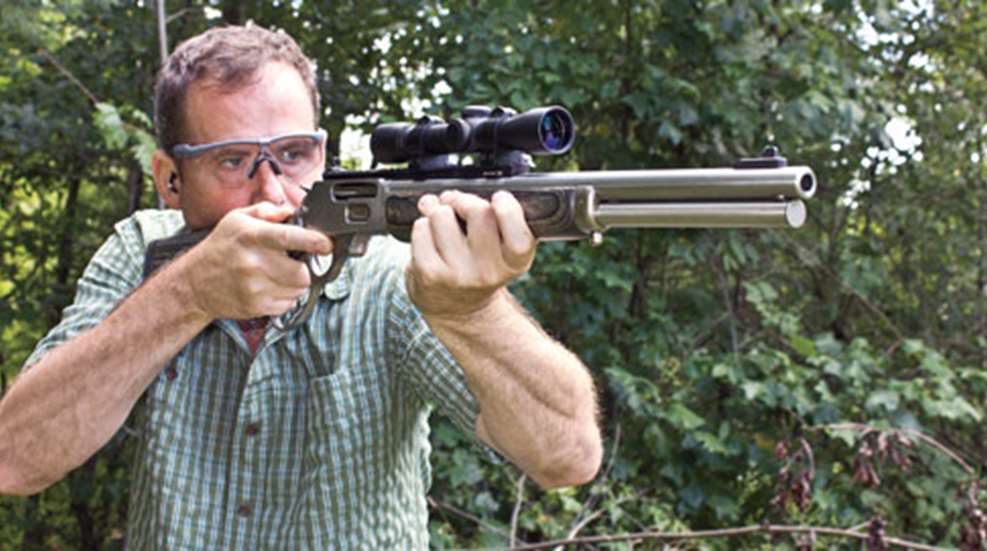
Weaver’s new K-Series Scout scope embodies most of what a scout scope should be: It’s compact, lightweight and has generous eye relief. It also has something you would not expect from a scout scope—4X magnification.
You may not know it but in April 2008, ATK acquired Weaver Optics from Meade Instruments, reuniting it with the Weaver scope ring and base division. Since then ATK has taken a genuine interest in the Weaver product line. This has led to the introduction of some very good and sometimes task-specific optics. In short, ATK is reestablishing Weaver as a pioneering and reliable riflescope manufacturer.
The scout scope is one of the most misunderstood rifle sighting concepts. Essentially, it is a riflescope that has extended eye relief—eye relief long enough to permit the scope to be mounted forward of the rifle’s action. Historically, scout scopes had low or no magnification. This permitted fast target acquisition because the shooter could keep both eyes open and, in a sense, succumb to the rifle’s natural point of aim. For all practical purposes, the scout scope was an optical version of open sights. The downside of the scout scope was lack of magnification.
Riflescopes must conform to the mathematical rules of the optical triangle that balances eye relief, field of view and magnification. Increase one of these elements and at least one of the others must suffer. The thing is, if you’re working with a scope with no magnification and shooting with both eyes open, field of view is almost a non-issue.
Weaver’s new Scout Scope introduces additional magnification into the mix. Since it is indeed a scout scope, eye relief could not be sacrificed so field of view had to be. At 100 yards field of view is a mere 8.5 feet. As a comparison, a standard Weaver K4 has field of view three times as wide. This means to see your target through the Weaver Scout Scope quickly, you’ll need to be at one with your natural point of aim, and it helps to keep both eyes open.
The Weaver Scout scope is built similarly to the other riflescopes from Weaver, like the aluminum tube version of their famous K4, which has a reputation for ruggedness and serviceability. The Weaver Scout scope sports a one-piece, aircraft grade, aluminum 1-inch tube, fully coated optics and a Weaver, Dual X reticle.
Before you spend your money on a riflescope there are some things you want to know. Is it waterproof? Will it hold zero? Are the adjustments consistent and do they provide the stated amount of correction? And, does it provide a clean, crisp image.
To see how the Weaver Scout scope performed, I first submerged it in my hot tub. After one minute in 104-degree water the scope showed no signs of leaking or fogging. I then mounted it to a Marlin 1895 SBL in .45-70 and zeroed the combination at 50 yards. The adjustments are supposed to equal 1/4 inch at 100 yards, which translates to 1/8 inch at 50 yards. The first bullet struck the target 7 inches low and a tad over 2 inches to the right. Moving the point of impact 56 clicks up and 17 clicks left put the next bullet within a half-inch of my point of aim.
Then, using the True Blue target I designed for Thompson Target, I “boxed” the scope. This target is made up of four, 6-inch circles; two on the top and two on the bottom. The center of each is 7.5 inches above/below or to the right/left of the others. At 100 yards 7.5 inches translates to 30, ¼-inch click adjustments. At 50 yards it takes twice as many clicks.
Why did I test the scope at 50 yards? Because that’s where the scope is set parallax free. Parallax is important because at the distance where a scope is parallax free, it will not matter if your eye is perfectly aligned with the scope. If you’re shooting at a distance where the scope is not parallax free you can move your head and watch the reticle move on the target. Using Federal’s 300-grain Fusion load—about the most powerful factory .45-70 load available—I fired and adjusted the reticle after each shot. The point of impact was within an inch of the center of each circle and the fifth shot cut the first shot fired at the first circle. The adjustments on the Weaver Scout Scope are accurate and repeatable.
Ideally, this rifle would need a butt-cuff of some sort to raise the check weld to the point that the eye lines up comfortably behind the scope. Regardless, the scope offered a crisp and bright image comparable to other scopes in its price range and some that are more expensive.
As for the reticle, the distance between the intersection of the vertical and horizontal cross wires and the point on the bottom vertical wire where it tapers from thick to thin equals 16 inches at 200 yards. With my .45-70 zeroed at 100 yards I can use the taper point on the bottom cross wire as an aiming point at 200 yards. If I zero at 200 yards, it becomes my 300-yard aiming point. The space between the traditional aiming point and the taper point is also a good reference to use when judging range.
I like this scope. It performed well. Granted, the limited field of view makes it all that much more important to mount the scope so you can see through it with a good cheek weld on the rifle. And, it’s not as fast to get on target as a scout scope with 1X or 1.5X magnification. However, the extra magnification gives you the ability to see your target better and may help you sort a deer out of the tangle. I was disappointed that the parallax was set at 50 yards. This made shooting tiny groups at ranges past 100 yards tough. It was still easy to keep shots inside the kill zone of any big game.
In my opinion this optic is best suited for a rifle like the Marlin model 1895 SBL, which comes with an XS Lever Rail. Its 4X magnification might be less than ideal for a true scout rifle but as a hunting sight, on a fast-handling lever gun, it has merit. And—if you can mount this scope far enough forward on your turkey gun—with its huge eye relief you’d be in no danger of “scope eye” from the stiffest recoiling 3 1/2-inch magnums, and 4x would be ideal for a turkey’s beak at 50 yards.
Type: Fixed 4X
Magnification: 4 X
Objective Lens Diameter: 28 mm
Eye Relief: 9.45"
Exit Pupil: 7 mm
Field of View @ 100 yards: 8.5’
Adjustment Range: 72" @ 100 yards
Coatings: Fully multi-coated
Length: 9.17"
Weight: 7 ozs.
Construction: aluminum, one-piece tube
MSRP: $265.49