Contrary to popular belief among the mainstream media and some non-gun people, gunpowder does not explode. It burns. As it burns it releases energy in the forms of heat and expanding gases. These expanding gases are what propel the bullet from the barrel. A graph that tracks this pressure curve looks like a very steep mountain as the pressure rapidly rises and falls. Hornady Superformance ammo uses specially developed powder that helps control the rate of burn.
Hornady powder engineers knew that if they could make the pressure rise slower, stay at or near the peak longer and then drop off slower, they could increase velocity without increasing the peak pressure. The resulting pressure graph looks more like an old, eroded and rounded-off mountain—just as high, but with slopes that are not as steep. While the peak pressure is the same as the sharp mountain graph, the average amount of pressure applied to the bullet from chamber to barrel exit would be higher.
To understand this better, let’s use your car as an analogy. Put it in gear, then push the gas pedal rapidly to the floor and quickly release it. This is how conventional powders apply “power” to the bullet. Note the peak speed you attained. Now, again from a stop, push the pedal to the floor, but do it slower, taking twice as long to hit the floor. Hold it for a few seconds then slowly release the pressure. Take just about twice as long to complete the cycle as you did the first time. You will find your peak speed is higher, even though both times you “floored” the gas. Think of this new powder technology as simply having a bit more control over how the gas pedal is pushed in a rifle.
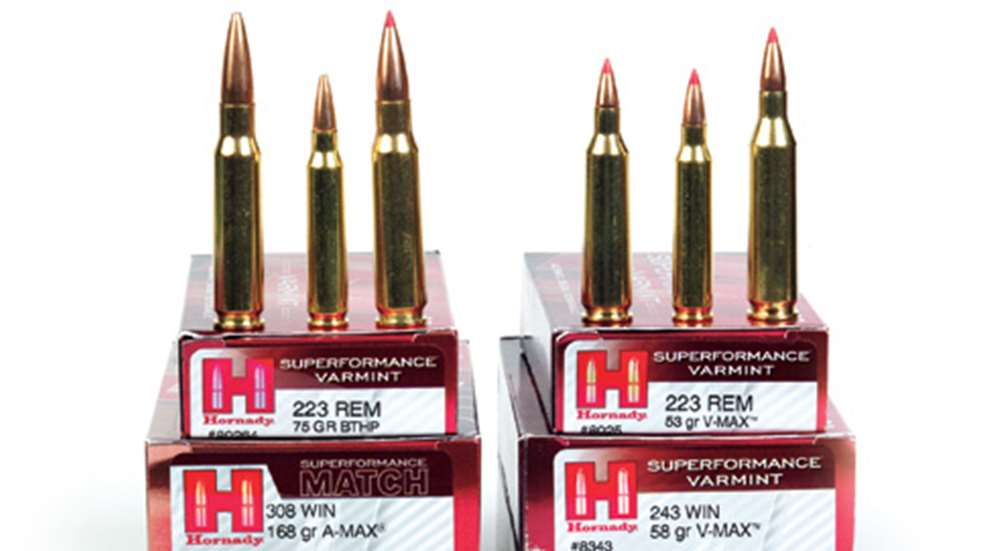
I reviewed Hornady Superformance hunting ammo in the April 2010 issue (“Hardware”). I was pleasantly surprised to learn via testing that it pretty much lived up to its claims with increased velocity and very good accuracy. As expected, the technology has trickled down to other types of rifle cartridges. The newest developments in the Superformace line are Superformance Varmint and Superformance Match. I’ll focus on the Varmint line here.
With predator hunting, velocity is king. Of course you need the right bullet and good shot placement, but in general, the faster the bullet, the fewer problems with small game like coyotes or groundhogs getting up and running away after being hit. The Hornady V-Max has always been one of the best varmint bullets around. Pushing it faster only makes it better.
Added velocity is also good for shooting prairie dogs. The faster the bullet gets to the target the less it drops and the less time the wind has to act on it. One side benefit of this new powder technology is that you gain the added velocity without more barrel erosion. Hornady claims its tests show lower pressures and temperatures, which equates to longer barrel life. This is extremely difficult for a non-manufacturer like me to test, so I’ll take Hornady’s word for it. But from what I know it is absolutely plausible, and that’s good news for high-volume prairie dog shooters.
The initial Superformance Varmint offerings are as follows:
The .222 Rem. load uses a 50-grain V-Max bullet. Hornady’s advertised muzzle velocity is 3345 fps. Hornady lists its standard velocity load as 3110 fps. Net gain: 235 fps. I did not test this load so I can’t comment on “real world” hunting rifle velocity.
The .223 Rem. ammo uses a new 53-grain bullet at 3465 fps. Hornady says the standard velocity for this bullet is 3240. (Net gain: 225 fps.) My test with a DPMS AR-15 with a 24-inch barrel averaged 3397 fps. The ammo averaged .766 inch for three, three-shot, 100 yard groups, making it one of the more accurate factory loads I have tested in this rifle.
The stats for the .22-250 are 4000 fps and 3800 fps—a gain of 200 fps with the Superformance. My velocity with a 26-inch barrel on my Weatherby was 3924 fps. In my rifle the groups averaged 1.17 inches—decent accuracy, but not up to what this rifle is capable of shooting. Every rifle is an individual and while this one doesn’t dislike the ammo, it’s not in love with it either.
The Superformance .243 Win. ammo is loaded with a 58-grain V-Max. Hornady claims 3945 fps and says the standard is 3750, so it’s a gain of 195 fps. However, I got 3666 fps from a Remington 700 with a 22-inch barrel and 3334 fps from a DPMS rifle with an 18-inch barrel. Even considering the shorter barrels, this is lower velocity than I expected. I would not expect a 279 fps drop in a standard 22-inch barrel, and frankly, the loss of 611 fps in the short barrel is excessive. The chronograph doesn’t lie, so I’m not sure what happened with this loading. Perhaps Hornady just got one wrong. I might forgive that, though, after seeing the accuracy results. The Model 700 .243 averaged .83 inch. That’s about as good as this gun can shoot, even with handloads. (In last year’s test of Superformance Hunting, the 95-grain SST load averaged .82 inch from this same rifle and produced 2975 fps.) From the DPMS rifle the Superformance ammo averaged exactly one-half inch. This is the first time I shot the new rifle, so I don’t have a baseline, but obviously that is outstanding accuracy.
In summary, over the course of two extensive testing sessions Hornady Superformance ammo has always shown a velocity gain over conventional ammo, and it has never shot poorly in any gun tested. Often it is one of the most accurate factory loads ever tested in the rifle. I would say that’s a remarkable track record.