For several years now, many cutting-edge shooters have been carrying a daypack full of devices to help them click the adjustments of their riflescopes to compensate for range and angle. As soon as optics companies started putting laser rangefinders inside scopes, however, the reign of the “ballistic daypack” was doomed because all that stuff would inevitably be part of the scope.
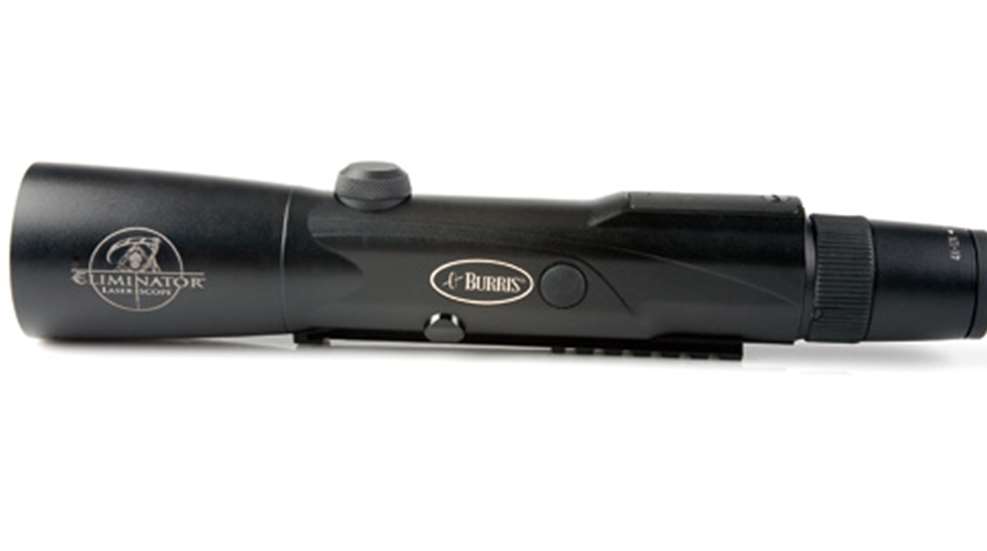
Burris has taken a big step in that direction with its Eliminator LaserScope. On the outside this appears to be the same LaserScope Burris introduced a few years ago, but the Eliminator doesn’t just indicate range. Instead, when the laser indicates the range, one of a series of electronic dots on the scope’s vertical crosshair light up. Place the lighted dot on whatever target you want to hit, press the trigger and that’s where the bullet will land, at any range out to 500 yards. (Well, as long as you hold the rifle steady and press the trigger correctly. That part of shooting a rifle hasn’t quite been computerized yet.)
That’s not all. When the Eliminator is aimed uphill or downhill, the laser/computer connection also automatically compensates for the angle of the shot. No more computing cosines when hunting the hills!
The Burris Eliminator is a 4x-12x-42mm variable, and its listed weight is 26 ounces, including the integral mount, designed to fit a Picatinny/Weaver base. That’s heavy compared to a standard 3x-10x scope, but it’s similar to many of the “tactical” scopes that shooters are clicking up and down these days, especially since the mount is part of the Eliminator’s weight.
The scope was mounted on a Remington 788 with a 24-inch, stainless E.R. Shaw barrel in .223 Remington, because it seemed logical that many Eliminators might be put on varmint rifles.
The big problem with a daypack full of electronics is speed in the field, especially when hunting predators like coyotes. The main virtue of the Eliminator is almost instantly combining all the steps of laser rangefinding, computer punching and scope adjustment.
Before heading to the range a specific load had to be picked and its ballistic data put into the scope. Hundreds of rounds of an accurate handload using the 50-grain Nosler Ballistic Tip and Ramshot TAC powder were already on hand, so the bullet’s ballistic coefficient and muzzle velocity were programmed into the scope, along with the planned zero of 200 yards. This programming would have been accomplished quicker with the help of an 8th grader, but still only took me 10 minutes or so—a second attempt would go much quicker.
The first field test took place on a fairly level piece of ground, on a day right after a few inches of snowfall. I shot at various sticks and small rocks poking out of the snow. The light recoil of the .223 showed right where the bullet landed, thanks in large part to the snow. It was a calm day and every shot landed very close to where it was aimed with the lighted dot on the scope’s reticle. The listed maximum range of 500 yards was exceeded with one shot of almost 600 yards, and the bullet still landed where aimed. Any of the shots would have hit a coyote’s chest.
The Eliminator’s laser rangefinder is factory-rated at 800 yards on reflective targets, and 550 yards on deer. There weren’t any deer handy, but it checked out close to those numbers on similar targets, whether a snow-covered hillside or a deer-sized sagebrush.
The next range session took place in the foothills of the mountains above the valley. There was still a little snow left in places, but a couple of cardboard boxes were also set up as targets. This shooting took place at angles of up to 40 degrees uphill, also out to around 500 yards, off Bog-Pod shooting sticks while sitting down. Once again, every shot struck very close to the aiming point, even at the steepest angles out to 500 yards. My conclusion was that the electronic reticle of the Eliminator works as advertised.
I next subjected the scope to several standard riflescope tests. Shooting the square resulted in four groups averaging under an inch at 100 yards, and the listed .25-inch clicks checked out perfectly. This may seem irrelevant in a scope that isn’t going to be clicked up and down, but sure, accurate adjustments tend to result in scopes that stay sighted-in even during hard field use.
A check of the listed 3-3.5-inch eye relief, using a flashlight shining in the objective lens, resulted in a measurement of 2.8 inches throughout the magnification range. This is a little shorter than the specifications, but eye relief is more flexible than the test indicates. The eye relief might be a little short when shooting a .300 Weatherby Magnum, though it should be noted that this was a pre-production scope.
Dunking the scope in 100-degree water with the turret caps off showed no leaks. It also was nice and clear after spending a night in a freezer amid pronghorn and elk steaks. Not many scopes fail these tests anymore, but it’s always good to know a scope is weatherproof before taking it into the field.
The optics test came last. This was done at night on a simple optics chart, with 10 alternating black-and-white lines that start out 1 inch thick at the top of the chart, ending up 1⁄16 inch wide at the bottom. This chart is lit by a 100-watt bulb placed 25 yards away, and the test is made with a scope set on 6x. (It might seem to make more sense to test a scope at a longer distance, but then atmosphere essentially becomes another lens; this is the reason optics manufacturers also do their testing at short ranges.) The test checks both brightness and resolution, though not color rendition, because individual human eyes perceive color differently.
A scope is rated by the smallest line that can be seen while the scope is on a steady rest. Below a certain point the chart appears gray, like a zebra in the distance. The Eliminator rated a 6, as it picked up the ¼-inch line on the chart. This is where most variable scopes with multi-coated lenses rate these days, and is very good for a scope that includes extra optical layers such as an electronic reticle.
The Eliminator is a major advance in hunting scopes. Hopefully there will be others of various sizes in the future.
Specs:
970-356-1670, www.burrisoptics.com
Type: 4x-12x-42mm laser riflescope
Finish: matte black
Field of View @ 100 yds: 25’ @ 4X; 9’ @ 12X
Advertised Eye Relief: Advertised: 3.0-3.5”; Actual: 2.8”
Click Value @ 100 yds: .25”
Windage and Elevation Adjustment Range @ 100 yds: 50”
Reticle: illuminated dots on plex-type reticle
Length: 13”
Weight: 26 ozs.
Suggested Retail Price: $1,298