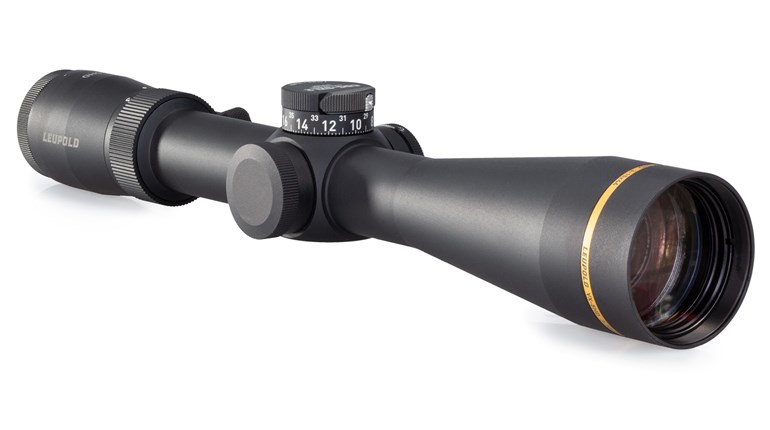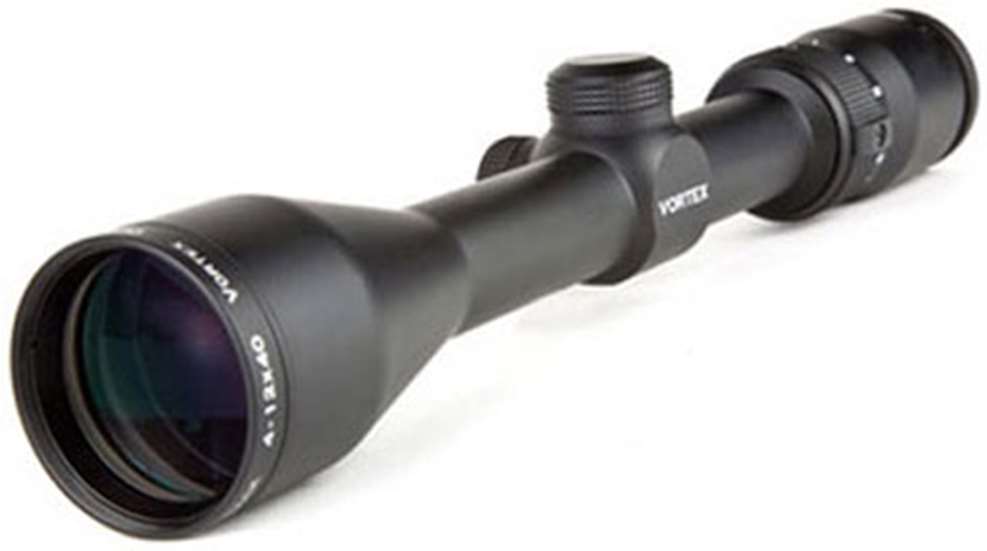
The Vortex Diamondback is surprising because it's surprisingly good, surprisingly priced and most of us have never heard of it. Vortex? This Madison, Wisc., company began selling binoculars to birders in the mid 1980s, then expanded to a catalog retailer and wholesaler as Eagle Optics. After listening to customers, it designed its own value-priced binoculars and had them assembled overseas. The units were such a hit that in 2000 the firm decided to put the Vortex spin on a full line of sophisticated optics designed here and built to specification in the Pacific Rim.
This isn't the first "newcomer" to the optics field. Over the years many new companies have introduced a variety of bargain-basement riflescopes, most of which should never have left the basement. Not this time. If the 4X-12X-40mm Diamondback I tested represents Vortex quality, performance and price-to-value ratio, it's the poster child for reasonably priced hunting scopes.
The Diamondback line features:
Fully multi-coated optics- All air-to-glass surfaces have multiple anti-reflection coatings, which in turn means minimum reflection loss, minimum flare, maximum brightness and maximum contrast. Give it an "A." The only reason I don't award "A+" is because I don't know how many layers have been applied and which wavelengths of the visible spectrum they most enhance. Two independent observers and I noted that the Diamondback transmitted a slightly brighter and higher resolution image than a famous-name scope costing twice as much. These were subjective tests, but unanimous. The Vortex gave the better overall image.
One-Piece main tube- The 1-inch tube is carved from a one-piece tube of 6061 T6 aircraft-grade aluminum. This means there are no joints at the turrets, so there is no chance of leakage and less chance of bending. I didn't pound tent stakes or subject the scope to any other torture tests, figuring an arbitrary beating without standards proves little. If a scope will handle repeated recoil from high-energy centerfire rifles, the knocks it takes from general field use shouldn't pose a problem.
Argon-purged, waterproof and fogproof- Like every scope I've ever tested, this one fogged on an internal ocular lens (appeared to be the second eyepiece lens in) after being taken from the freezer into a 75-degree room.
The fogging covered about 50 percent of the center of the lens and cleared completely four minutes after exiting the freezer. No internal moisture or spotting was subsequently noted. After complete submersion for 15 minutes, the Vortex emerged refreshed and internally dry. No bubble streams rose from the instrument, not even while the power ring and eyepiece focus ring were turned. The lens caps were not removed during submersion. What wasn't evident but may prove significant over the long haul was the internal argon gas. Most scopes are moisture-purged with nitrogen gas. Argon gas molecules are significantly larger than nitrogen, thus less likely to leak from tiny cracks in the seals as the scope ages. In addition, argon gas reportedly maintains its protective properties over a wider range of temperatures than does nitrogen gas. Only time will tell, but this sounds good to me.
Zero-reset dials- For most of us, the ability to reset windage and elevation dials to zero after sighting in is no big whoopee, but some shooters like to crank in adjustments to match specific loads or even to aim dead-on at extended ranges. Thus, if a your rifle/load is sighted to point of aim at 200 yards, turn the slotted center screw to loosen the dial, reset it to zero, tighten the screw, then turn the dial to whatever number matches bullet impact at your next chosen distance. The adjustments were smooth, precise and repeatable as proven when I "shot the square." I mounted the Vortex to a Jarrett Beanfield rifle in 7mm-08 Rem., which consistently shoots handloads .5 MOA. After the initial three-shot group I adjusted the crosshairs 16 clicks down, right, up and left in sequence, firing three-shot groups at each new setting. Those groups centered within a quarter inch of where they were supposed to and the final shot landed smack in the middle of the first group fired. Another "A" grade.
VIP warranty- Vortex pledges to repair or replace defective scopes at no charge, no matter the cause of the problem. And they do it in Wisconsin with a seven-day average turn around. Whoa. That's a pretty generous guarantee, suggesting they have considerable faith in both their product and their customers.
I'll confess a bias against "no-name" optics companies, but my review of this Diamondback kicked that bias. This is no dime store gimmick, but a high-quality, solid performer that looks and feels as solid as it works. I detected no parallax at 100 yards, observed no distracting optical aberrations, discovered no mechanical hitches. In short, I'd take this scope hunting anywhere, anytime, no reservations.
Type: variable-magnification riflescope
Main Tube: 1-inch, one-piece
Materials: aluminum alloy
Magnification: 4X-12X
Objective Lens: 40mm
Reticle: Dead-Hold BDC
Dimensions: length-11.9"; width-14.6 ozs.
Eye Relief: 3.4 to 3.1mm
Exit Pupil: 10mm @ 4X, 3.3mm @ 12X
Field of View @ 100 yards: 32.4' @ 4X, 11.3' @ 12X
Adjustments: .25" per click, hand-adjustable
Coatings: fully multi-coated
Finish: anodized satin (matte) black
Accessories: lens covers
MSRP: $259