Tools are crafted specific tasks. Sure, some can be repurposed, but they’re not as effective in their unplanned roles as they are for their intended uses. Need proof? Consider this: a sledgehammer can be used to drive roofing nails and a roofing hammer employed to pound a fencepost, but neither scenario is ideal—actually far from it. In one instance, you’ll assuredly smash your fingers in short order, while in the other you’ll be hammering away for eternity. A similar situation is found in shotgunning; the 12 gauge is cast into roles for which other gauges—10, 16, 20, and 28, as well as .410 bore—are just as effective and better suited. This is especially true of the 10 gauge.
The long-range specialist lost some of its luster in 1988, when Mossberg and Federal Cartridge Co. jointly unveiled the 3½-inch 12 gauge. With a higher-pressure ceiling (14,000-p.s.i. maximum average pressure, or MAP, versus the 3-inch 12 gauge’s 11,500-p.s.i. MAP) and additional space for components (i.e. larger shot charges, bulkier propellants, and newer wad designs), outwardly the 3½-inch 12 gauge looked to displace (if not replace) the elder 10 gauge. Appearances can be deceiver, though. Size matters.
According to Ballistic Products, Inc. (BPI), the shotgun specialists, “In all larger bores more shot may be placed in a load and driven with higher speed. Large pellets may also be used without incurring pattern density or consistency reductions. The reason for this phenomenon is that a greater number of pellets and/or pellets of a larger size work their way through the constricted area of a choke at the same time.” As the 10 gauge was designed for long-range waterfowling, the ability to use (and reliably pattern) large shot is an important asset.
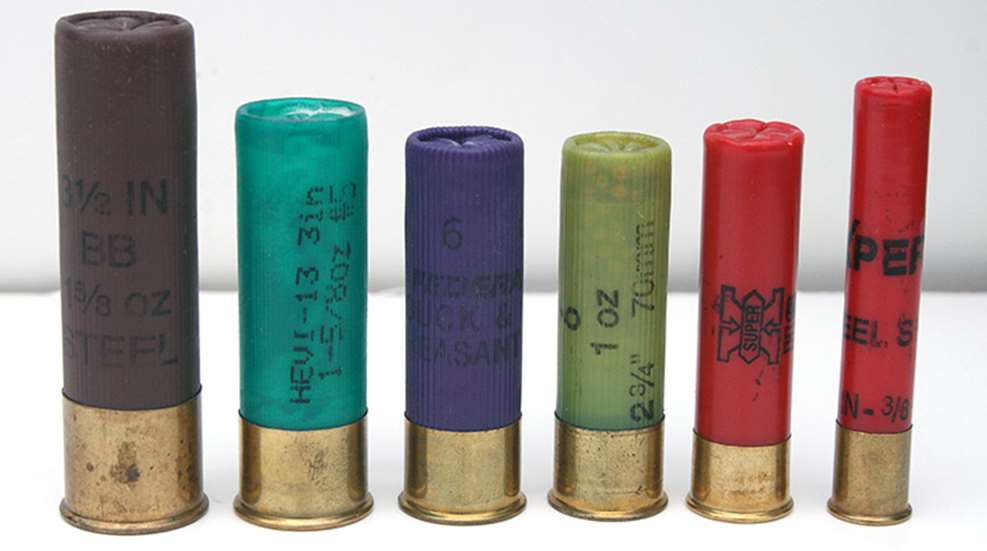
With a nominal 0.775”-bore diameter (as opposed to the 12 gauge’s 0.729”), the 10 gauge is better able to handle large pellets than is its smaller counterpart. This is particularly important when studying steel shot. Why?
As cited in BPI’s Status of Steel, 16th Ed., “During the firing process every payload of shot must, of course, pass through the area of constriction at the end of the shotgun’s barrel. When the steel pellets are too large for the particular gauge being used, the shot can form into a connecting bridge of pellets—perhaps spanning the width of the bore and beyond.” Bridging of larger sized steel pellets exerts such tremendous pressure that the bridged pellets can force themselves through the shotcup, (any shotcup), and make contact with the barrel and choke.” This results in damage to the aforementioned shotgun parts. For this reason, “T” (0.200”) is the largest steel pellet that should be used in the 12 gauge, while the 10-gauge users should stop at “F” (0.220”).
Concerning steel payloads, the 3½” 12 and 10 gauges top out at the same weight, 1 5/8 ozs., and Fiocchi’s 12-gr., 3½” Golden Goose (GG) loads—the only ones to utilize that shot charge—are slightly faster than the 10-ga. offerings. Whereas the GG loads attain 1,430 f.p.s., Winchester’s Drylok Super Steel and Federal Premium’s Black Cloud rounds reach 1,350 f.p.s. and 1,375 f.p.s., respectively. To be frank, the faster 1½-oz. loads, such as Remington’s HyperSonic Steel and HEVI-Shot’s HEVI-Metal High Speed, which attain 1,500 f.p.s., would be better choices for shooting geese at longer distances. That payload attains the same velocity in the 3½” 12 gauge. As mentioned elsewhere, the 10 gauge will shine with the larger pellets needed to down the big birds at distance. And, although the 3½” 12 gauge (and especially 3” 12 gauge) offer great diversity in factory waterfowl loads, through handloading the 10 gauge can be loaded all the way down to even 7/8-oz. steel loads (at 1,710 f.p.s.). The best loads, though, will be found in the 1¼-oz. to 1½-oz. range. Ten-ga. steel shells are about $5 to $15 more per box than 3½” 12s.
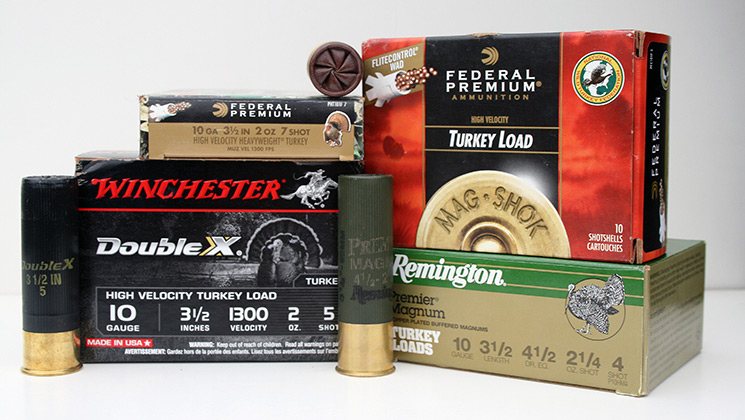
The difference between 10- and 12-ga. payloads is most apparent in turkey ammunition. In the 10 gauge the heaviest factory turkey loads (available from HEVI-Shot) feature an enormous 2 3/8 ozs. of the tungsten-based shot. The 3½” 12 gauge, on the other hand, tops out at 2¼ ozs., and the 3” version has 2 ozs. My favorite turkey 10-ga. load, Federal Premium’s Mag-Shok Turkey loaded with 2 ozs. of No. 7 HEAVYWEIGHT in the Flitecontrol wad, bests the 3½” 12 gauge by 1/8 oz. and 3” by 3/8 oz. Using that load I killed a longbeard this spring well beyond 50 yds. If you’re a handloader and ardent turkey hunter, BPI has recipes to load up to 2½ ozs. of shot. Using magnum lead shot, that’s 565 (No. 6) or 338 (No. 4) pellets. Talk about a tom taker!
What about buckshot? How does 18 copper-plated-lead 00 buck pellets at 1,100 f.p.s. sound? The same pellet count can be found in 3½” 12-ga. loads, but the increased heft of most 10-ga. shotguns will lessen perceived recoil. As for 10-ga. slugs, the pickings are slim; Federal offers a 1¾-oz. foster-type slug in its Power-Shok line.
As for shotguns, I suggest one of the 10-ga. semi-automatics because, between the firearm’s heft and gas operation, recoil is quite tolerable. Currently, Browning manufactures two versions of its Gold Light 10 gauge; both weigh 9 lbs., 9 ozs., have 26” barrels, and retail for $1,739. The company also chambers its pump-action BPS in 10 gauge. Although more affordable—a suggested retail price of $799—and slightly heavier than the Gold Light guns, the lack of gas operation results in increased perceived recoil.
Some excellent guns can be found on the used market, too. I’ve seen Remington’s no-longer-manufactured SP-10 selling for less than $900, and Ithaca’s Mag-10 generally are less costly yet. I would recommend avoiding single-shot shotguns in 10 gauge, such as those from Harrington & Richardson, as they’re too lightweight for the gauge. As can be expected, recoil will be fierce. Similarly, I’d shy away from the older side-by-sides as they aren’t made to handle the rigors of steel and HEVI-Shot. If the gun is deemed safe by a competent gunsmith, TomBob Outdoors’ lead-free ITX Original-10 shot (available from Ballistic Products, Inc.) can be handloaded and used it.
As a parting thought, here’s what BPI had to say about the 10 gauge, “Just as the 3” 20 gauge is not a direct replacement for the 12 gauge, neither is the 3½” 12 meant to do the 10 gauge’s job. Pass-shooting geese—there is only the 10 gauge. Clean kills are the rule.” Indeed, the 10 gauge is a specialized tool. You should add one to your repertoire of equipment. You won’t regret it.