Shooting Uphill and Down

by
posted on March 31, 2014
** When you buy products through the links on our site, we may earn a commission that supports NRA's mission to protect, preserve and defend the Second Amendment. **
qa_ah2015_fs.jpg (17)

Q: I’m heading to Alaska for a sheep hunt later this year, and I’m told it will be some pretty mountainous country. I’m a flatlander from Mississippi not accustomed to shooting at game at steep angles, and local “experts” have given me four different answers about where to hold. Can you give me the straight answer?

A: Most of us do all our range shooting on the straight and level, with muzzle and target placed at the same elevation. But shooting at mountain-dwelling game such as sheep and goats may require shots to be taken at extreme angles, and these shots require some alteration of the aiming point.

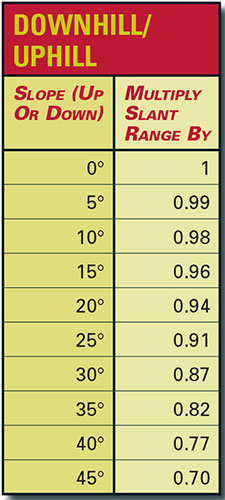
Shooting uphill and downhill is flatter since the force of gravity is applied at less than the usual 90-degree angle to the flight path. On a given slope, the effect is substantially the same in firing uphill or down. To find the horizontal equivalent to a given slant range, the accompanying table can be used for elevations up to 45 degrees. For example, the horizontal range corresponding to a slant range of 300 yards on a 45-degree slope is 210 yards. The rifle should be aimed for 210 yards; if aimed for 300, the bullet may pass over the target.

At small angles, the effect is trifling. At steep angles, however, it can become a major consideration, compounding the difficulty of range estimation and angle determination in mountainous country.

Latest

Ruger American Gen 2 Lede

Top 10 New Hunting Rifles for 2025

As the year draws to its inevitable close, we asked Philip Massaro to select his top 10 favorite rifles that debuted in 2025. Without any further adieu, let’s dive into the list.

The 4 Classic Hunting Platforms

Andi Bogard takes a look at the classic actions and platforms that laid the foundation for today’s hunting rifles.

Conservation Partners Launch Novel Turkey Nesting Research

Predator populations—nest raiders and full-feathered turkey killers alike—are growing across the United States. To determine if their increasing numbers are a leading cause of wild turkey population declines, Turkeys For Tomorrow (TFT) has announced a groundbreaking study on predator impacts on nesting and poult-rearing success.

Muleys The Old Way: Traditional Muzzleloading

Aram von Benedikt and his son took part in one of the oldest American traditions there is: muzzleloading for deer with a traditional smokepole. Read on for more about their adventure.

MSU Deer Lab Celebrates 50 Years

For 50 years the Mississippi State University (MSU) Deer Lab—a partnership between the university’s Forest and Wildlife Research Center (FWRC) and MSU Extension Service in Starkville, Miss.—has delivered nationally recognized research on deer biology, habitat management and land stewardship.

#SundayGunday: Our Top 5 in 2025

Sitting on your couch in an eggnog stupor, wrapping paper still draped off every chair in sight? Still procrastinating getting up, cleaning, up or any sort of behavior that could be remotely described as productive? Here's something to keep you further occupied in your sedentary state. Read on, to check out our Top 5 #SundayGundays of 2025, as selected by you, our audience.

Interests


Get the best of American Hunter delivered to your inbox.