1. The National Bird?
The wild turkey is a fascinating creature, so much so that Benjamin Franklin was of the opinion that it should be named the United States' national bird instead of the bald eagle.
2. Making a Comeback
There are so many wild turkeys today that many young folks do not realize that it was less than a hundred years ago—back in the early 1930s—that the wild turkey was near extinction in America. Lack of quality habitat was the key culprit in the past, but with the passing of the Pittman-Robertson Act in 1937, an excise tax on sporting arms and ammunition, wildlife restoration programs have the money to restore wild turkey population and wild turkey habitat. Coupled with the invention of the rocket net, with which wildlife agencies and the National Wild Turkey Federation can more readily trap and transfer turkey populations to areas of suitable habitat, turkey numbers today have skyrocketed, from only about 30,000 turkeys in the early 1900s to nearly 7 million today.
3. Birds of a Feather
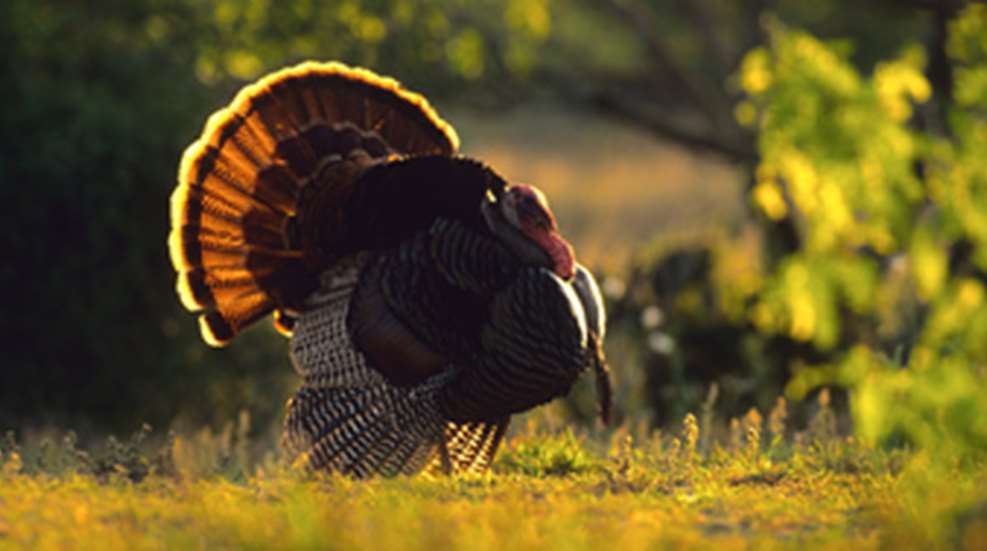
Between 5,000 to 6,000 feathers cover the body of an adult turkey in patterns called feather tracts. A turkey's feathers provide a variety of survival functions—they keep it warm and dry, allow it to fly, and show off for the opposite sex. The head and upper part of the neck are featherless. Most of the feathers exhibit a metallic glittering, called iridescence, with varying colors of red, green, copper, bronze and gold.
4. Spurred On
Only males have spurs. Both sexes have powerful legs covered with scales and are born with a small button spur on the back of the leg. Soon after birth, a male's spur starts growing pointed and curved and can grow to about 2 inches. Most hens' spurs do not grow any longer than they are at birth.
5. Long Beards
Only gobblers have beards for the most part: A gobbler's beard is really tufts of filaments, or modified feathers, growing out from the chest. Jakes have beards of 3 to 4inches in length, while a 2-year-old gobbler has a 7- to 9-inch beard. Older gobblers have beards of 10-plus inches. A mature gobbler will have a beard that is about 9 inches, though they can grow much longer. Only an estimated 10 to 20 percent of hens have beards.
6. Motherhood
Hen turkeys lay a "clutch" of 10 to 12 eggs over a 10 to 14-day period, usually laying one egg per day. Eggs are incubated for about 28 days, and are occasionally turned and rearranged until they are ready to hatch. A newly hatched flock must be ready to leave the nest within 12 to 24 hours to feed.
7. The Species List
According to the National Wild Turkey Federation, of the five wild turkey subspecies in North America, the Eastern is the most common, with an estimated 5.1 to 5.3 million turkeys. Next most common is the Rio Grande (1.25 million); Merriam's (350,000); Osceola (100,000) and Gould's (less than 5,000).