With myriad styles and brands available, choosing a system to mount a scope to your new rifle can be more confusing than actually deciding on a new rifle.
Essentially, there are two categories of scope mounts: fixed and detachable. Detachable mounting systems (including the rings and/or bases) let you swap scopes more easily or use your rifle’s open sights quickly. Fixed mounts are more permanent.
Rings
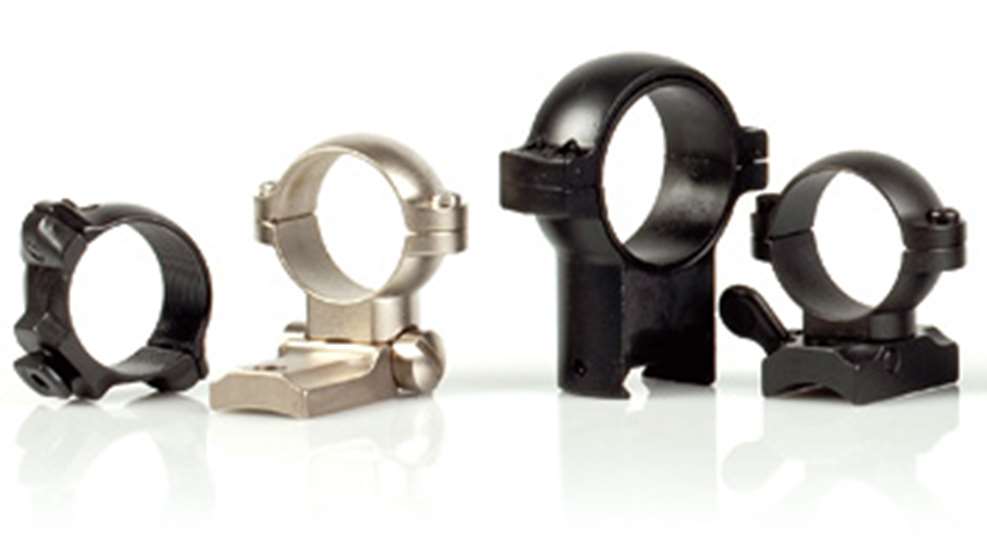
There are also two main styles of rings; some are split vertically while others are split horizontally. With vertically split rings, each ring half engages the base (also called a “rail” if it is in one piece), and this makes the mount stronger. With horizontally split rings, only the bottom ring-half engages the base. As a cost of their strength, however, vertically split rings are slightly more difficult to install. Ring halves are connected with two, four or six screws. More screws provide insurance in case one works loose. Some rings use Allen-head screws, some use slot-head screws and others—perhaps the most desirable due to their ability to resist “boogering”—are Torx-head screws. Rings come in 1-inch, 30mm and 34mm sizes to match scope tube diameters, and in different heights and finishes. All these variables dictate price.
Attachment Methods
Mounting systems are further categorized by the way they attach to your rifle. Some use a dual dovetail design while others use a Weaver-style rail in which the rings clamp onto an angular base; while yet others use a similar Picatinny rail. Additionally, some rifle manufacturers, such as Sako and Ruger, have developed their own proprietary mounts. But I’ll focus on manufacturers that make mounts for the majority of rifles available today.
Materials
Rings are manufactured differently from various materials. Steel, aluminum and high-grade alloy rings are machined; sintered steel and zinc-alloy rings are cast then machined. (Sintered steel is made by heating compressed iron powder and graphite to form a solid.) Solid steel is strongest, which is why some sintered steel rings have solid steel recoil lugs. Aluminum-alloy rings with integral bases rival the strength of steel rings.
Bases
Most mounting systems utilize one- or two-piece bases unless the base is built into the gun’s receiver. Like rings, bases are also machined from steel or aluminum, while others are cast from sintered steel. Some rings have integral bases attached to the bottom ring-half.
Making Sense of Scope Mounts
If you plan on swapping scopes on one rifle, go with detachable rings. Fixed systems have cleaner lines and weigh less. Generally speaking, it is advisable to use stronger rings on rifles with heavy recoil. For example, it’s best to use expensive, machined steel mounts—or at least one with a steel lug—on a .375 H&H, while nearly any inexpensive mount will work for your .22 LR. Alternately, integral aluminum systems with four ring-screws are nearly as rugged. There are too many styles to cover them all, but whatever you choose, take time and care in mounting your scope properly, and use blue Loktite on the screws. Here are some mounts I often use:
-Fixed-Mount Options
Dual-dovetail rings are fixed, horizontally split, steel rings. They’ve been around a long time because they work. A wedge, called a dovetail, on the bottom half of each ring inserts into the base and turns 90 degrees. Some have extensions to work on scopes with limited mounting space. Millett’s nickel-steel, dual-dovetail rings are called Turn-In Rings.
Universal systems use a dovetail front ring but a rear base with opposing screws for windage adjustment. This lets you sight in with the reticle closer to the scope’s center so as to maximize its windage adjustment range. Universal rings from Burris, Leupold, Millett and Weaver are similar and interchangeable. The system is not as strong as dual-dovetail mounts and both require alignment rods for proper mounting to avoid placing great stress on your scope’s tube. Expect to pay between $40 and $80 for rings and bases combined.
-Detachable-Mount Options
Both lever- and screw-lock detachable rings return very close to zero. I use them often. Horizontally split Burris Quick Detach Zee, Leupold QRW and Weaver Grand Slam rings install easily. Burris Zee rings are solid steel with a machined recoil lug. QRW and Grand Slam rings are sintered steel rings (QRWs have a steel lug). Grand Slam and Burris rings use two screws per ring and QRWs have four. All work with Weaver or Picatinny bases. They cost $50 to $75.
Leupold’s steel QR rings are horizontally split, two-screw rings that lock into steel bases via a cam lever. The release lever is on the base, not the ring. QR mounts are strong and return to zero well, which is probably why Nosler chose this system for its custom rifles. The system costs $80, but additional rings are only about $25.
Talley vertically split, Steel Detachable Rings return to zero the best of any I’ve used. The front and rear of the base serve as the recoil lug. Custom rifle builder Charlie Sisk recommends them almost exclusively. Thumb-lever or screw-release models are available in various heights and are made of case-hardened, or stainless, steel. They only work on Talley bases for which Talley also makes a backup peep sight. Good gear is not cheap—expect to pay $90 or more.
Warne vertically split lever and screw-release rings are made from sintered steel. DuraSight is made from Z2 alloy. Both work on Weaver-style bases and both companies make bases too. Warne’s bases are steel and DuraSight’s are alloy. Warne Maxima rings have a real steel recoil lug. The DuraSight lug is cast with the ring. I use both because they’re reliable. With heavy scopes or big-bores I’ll go with Warne. Rings and bases from DuraSight start at $25; you’ll pay $50 for Warne.
Many .22 rifles have 3/8-inch grooved receivers that require a special ring. Weaver’s almost horizontally split aluminum, Quad-Lock rings bite a scope and the grooved receiver like a snapping turtle for around $15. They’re affordable and dependable. Burris offers all-steel, horizontally split rings and Talley has vertically split steel rings, both for 3/8-inch dovetails. The Burris rings are about $30 and the Talley rings cost nearly $50.
As a side note, the Posi-Align insert system is a unique feature of Burris Signature rings, which use in-ring plastic bushings to correct for scope misalignment by as much as 20 inches at 100 yards. They’re great for rifles with alignment problems and even for long-range rifles that need an off-set to maximize scope adjustment range.
-Integral Ring and Base Mounts
Talley’s integral rings were originally designed by Melvin Forbes of Ultra Light Arms for his custom rifles. Talley now makes them for most rifles by machining 7000-series alloy. A set weighs 1.5 ounces. These $45, four-screw rings are vice-like. I use them on half the rifles I own.
DuraSight offers a similar product. The integral design that’s cast from Z2 alloy makes these two-screw, integral mounts strong and affordable at $25.
-Tactical Rings
Tactical rings are mostly for maintaining zero, forever, no matter what. They’re not a bad idea on hunting rifles if big, heavy scopes are used and you don’t mind the extra weight. Talley Tactical rings are machined from 7000-series alloy; whereas Trijicon uses 4140 steel. The Talley rings work only on Picatinny rails. Weaver’s six-screw Tactical rings are aluminum and what I used to mount a heavy 30mm scope to my Sisk custom .308 Winchester. Badger Ordnance makes ultra-tough mounts too. All are crowbar-strong but at $45 Weavers are the most affordable and, like the Trijicon rings, will work on Weaver bases. Expect to pay as much as $100 to $200 for the others.