The model designation for Ruger 77 rifles changed to “Hawkeye” in 2006. This change brought with it the LC6 trigger system and a recontoured stock. The Hawkeye Hunter is the most recent addition to this new line, but before we look at that rifle, you should know where its moniker came from. For many years, the term “Hawkeye” has been bestowed upon hunters who were excellent marksmen—this did not happen by accident.
Between 1823 and 1841, James Fenimore Cooper published a pentalogy of novels that became known as the Leatherstocking Tales. They featured a central figure named Natty Bumppo. You’ve probably never heard of him, but Cooper gave him several nicknames, one of which was “Hawkeye,” a name you may recognize from Daniel Day Lewis’ character in “The Last of the Mohicans.” Hawkeye’s fictional marksmanship abilities were so legendary, they forever established “Hawkeye” as a moniker for a good rifle shot. That’s how Hawkeye became associated with riflemen, and from there, with Ruger’s premier line of bolt-action rifles.
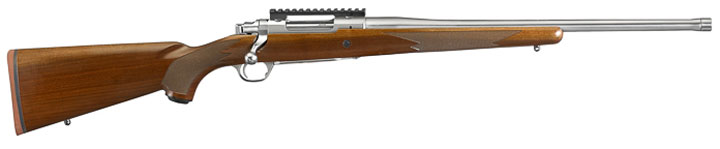
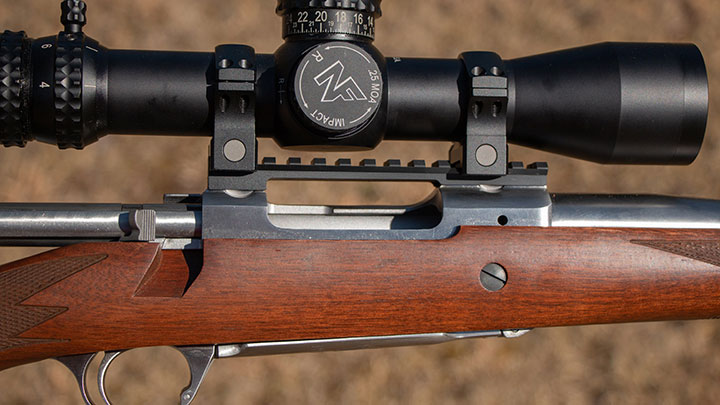
This new rifle is essentially a standard Hawkeye, but with a couple added features that should appeal to modern big-game hunters. Its Picatinny rail for the mounting of optics is a rather surprising inclusion, because Ruger is well-known for, and has been dedicated to, the very good and practical integral scope-mounting system that originated on the Model 77 before the turn of the century. The advantages of a Picatinny, however, are two-fold. It allows the use of Picatinny scope rings, which seem to have become the de facto standard with modern riflemen, and for those who intend to shoot at extended distance, the 20 MOA cant provides 20 minutes of compensation. While many riflescopes run out of adjustment around 600 yards, this 20 MOA offset gives more than 100 inches of trajectory compensation at that distance. The rail is attached to the receiver with four 8-40 screws, but if you would rather utilize the standard Ruger rings, you can remove the rail. Just like all other Hawkeye rifles, the receiver is machined to accept standard Ruger rings.
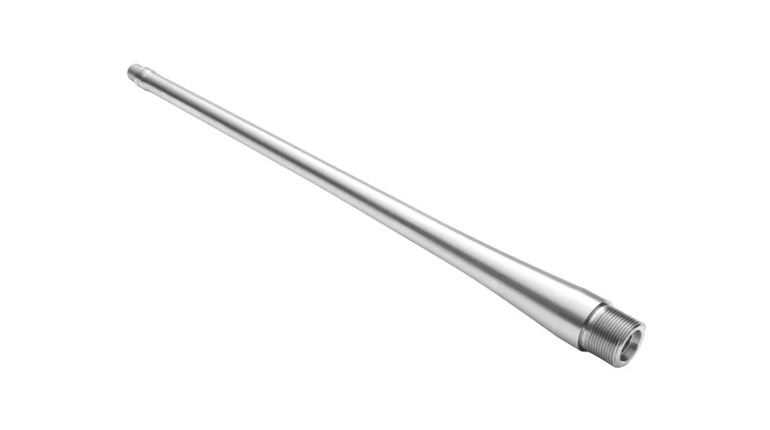
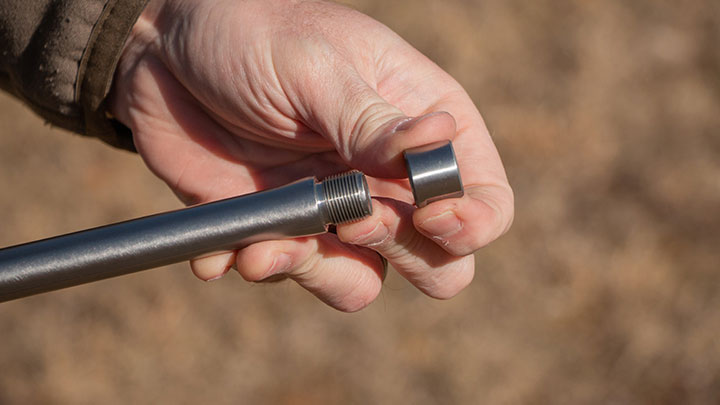
Another new feature is the threaded muzzle. The stainless-steel action is fitted with either a 20-, 22-, or 24-inch (depending on the chambering) stainless-steel barrel, with 5-R rifling, and all barrels have a threaded muzzle with a protective cap. The lone exception is the .300 Win. Mag., which comes with a radial-port muzzle break. One note about the barrels that’s worth mentioning, is Ruger is wisely offering the 7mm Rem. Mag. with a faster-than-SAAMI-specified 1-8.5" twist rate.
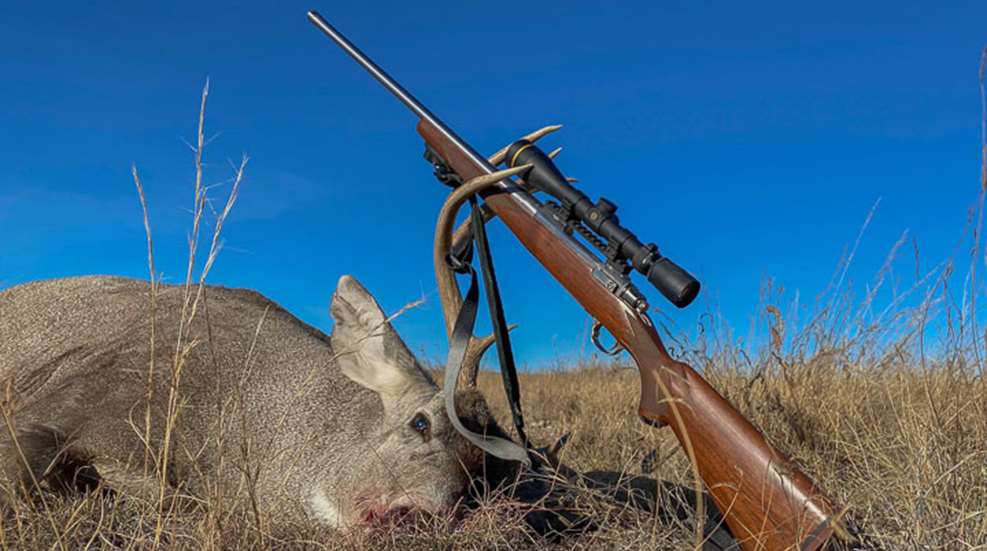
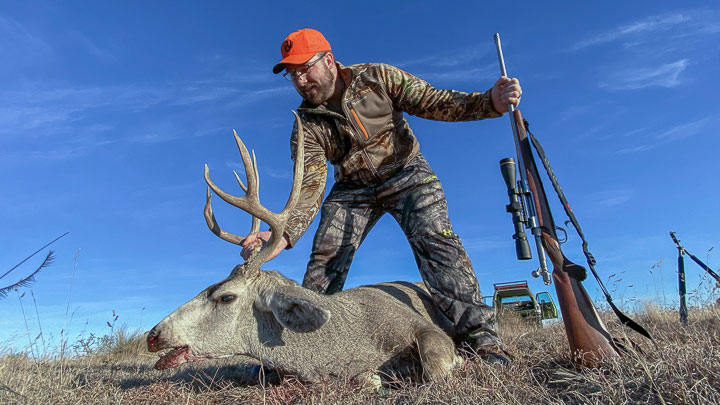
I hunted West Texas in November of 2019 with a Hawkeye Hunter chambered in .300 Win. Mag. We were after mule deer, and I would have rather had a rifle that recoiled a lot less—a .300 Win. Mag. is simply not needed for mule deer. Coyotes were also fair game, and on the first day of the hunt we caught a pair running along a ridge line. With a quick shot, I whacked the rear song dog as it loped along at about 200 yards.
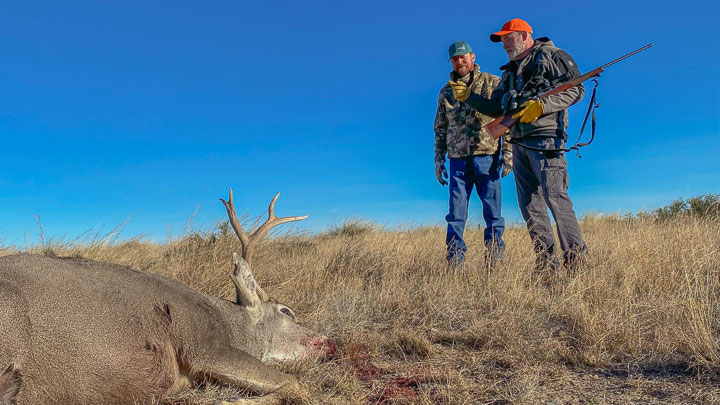
Two days later, we snuck to within about 220 yards of a decent buck only ten yards away from jumping the neighbor’s fence. He never made it. I was very pleased with how the rifle performed, but really wanted to try one chambered for a cartridge that did not kill on both ends. Shooting off the bench, recoil with the .300 Win. Mag. was eye watering, which is probably why Ruger ships it with a muzzle break. I despise muzzle breaks, as I hate the ear-splitting blast they give more than I hate hard recoil, but maybe I should have left this one on the rifle.
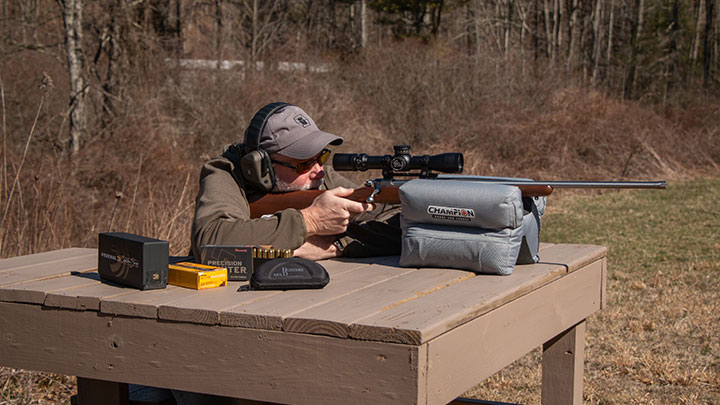
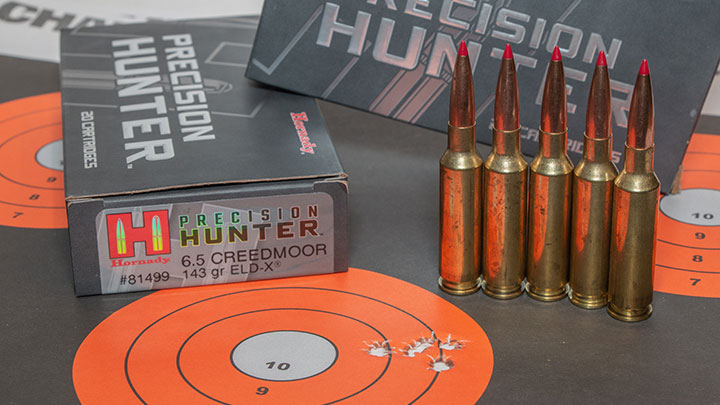
After the hunt, I asked for a Hawkeye Hunter chambered in 6.5 Creedmoor, so I could spend substantial time with it on the bench to see what level of precision one might expect from these new rifles. Out of the box, the trigger on that rifle broke with only an infinitesimal amount of creep, at a repeatable 3.5 pounds. Fit, finish and reliability were on par with what has come to be expected from Ruger. The first group fired from the rifle printed a 0.74-inch five-shot group, and after testing three loads, firing five, five-shot groups with each, the average precision measured out at 1.07 inches at 100 yards.
I was a bit slow to get with the Creedmoor revolution. That was probably a good thing; every day it seems like there’s another 6.5 Creedmoor rifle to choose from. I’ve read all the Leatherstocking Tales, and have always liked Ruger Hawkeye (77)-style rifles. This just might be the 6.5 Creedmoor for me. With a suggested retail of $1099, it’s not the least expensive Creedmoor-chambered option, but based on my time with two Hawkeye Hunters, they’re worth every penny.
SPECIFICATIONS:
Manufacturer: Sturm Ruger & Company Inc.
Model: Ruger Hawkeye Hunter
Available Chamberings (Twist Rate): .204 Ruger (1:12"), 6.5 Creedmoor (1:8"), 6.5 PRC (1:8"), .308 Winchester (1:10"), .30-06 Springfield (1:10"), 7mm Rem. Mag. (1:8.5"), .300 Win. Mag. (1:10")
Action: Bolt—Ruger Hawkeye (right and left hand versions)
Barrel: Stainless steel with 5-R rifling and threaded muzzle with cap/muzzle break
Barrel Length: .308 Winchester (20-inch) 6.5 Creedmoor, 6.5 PRC, .30-06 Springfield (22-inch) .204 Ruger, 7mm Rem. Mag., .300 Win. Mag. (24-inch)
Right Hand: .204 Ruger, 6.5 Creedmoor, 6.5 PRC, .308 Winchester, .30-06 Springfield, 7mm Rem. Mag., .300 Win. Mag.
Left Hand Options: 6.5 Creedmoor and .300 Win. Mag.
Safety: Three-position
Stock: Checkered Walnut
Finish: Brushed Stainless
Trigger: LC6 (3.5 lbs. on test rifle)
Weight: 7 lbs., 2.3 ozs. (test rifle/unloaded)
Capacity: .204 Ruger (5), 6.5 Creedmoor (4), 6.5 PRC (3), .308 Winchester (4), .30-06 Springfield (4), 7mm Rem. Mag. (3), .300 Win. Mag. (3)
Overall Length: 40 – 44.75" (test rifle 42")
MSRP: $1,099; ruger.com
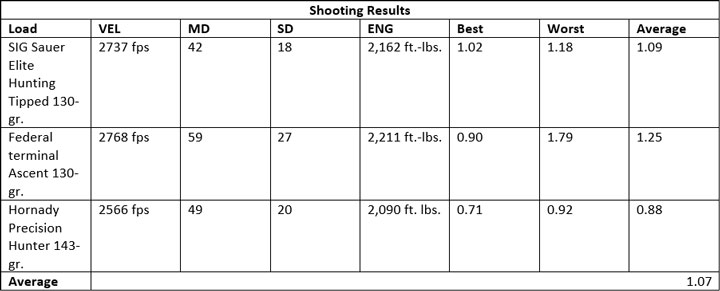
NOTES: Average muzzle velocity (VEL) maximum velocity deviation (MD) standard velocity deviation (SD) and muzzle energy (ENG) were established by firing ten shots over a Caldwell G2 chronograph with the screens positioned 10-feet from the muzzle. Shooting precision was established by firing five, five-shot groups, from a sandbag rest, with a Nightforce ATACR 4-16X, at 100 yards. Best, worst, and average group sizes are listed. TEMP: 50° PRESSURE: 29.95 inHg HUMIDITY: 50% ELEVATION: 2,200 feet.