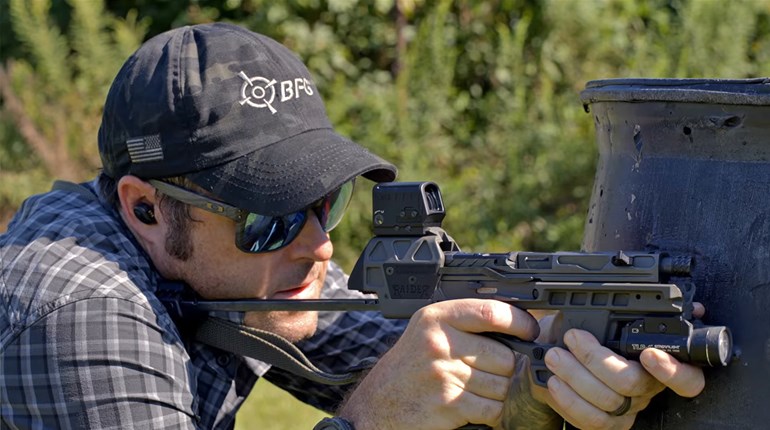
I get why subsonic ammo is cool: It’s as quiet as a cobra and kicks like a flea. Without serious muzzle blast or the supersonic crack, hunters can forego hearing protection so that glorious plinking sound of bullets striking their mark can be heard all the better. Besides, Navy SEALs use it, right?!
While non-military dudes like me boyishly fantasize about tiptoeing into a devil’s den to snuff evil where it sleeps—all without waking the wife—more than one actual SEAL combat veteran has indicated that subsonic rifle ammo is actually rarely used in combat. Most of these guys prefer 77-grain, full-power ammo that produces maximum energy from their suppressed M4 carbines. Nonetheless, now that AR-15s and suppressors are more popular than ever, the tactical crowd clamors for commercial subsonic offerings. Manufacturers have obliged. And make no mistake; I’m a big fan of it. But it’s not great for hunting big game.
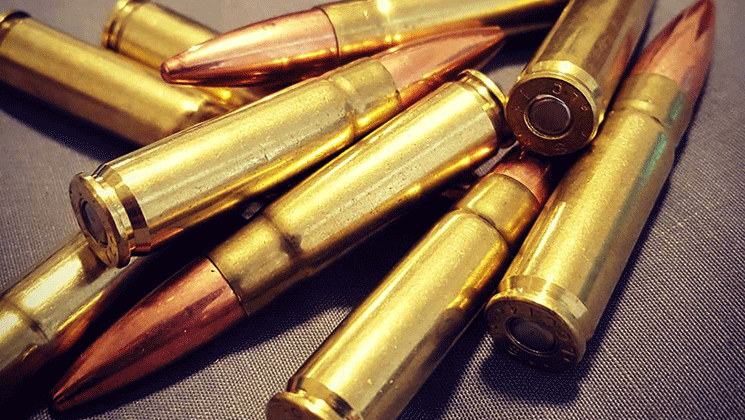
That’s because subsonic rounds in popular AR calibers like .223 Rem. simply aren't powerful enough to cleanly kill game under normal hunting conditions. Just look at the numbers:
A typical bullet from a .223/5.56 cartridge weighs 55 grains. The supersonic threshold is 1127 fps at sea level. So a 55-grain bullet fired at 1100 has a maximum muzzle energy (ME) of 148 ft.-lbs. and 130 at 100 yards. Compare this to the nominal ME of a 40-grain .22 LR load; 1255 fps, it’s about 140 ft.-lbs. That’s right. It’s virtually the same.
For reference, the commonly accepted standard among hunters suggests that at least 1,000 ft.-lbs. energy (at the range at which the animal is targeted) is needed for deer-sized game. In my experience, when energies fall below roughly 600 ft.-lbs. Bullets lose their expansion, penetration and shock properties; Even if hit perfectly, animals tend to run longer after the shot before dying; if not hit perfectly, wounding becomes prevalent. Headshots are dicey at best. If you wouldn’t hunt deer with a .22 LR, then there’s little reason to hunt them with a subsonic .223 round either.
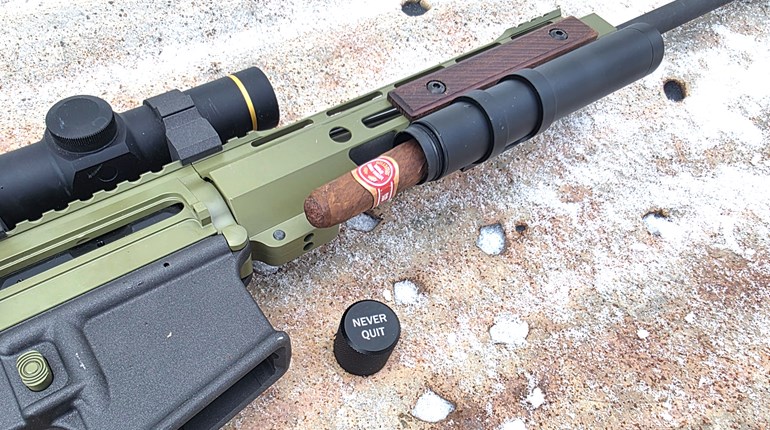
Certainly, I can think of scenarios where big-game hunters desire to be silent—such as shooting as many wild pigs as possible without spooking others nearby. Frankly, however, this is unrealistic. At ultra-close range where subsonic rounds must be used to consistently kill pigs and not just injure them—even slight noise and commotion will almost always cause the others to flee. Past 50 yards, the bullet likely won’t penetrate a boar’s hide, much less deliver a mortal wound. In fact, the AR-15 will likely fail to function after the first shot due to the reduced power loads. Therefore, if you must use your AR for hogs, use a silencer to protect your hearing and not awaken the neighbors, but use full-power hunting loads with premium, controlled-expansion bullets. It may not be as cool, but you’ll be better off.
Or you can go with larger caliber subsonic rounds.
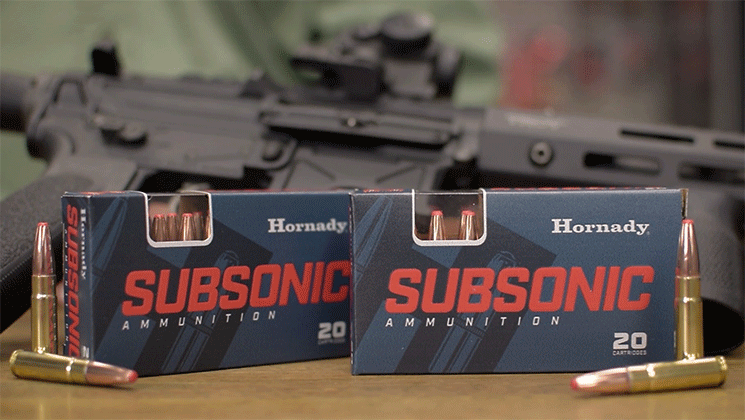
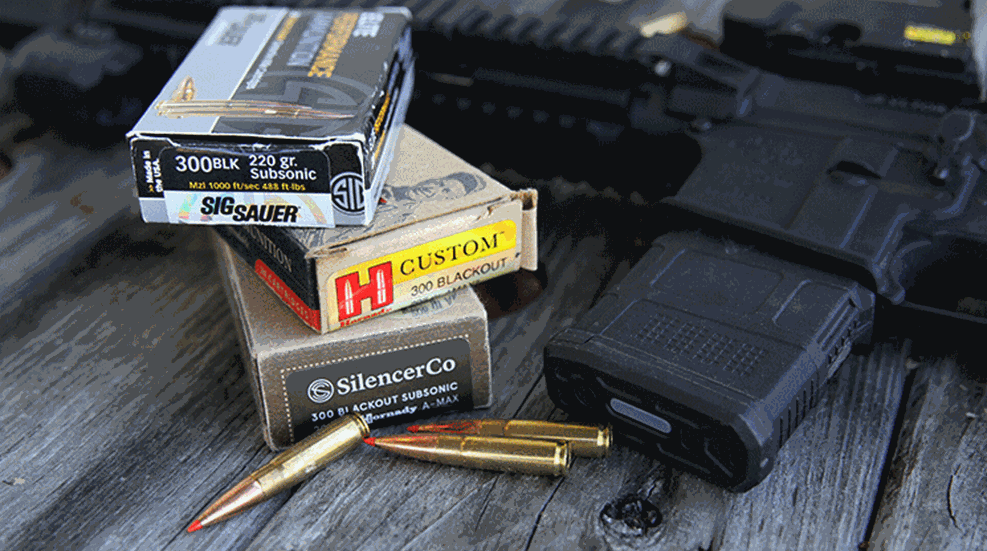
In fact, the .223’s poor energy production at subsonic speeds was a big reason why the .300 Blackout was invented. You see, if a round’s velocity must never exceed 1127 fps, the only way it can produce more energy (at the muzzle) is to increase the mass of the bullet. With its larger, .30-caliber diameter and heavier bullets that weigh up to 220 grains, the .300 AAC Blackout effectively quadruples the energy output of a subsonic .223. (Hornady’s very accurate new subsonic .300 Blackout round features its 190-grain Sub-X bullet that leaves the muzzle at 1050 fps for a ME of 465 ft.-lbs.; SIG Sauer’s 220-grain load produces 488 ME. Comparatively, a .30-30 Win. has four times the energy!) While uber-fun to shoot, this is marginal performance for normal big-game hunting conditions for all but the closest, perfectly placed shots on game. Reality is, for everything a subsonic .300 Blackout can do in terms of hunting, a suppressed, full-power .300 Blackout, with its 1,450 ft.-lbs. ME, can do better.
If you must hunt big game as silently as possible with an AR-style rifle, strongly consider the .458 SOCOM round (or .450 Bushmaster) that was built to function on existing AR-15-sized platforms. Loaded in subsonic form, the SOCOM pushes a 500-grain bullet at 1075 fps at the muzzle, resulting in 1280 ME. Of course it is not as fun to shoot as the .223 or Blackout because it also has much more recoil, but as they say, there’s no free lunch. It’s whisper quiet when suppressed, and deadly out to a couple hundred yards.
In conclusion, for small game, practice and plinking, subsonic ammo is great stuff. It’s fun, accurate and satisfying to shoot. But it’s best to use full-power rounds—or large calibers—for big game. Just because the law currently classifies some critters as non-game animals doesn’t mean that hunting ethics shouldn’t apply.
Most Popular