When it set out to design its first riflescope specifically made for hunting dangerous game, Nikon thought it might be a good idea to check in with the folks who actually hunt dangerous game for a living. So, Nikon staff traveled to Africa and talked with eight professional hunters.
These are the guys in the trenches, the hunters who earn a living chasing critters that can stomp us into a bloody puddle, or chew our heads off if the slightest thing goes wrong. As you might have guessed, they had some strong opinions.
The No. 1 unanimous requirement is that the scope must be tough. These guys see a lot of clients from all over the world and they are witness to just about every conceivable make, model and type of scope in the field. They know that hunting dangerous game requires big, powerful and hard-kicking rifles and they have seen enough scopes fail to know that if it’s not tough, it’s worthless.
Their next requirement is that the reticle must be bold and must draw the shooter’s eye to the center. The problem, as the PHs see it, is that a lot of reticles fade into the background in poor light. That means a hunter often needs to search for the reticle when he should be shooting. The pros liked the bold German No. 4 style reticle, which is what Nikon picked for this, the African series. This reticle uses a heavy central crosshair so that it’s visible in poor light. Three of the four legs of the reticle have very thick arms that stop just short of the center. The top arm is the exception; it does not have a bold section, which allows for better visibility of the target and helps to draw the eye to the center. Another suggestion made by many of the PHs was an illuminated reticle for use in poor light, as is often encountered when hunting leopard or even following up on a late shot. The pros also wanted a scope that coulc be adjusted to have zero (or as close as optically possible to zero) magnification (1X) when it’s turned to its lowest setting, so that it can be used in a fast-breaking situation with both eyes open. Finally, the scope must have a tube length to allow proper mounting on the long actions of dangerous game (DG) rifles.
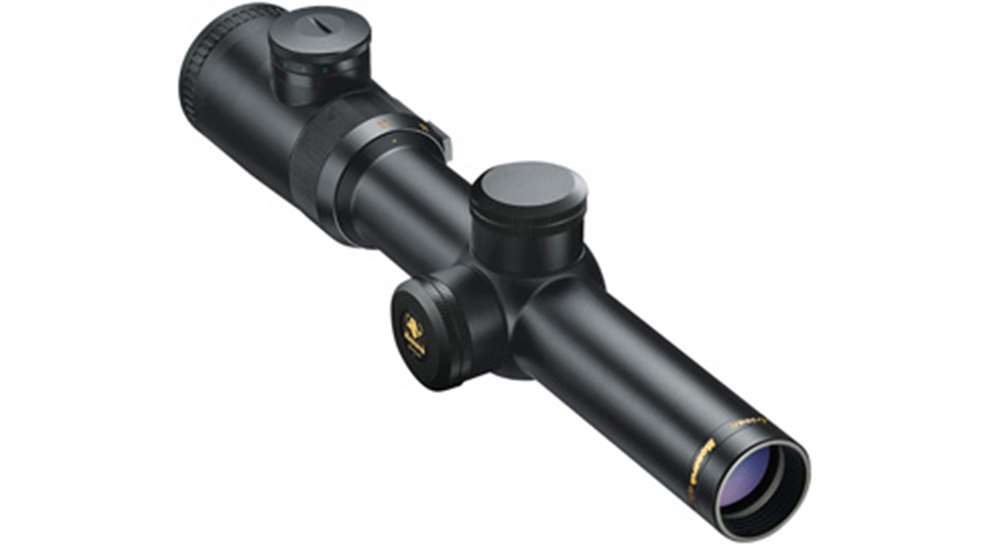
Nikon built the scope the professional hunters “designed” and called it the Monarch African series. The toughness angle was already covered, as all Nikon Monarch scopes are tested to 1,000 Gs, which exceeds the recoil of any rifle (one of the toughest standards in the industry).
The African series is available in three models: a 1-inch tube, 1X-4X-20mm; and two 30mm tubes, a 1X.1-4X-24mm scopes and one with an illuminated reticle. The illuminated model has a lighted center in either red or green depending on which way you turn the dial. That’s the scope I tested.
One important aspect of any scope used for dangerous game is that it have a large “eyebox,” which is the area from which a full field of view can be seen. While eye relief is the distance from the scope to the shooter’s eye where a full field of view is possible, the “eyebox” is 90 degrees to eye relief. It is the area—up and down, left and right—that the eye can move and still maintain a full field of view. One good analogy is that it’s like looking through a window instead of a keyhole.
The bigger the eyebox, the less critical eye position becomes. The African series uses a large ocular lens (44mm outside diameter), which increases the size of the eyebox. A bigger eyebox means the position of the eye behind the scope is less critical, so if you mount the gun from an awkward position or do not get a perfect cheek weld on the stock, you will still have a full view in the scope. And because of the nature of the low-magnification design, these scopes also have a very wide field of view, which mates well with the big eyebox.
This scope is by no means limited to use only in Africa. It’s also a good design for any close and fast-shooting situation. For example, it’s a good choice for tracking whitetail deer where shots are often fast and at running targets. It is also a very good choice for use in three-gun action shooting or for a tactical defensive rifle.
The 30mm models have a fixed and constant 3.7-inch eye relief—a very big deal on big, powerful and hard-recoiling rifles. The 1-inch models have slightly more. This long eye relief helps keep your eyebrow and the scope from becoming intimate during recoil, which results in fewer bloodstained shirts. It is also a big deal for hunters using slug guns, which can kick as much as dangerous game rifles.
The fully multi-coated optics are bright and clear, as might be expected. Brightness is a result of good optics, coatings and construction, all of which aid in maximum light transmission. Brightness testing is mostly subjective though, unless you have expensive laboratory equipment. With that in mind, I did test for target resolution as the late-afternoon light faded, checking every few minutes to see how bright the image remained and how well I was able to see detail on a 50-yard target. I found the scope to be bright and clear even in poor light. It’s impossible to assign a number to that, other than to say it was as good as any similar scope I have tested over the years and better than most. It’s important to note that the lower magnification of these scopes keeps the image bright, even with their restively smaller objective lens diameters. Brightness is important, as it is not uncommon to follow up wounded game in poor light.
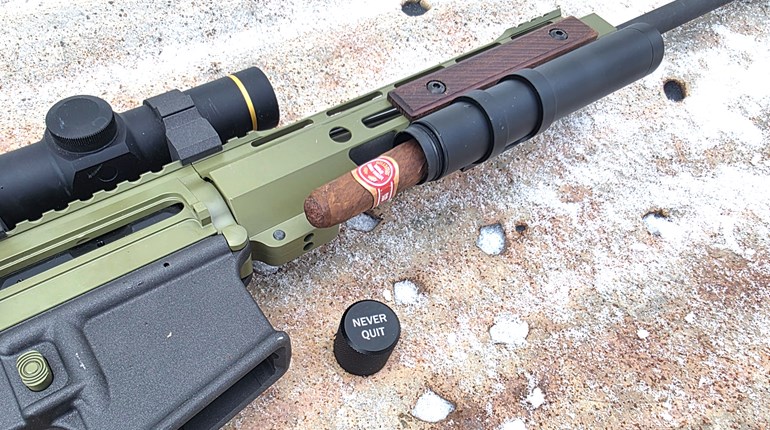
After the scope passed my waterproof test of dunking it sans the adjustment caps in a tub of warm water for 15 minutes, I mounted it on an accurate, bull-barrelled AR-15-style DPMS rifle. With my son, Nathan, home from college and eager for some trigger time, I manned the spotting scope while he shot the rifle. The first thing we noticed when sighting in was that point of impact moved exactly the distance expected when we made adjustments. You would be surprised how often other scopes do not do this.
Once it was zeroed, Nathan fired a two-shot group on an Outers “Motion Control” target. This target has a center aiming point surrounded by four more aiming points in each of the corners. We “walked the grid” by adjusting for the distance to each of the four corners and shooting a two-shot group at each one while constantly aiming at the center. Then, after moving to each of the four corners, we adjusted the scope back to the center. The four groups were on average within one-third of an inch of where they were expected. The final group overlapped the first group, with the centers less than four-tenths of an inch apart. This is statistically near-perfect performance, given the variations in the rifle’s accuracy and other variables.
Then I moved the scope to my .458 Winchester and let Nathan sight it in from the bench. (Hey, I’m no dummy! DG rifles kick when shot from sandbags.) I took my turn and shot up the rest of two boxes of Federal 500-grain Trophy Bonded ammo doing some speed drills. In total, we fired 40 hard-kicking rounds of .458 Win. Mag. ammo. (Of course, that brutality followed the 50 .223 Remington rounds we subjected the scope to on the DPMS. While the difference in recoil is vast, it all counts.) Plus, we twisted the adjustment dials back and forth on both guns a considerable amount. The Monarch African took it all in stride and the scope is holding zero, looking clear and working perfectly.
My conclusion, and Nathan’s, is that we like this scope. In fact, it just found a permanent home on my .458, replacing the scope that’s been on the rifle since I built it five years ago, as this Nikon is clearly a superior unit.
Specs
Type: variable-power riflescope
Magnification Range: 1.1X-4X
Objective Lens Diameter: 24mm (tested); 20mm
Focusing Range: hand-adjustable, ¼ MOA clicks; 80 MOA range
Reticle: German No. 4; red and green illumination in center
Eye Relief: 3.7" (tested)
Exit Pupil: 6mm @ 4X
Twilight Factor: 4.47 @ 4X
Field of View @ 100 yards: 108' @ 1X, 29.3'@ 4X
Coatings: fully multi-coated
Dimensions: length, 10.5"; tube diameter, 30mm (tested), 1”
Mounting Space: 6.85"
Weight: 16.93 ozs.
Construction: one-piece aluminum tube
Finish: matte black
MSRP: 1X-4X-20mm (1" tube) $279; 1.1X-4X-30mm, $769.95; IR model, $859.95 (tested)