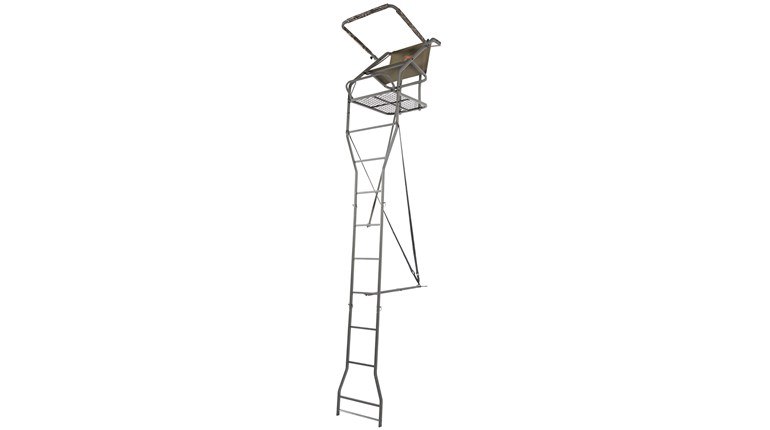
As much as I love hunting from a treestand—the wind in my face, scanning the nearby woods unencumbered—I have run into two situations when the whitetail hunting is better from a ground blind. Both situations have to do with the unique advantage of blinds to bottle and better contain human scent.
Feeding Areas
The first situation occurs when hunting a feeding area, regardless of the time of season. The blind allows you to stay undetected for what may be many minutes as multiple deer filter into the feeding area from every direction. It is very hard to predict which trail deer will use when they come to feed, thus it is equally hard to figure out which wind you need to play to keep your scent from the deer. Ideally, you simply hunt the blind and bottle the scent, giving little consideration to wind direction.
There is another big advantage to hunting blinds in feeding areas. Once the deer become accustomed to the blind, you can move it around the field or plot and the deer will barely take notice. Last season this tactic nearly produced the biggest buck of my life.
After running cameras on the food plot throughout September, I finally started to get photos of the giant buck in daylight. I’d hunted this deer for three seasons already and knew from experience that he accepted ground blinds fairly readily. I moved the blind in immediately and within a week he was on the plot again in daylight. Unfortunately, the plot is located on a ridge field. The deer were feeding on several parts of the ridge. It was too much ground to cover from a single spot.
I started with the blind on one edge of the field. I nearly got the buck the first evening in but a doe heard me open the blind window and spooked, taking the trophy with her. As I continued to monitor the field with trail-cameras, it became obvious that he was not using the end near the blind, so I moved it 50 yards farther into the field. The next time in I had another encounter with the giant, but he gave me just one shot. Unfortunately, he stopped right behind a patch of thin foxtail grass. Over the next two weeks I saw the buck a couple more times, but always on the far end of the field. Again, I moved the blind farther into the field.
The next time in the blind, the buck walked past at 30 yards—near the end of legal shooting time. In my excitement, I misjudged the distance and shot over his back.
Fortunately, I was able to kill the buck in early November from a treestand nearby, but that deer proved the incredible opportunity ground blinds offer when hunting feeding areas. Of course, one of the keys to success was keeping my scent bottled up inside so that the deer downwind didn’t smell me, but the ability to fine-tune the position of the blind was the real key.
Another old buck I hunted last season provided an additional lesson. I had also been hunting “Loppy” for three seasons. So, even though he didn’t have giant antlers, he was a highly sought trophy. Late-season hunting is tough because the deer are more alert than they are earlier in the year. You often have to avoid detection by a number of does before you get a shot at a buck, and that becomes even tougher with a bow because of the close ranges.
The hunt was textbook; it was the first time I had seen Loppy in two seasons. Another buck walked past close to the blind before Loppy worked his way through a gate opening and offered a 25-yard shot. The trees on that end of the plot were too small to hang a stand. Without the blind, I never would have shot one of the oldest bucks I have ever killed. I guess I am getting soft, because when it gets frigid in the late season, as it was that day, blinds and portable heaters are sure a nice combination!
Unpredictable Winds
Blinds also outperform treestands whenever you are hunting an area where the wind swirls. For example, this often happens when hunting a funnel on a ditch or creek crossing at the bottom of a draw. Such spots are nearly impossible to hunt from a stand. However, because you can set up a blind to contain your scent, you can get away with hunting these locations from a blind.
How to Scent-Proof A Ground Blind
Ideally, a ground blind would be airtight, but that is impractical for two reasons. First, you might suffocate. Second, the inside of the windows will fog up unmercifully on cold days. The best solution is a setup with a small bit of ventilation that you can control. A sliding door over a vent is a good example. Opening a small window on the downwind side of the blind will also work.
Most of the time you can keep the vent open but when there are deer downwind you may have to close it. The idea, of course, is to keep the wind blowing around the blind, not through it. Scent-proofing the windows is the key.
The blinds that I hunted last year offered two different solutions. The first one was a homemade box where I taped clear plastic wrap across the windows to prevent the air from escaping. By the way, you can shoot through that stuff easily without affecting accuracy (if you are shooting fixed-blade broadheads). The other blind was a Redneck with windows that sealed when closed.
Exit Strategy
When bowhunting a feeding area from a ground blind you’ll need someone to drive in with a vehicle or ATV and move the deer off naturally so you can sneak off without the deer knowing you were there. If you can’t arrange such a diversion, blind hunting is not nearly as productive long-term.
After reading of my successes from blinds last season, you might think I will be in one every day this fall. I don’t love blind hunting. I still prefer hunting from a treestand whenever possible because I love the full range of view, the natural sounds and the wind in my face. However, there is no question that in certain situations, there is no better way to kill a nice buck than from a well-constructed ground blind.