Rifle hunters are well versed in the importance of sighting-in, but most smooth-bore hunters have never patterned their shotgun—and that means they have no real idea how it performs. They simply assume that any modified choke, for example, shoots the same pattern as any other modified choke, irrespective of the barrel or load, and the same applies to any other size of choke. Nothing could be further from the truth, however. Consequently, many hunters are putting themselves at a distinct disadvantage.
There are numerous shotgun chokes available for a wide variety of hunting and shooting applications, but these are the four most common, along with their general application:
• Full Choke—For tight patterns at extended ranges
• Modified Choke—For dense patterns at medium range
• Improved Cylinder Choke—For an effective pattern within 25 yards
• Cylinder Bore—Essentially no choke, for extremely close-range shooting
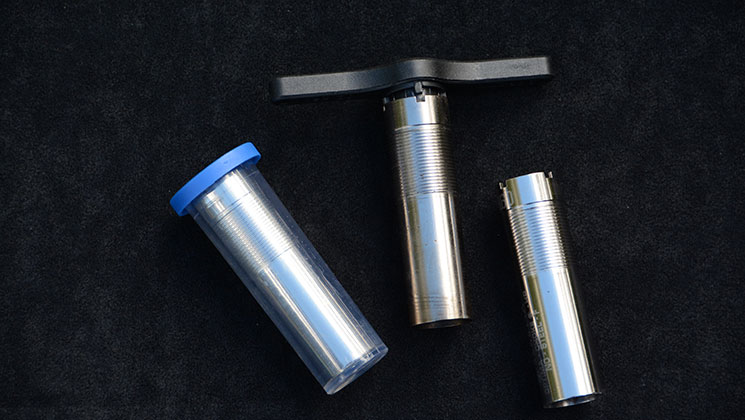
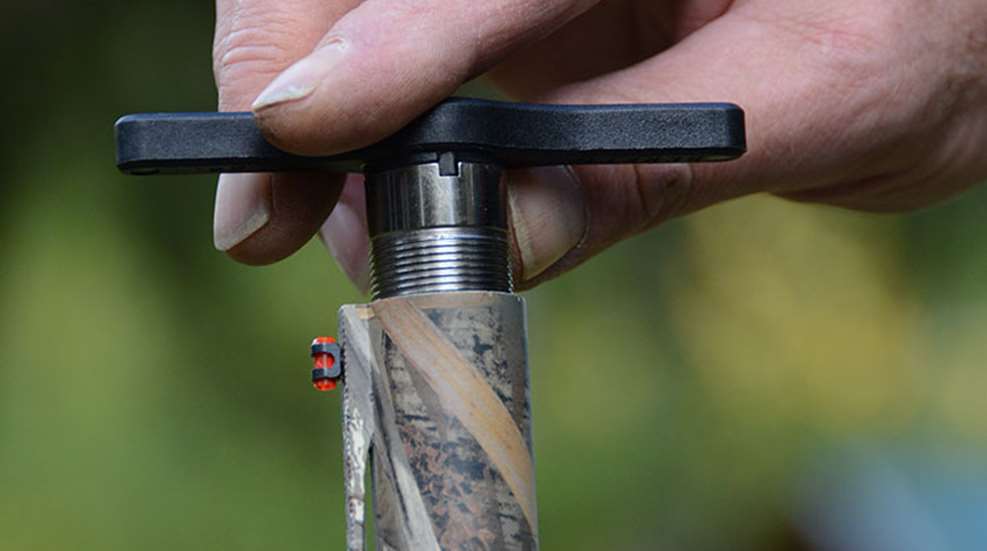
To ensure your shotgun is putting pellets right where you want them at the distance you expect to be shooting, however, you must match the proper choke to the specific gun and load you’ll be using. And to do this, you need to pattern your shotgun. Here’s how.
Traditional Patterning
The classic patterning protocol is to shoot a paper target at 40 yards, then count the number of pellets that land within a 30-inch circle. You then divide this number by the total number of pellets in the load to arrive at a pattern density percentage. If 70 percent or more of the pellets fall within the circle, your pattern is described as that of a full choke. If it’s 60 to 69 percent, the pattern is that of a modified choke, while 50 to 59 is improved cylinder—anything less is considered cylinder bore. These numbers reflect the actual downrange pattern of your gun and don’t necessarily match the barrel’s choke designation. I’ve patterned many loads out of a modified choke, for example, that performed as though they came out of a full choke.
Practical Patterning
While you can certainly learn a lot from following the traditional patterning recipe, it’s more practical to pattern each shotgun and load at the distances you expect to be shooting afield. For example, a turkey hunter may want to see a pattern with a load of 1½-ounce, copper-plated #5 shot at 45 yards, while a goose hunter who shoots over decoys will be interested in how 1¼-ounce steel BBs pattern at 35 yards. Likewise, ruffed grouse hunters may want to understand how 1 1/8-ounce #7½ lead performs at 20 yards. Remember, don’t expect each load and choke combination to shoot as advertised, because it just isn’t so.
What to Look For
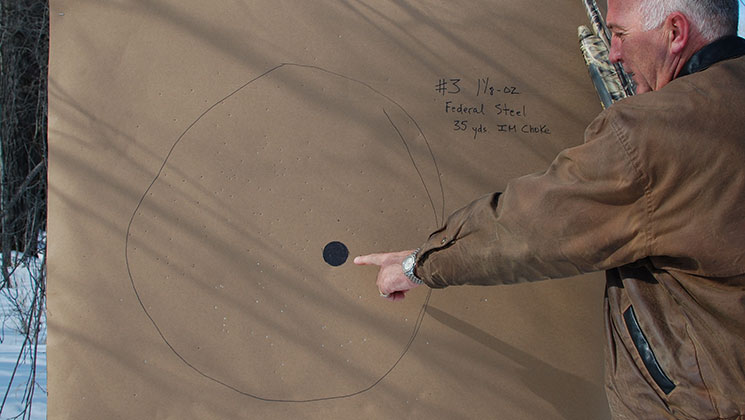
When I pattern a particular load, I take three or four shots with each different choke at the distance I expect to be shooting when hunting, changing targets after each round. I don’t bother to count the pellet holes, but instead look at the overall pellet distribution. Not only does this tell me in practical terms how dense the pattern is, it also shows me where it’s the most dense in relation to the aiming point on my target. This will reveal whether a shotgun has a tendency to shoot to the left or the right of, or above or below, your aim point. You may be very surprised to learn your shotgun doesn’t necessarily shoot where it’s pointed.
Typically, I want to see the holes evenly spread across a 30-inch circle. However, if I see patterns that are overly dense in the centre with significantly uneven fringes, or if I note clumping of pellets interspersed with voids of no pellet strikes, it’s time to consider changing either the choke or the load. One manufacturer’s shell will seldom pattern the same as another’s, even when loaded with the same amount of powder and shot charge.
In my experience, smaller pellet sizes tend to pattern more consistently than do larger ones. This can be especially important for goose and turkey hunters using larger shot sizes, often at extended ranges. With steel, the conventional wisdom is to drop down to more open chokes to achieve the most consistent patterns. In reality, that can literally be a hit or miss proposition; pattern your loads to see for yourself which perform best.
Similarly, tradition dictates that turkey hunters use a full choke, or even extra-full, to ensure dense patterns at longer ranges. Again, this just isn’t universally the case. Whatever the shooting scenario, always pattern the loads you’ll be taking in the field to help you select the best load-choke combination—and put more birds in the bag in the process.