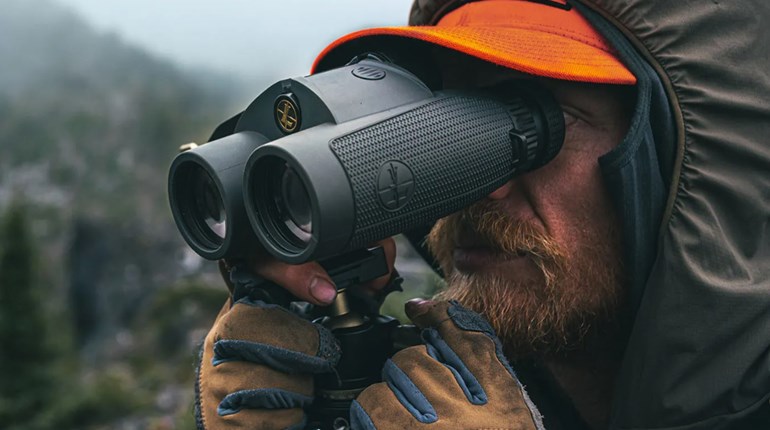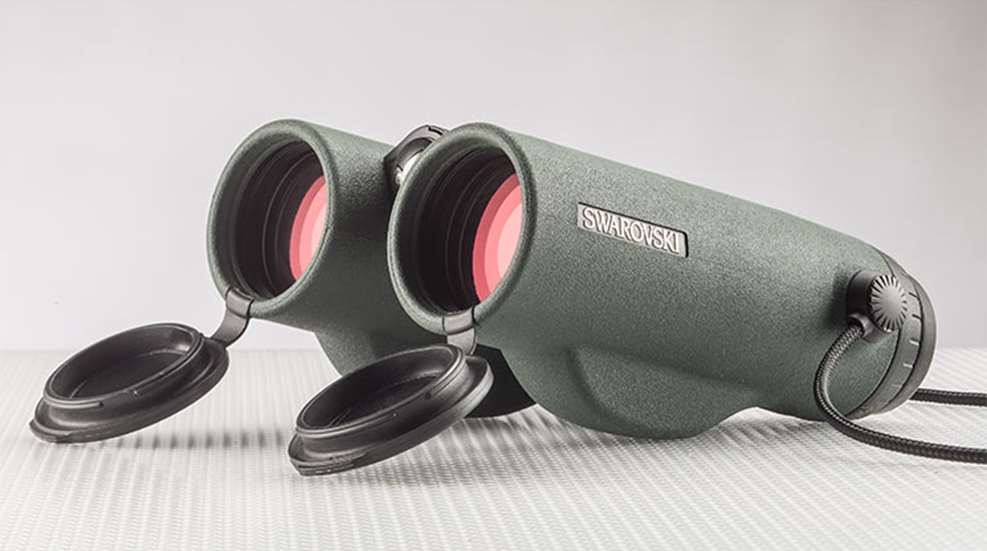
Here’s a question for hard-core big-game hunters: How much is efficiency worth to you? Or more to the point: Is the convenience of a rangefinding (RF) binocular worth the extra money and the extra weight vs. carrying separate bino and rangefinder units?
I found that binos with a built-in rangefinder, segregated by brand and performance level, weigh 5-15 percent more than their non-RF counterparts. The subject of this review, the Swarovski EL Range 10x42mm, for example, weighs 31.6 ounces vs. the non-RF EL at 28 ounces—12.8 percent heavier. But combine the base-model EL with a typical pocket-sized, 6-ounce rangefinder, and the EL Range is 7.6 percent lighter. So while the difference isn’t striking, RF glasses can help lighten the overall load a bit.
Likewise the cost differential is not huge. Most RF binos sell for $200-$600 more than corresponding non-RF models, about the same as you will pay for a standalone rangefinder depending on its features.
Over the course of a prolonged field trial, the EL Range demonstrated that its practicality goes beyond simply having one less item to pack. Most of us are familiar with the shuffle from binocular to rangefinder; it takes time, requires movement and, depending on circumstances, may cause us to lose sight of our game. An RF binocular prevents all that and eases ranging by providing a larger, better subject image in a wider field of view, plus it doesn’t shake as much in the hand.
Beyond those inherent benefits, Swarovski has built an instrument that optimizes ranging serviceability and speed. While the EL Range also provides ballistic assistance, that aspect is more limited than can be found in competing models.
In the field it soon became apparent that the test unit excelled at one-touch reads. In this key area, it was at least as good as any rangefinder or RF bino I have previously used, and clearly better than most. Rarely did it fail to yield an immediate read out to almost the stated maximum of 1,500 yards, and that included deer in favorable light conditions. Difficult, minimally reflective subjects, like black bears and feral hogs in midday light, yielded consistent one-touch readings out to about 1,200 yards. Though I have “stretched” other RF products farther, doing so mostly entailed repeated tries on big, highly reflective surfaces like an 18-wheeler or a light-colored rock outcrop. In what I rate as two very difficult ranging scenarios—bright sun over open snowpack and across choppy water bouncing low-horizon sunlight at crazy angles—the EL Range scarcely missed a beat. It proved a reliable partner.
A ranging feature I came to appreciate while hunting was the scan mode, which synchronizes readings on moving subjects. This seemingly occurs as fast as the display can repaint. Not only did it allow me to keep track of changing distance, it gave me a clue to how fast an animal was moving. Though not quite as one-touch infallible as ranging stationery subjects, the scan mode was mostly dependable.
The EL Range can also calculate inclination (angle) and the resulting adjusted shooting distance, displaying either figure, according to user selection, as a secondary number under the straight-line range. This function also performed quickly and flawlessly. Though the approach here is simpler than with high-end rangefinders that can be programmed to provide specific trajectory-compensation cues, I think Swarovski may have gotten it right, figuring that long-range hunters geared to use such technology are mostly counting on their riflescopes or phone apps for ballistic solutions.
As one would expect, the imaging is pretty great, too. After all, this is a genuine EL, the binocular that’s dominated the best-of-the-best stratum since it debuted in 1999. From the outset, Swarovski has outfitted its franchise player with the best glass available. Nowadays that means fluoride-containing lenses and mirror-finished roof prisms from Germany’s famed Schott Glaswerke. While these critical components aren’t exclusive to Swarovski, you’d think they are if you talk to the many hunters and guides who swear the brand delivers brighter and sharper images than the competition. What are proprietary are the internal construction and specific glass treatments, currently including a prism mirror finish called SwaroBright and SwaroTop anti-reflection lens coatings.
The result, I agree with Swarovski brand loyalists, is exceptional brightness and vivid imagery that’s practically 3-D true-to-life. Worth noting here is an informal resolution test—informal in that several variables can skew the results—I like to perform, where a minimum of three participants see how far away they can read headlines like the one on our back page. The farthest average distance with a 10x42mm binocular to date was 83 yards, a tie between a recent-generation EL and a Zeiss Victory HT, neither an RF model. This time an RF bino hit that mark, too.
Swarovski also deserves credit for understanding it’s not just our eyes that interface with binoculars. While laser housings make some RF binos a bit ungainly, that’s not the case where Swarovski has positioned them, on the undersides of both barrels. It follows that the EL line, which pioneered the trendy open-bridge, wraparound grip, would now sport an upgraded FieldPro package that replaces flat carry straps with sturdy cords attached directly to the magnesium chassis via free-turning mini bayonet pins. Thus the bino always hangs at a convenient angle, and users can instantly switch from the cord to harness carry simply by freeing the connectors. Too, the package’s flip-down lens covers integrate so solidly there’s little chance they’ll get lost.
Beyond comparative measures, my lasting perceptions of specific binoculars often hinge on extraordinary sights they’ve placed into the old memory banks. No shortage of those with the EL Range, and one in particular rates an 11 on a scale of 10.
On a sunny spring afternoon in coastal southeast Alaska, I was glassing and ranging a brown bear that, at 400-plus yards, was much too far to consider a shot, and anyhow, my guide was still sizing him up. And by coastal, I mean we were right on the beach, hidden amongst the boulders. In a moment of inattention, I glanced out the cove toward the ship channel, and spied a whale spout. I trained the EL Range in that direction and soon saw a couple more spouts.
The bear was grazing, going nowhere, so I kept peeking seaward, saw more spouts, and then amongst them a whale breached. When a second giant burst from the water, I got it in the glasses and, mostly out of habit, hit the ranging button: 1405. Shining like obsidian, monumental in scale thanks to 10X magnification, the creature gave me a reading approaching the EL Range’s maximum reach. What a moment to be looking through one of the world’s best binoculars!
Technical Specifications:
• Type: roof-prism rangefinding binocular
• Magnification: 8X, 10X (tested)
• Objective Lens Diameter: 42mm
• Focusing Range: 16.4'-infinity
• Eye Relief: 17.3mm
• Exit Pupil: 4.2mm
• Field of View @ 1,000 Yds: 330'
• Coatings: fully multi-coated lenses w/SwaroTop, SwaroClean, SwaroDur; prisms w/SwaroBright
• Construction: magnesium chassis w/laser rangefinder, rubber armor, HD glass; nitrogen-filled; waterproof to 13'
• Rangefinder Min./Max. Range: 33 yds./ 1,500 yds.
• Modes: single measurement, scan, angle, SwaroAim angle-compensated range
• Power Source: 1 CR2 battery (included)
• Dimensions: length 6.3"; width 5.4"; weight 31 ozs. (wo/battery)
• Accessories: field bag; FieldPro carry strap, eyepiece and objective lens covers
• MSRP: $3,666