The first successful self-contained metallic cartridge in the U.S. was a rimfire, the .22 Short. It was introduced in 1857 as a self-defense round and it is still in production today.
That inspired a huge number of rimfire cartridges, including the .44 Henry Flat used in the famous Henry Rifle. Throughout the 19th century everyone and his brother it seems introduced a rimfire cartridge, but very few were successful. A quick count in Cartridges of the World produces 36 obsolete rimfire cartridges ranging from the 5mm Remington through the .58 Miller.
One of those forgotten cartridges is the .22 Winchester Rimfire (WRF). When I was a kid, one of my buddies had an obsolete .22 WRF rifle his grandfather had given him, along with a partial box of ammo that he hoarded like the Miser with his gold. He finally shot a rabbit with the rifle, which my beagle puppy dragged into a brush pile and ate. I think that might be the last time that puppy hunted with us.
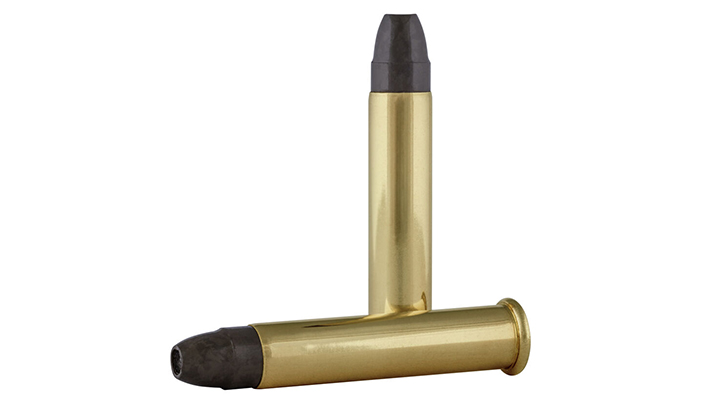
The .22 WRF is significant because it is the parent case for the .22 Winchester Magnum Rimfire (WMR), which was introduced in 1959. Winchester lengthened the case of the WRF, pepped up the power and called it a Magnum, which was crucial for marketing in that era.
The new .22 WMR used a 40-grain bullet with a very thin jacket. Muzzle velocity was just short of 2000 fps, making this cartridge considerably more potent than the popular .22 Long Rifle (LR). The .22 WMR remains the only successful rimfire cartridge introduction of the 20th century.
My first experience was with a Ruger Single-Six revolver that I carried on my trap line. The first thing I shot with that handgun was a porcupine that was trashing our camp. They are very difficult to kill and often will shrug off hits from a .22 LR until you start to doubt if you are shooting real bullets. This “magnum” shocked me with how fast it killed the porcupine and the damage it inflicted.
I became a believer in the .22 WMR after using it in several rifles and handguns to take a wide range of varmints from squirrels to coyotes. Over the years, the various ammo companies have introduced different loads for the .22 WMR, making it even more effective.
The latest introduction is from the rimfire overlord, CCI. The company makes more rimfire ammo than any other and is often the leader in technological advancement. (Its Stinger .22 LR changed the industry.) A couple of years ago it introduced a segmented .22 LR cartridge. This uses a bullet that is pre-scored so it segments into three pieces upon impact. The idea is that three projectiles cause more damage than just one. A segmenting bullet also helps prevent over-penetration, making it safer to use for pest control in areas where that might be an issue.
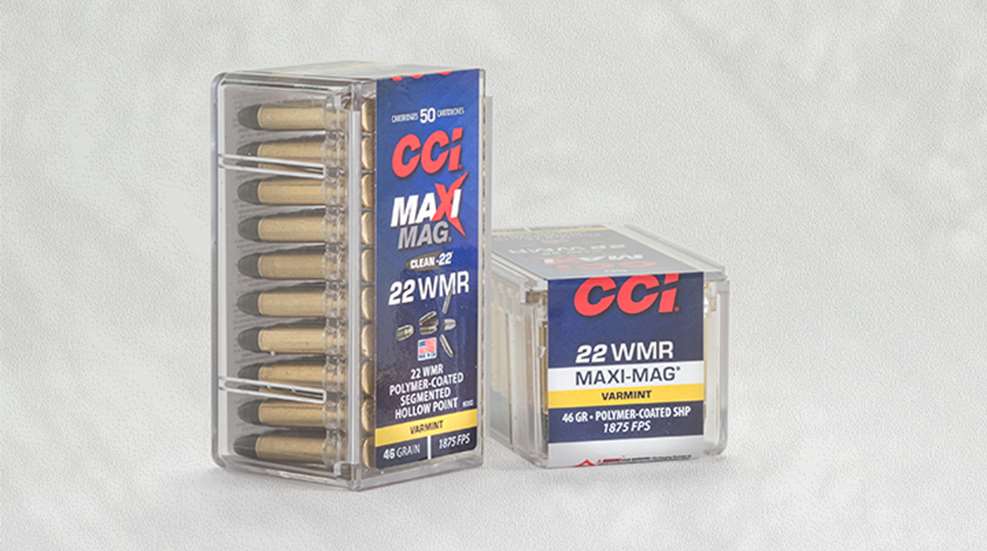
New for this year is the CCI Maxi-Mag Segmented Hollow Point 22 WMR. This load uses the same segmented-bullet technology, adjusted for the more powerful WMR cartridge. The 46-grain bullet is coated with polymer that serves two purposes: It helps hold the segmented bullet together until impact, and the coating also helps to reduce metal fouling in the rifle’s bore. CCI also says it reduces lead fouling in suppressors by 60 to 80 percent.
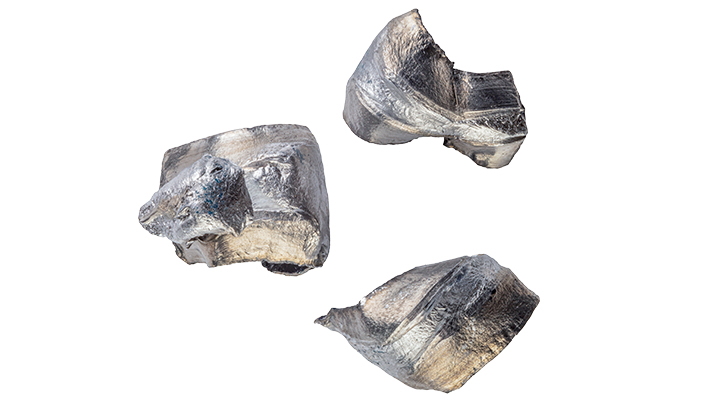
I tested this ammo by shooting down from a second-story deck into a bucket of water. The first shot split the side of my bucket and splashed water high enough to get me wet. I found the bullet flattened like a washer, but it did not segment. I talked with the engineer who designed this ammo, and he told me that with close-range, full-velocity impact, sometimes the nose deforms enough to meld the pieces together and the bullet expands rather than segments. I got a new bucket and tried it again. This time I fired five shots into the water. The splash was much less dramatic and the bucket survived. All of the bullets segmented into three separate pieces. Water is a “hard” medium compared to ballistic gelatin, which is probably why the first bullet expanded rather than segmented. However, water is extremely consistent, so it works well as a “poor man’s ballistic gelatin.” (I know at least one major bullet company that uses water as its test medium because of the consistency.)
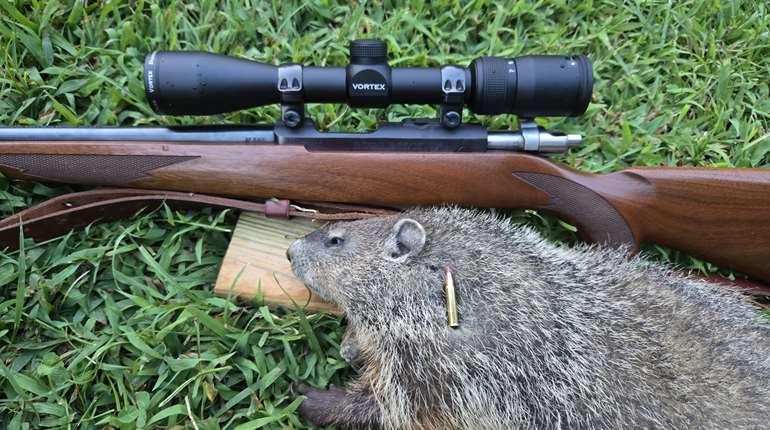
Then I took it “live” and shot some red and gray squirrels. The ammo performed well on all of them, with fast kills and a bit less tissue damage than I have come to expect from most other .22 WMR impacts. CCI says one big advantage of this bullet technology is that it expands or segments even at lower velocities. That makes it a great choice for shooting ground squirrels or prairie dogs where some of the shots may be on the long side. I expect this would be a great choice for foxes, and I am told by CCI engineers that it flattens coyotes with broadside shots and results in very little pelt damage.
During my range testing I used a Savage A22 Magnum rifle that I knew to be very accurate with other .22 WMR ammo. This CCI ammo averaged less than 1 inch at 50 yards—not the best this rifle has ever shot, but still excellent accuracy.
This is much different bullet technology than what we are used to in terms of terminal performance. Based on my experience with segmented bullets in both the .22 LR and now the .22 WMR, it’s something small-game and varmint hunters should consider using. The segmented bullets seem to kill very humanely while reducing tissue and pelt damage. They are also safer, reducing over-penetration and the chance of ricochets.
Note: The good news is that CCI has made a run of .22 WRF ammo. So all those old rifles can be dusted off and hunted with again!

Technical Specifications
• Caliber: .22 WMR
• Bullet Weight: 46 grains
• Bullet Type: Segmented Hollow Point
• Ballistic Coefficient: .139
• Muzzle Velocity (advertised): 1875 fps
• Muzzle Energy (advertised): 359 ft.-lbs.
• MSRP: $19.99 per 50-rnd. box; cci-ammunition.com