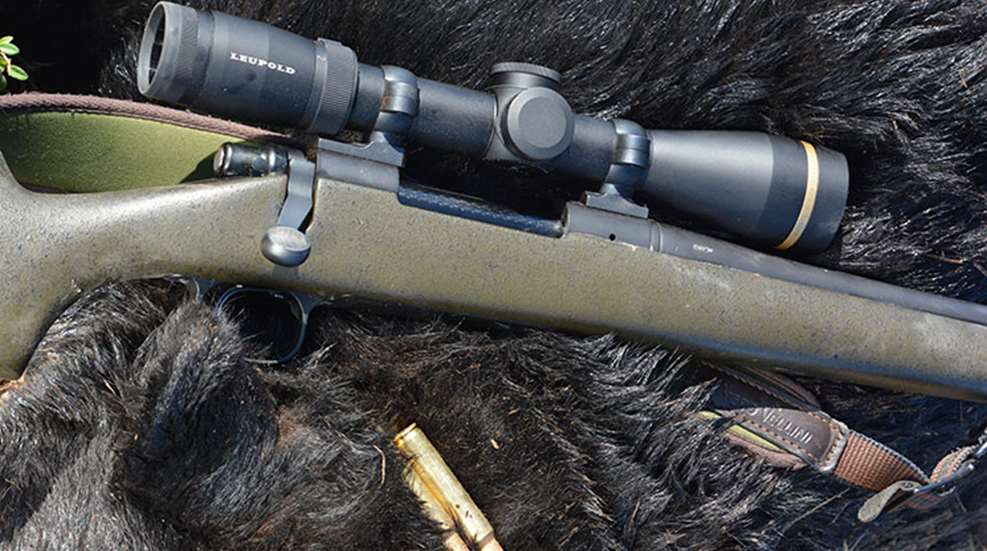
Editor's note: Bryce M. Towsley put the Remington AWR to use on a black bear hunt. Catch up on his story here.
The Remington Model 700 AWR (American Wilderness Rifle) offers serious hunters features previously available only in expensive custom-shop rifles. It will be available as a cataloged rifle in mid-July at an MSRP of only $1,050, yet it is designed for the harshest hunting conditions.
The 416 stainless steel barrel and action are coated with Cerakote to protect against the elements. Barrel length is 24 inches in standard calibers, 26 in the Remington Ultra Magnums. Barrels feature 5R rifling, a cutting-edge, five-groove rifling that changes angles and radiuses so the bore fouls less and remains accurate much longer between cleaning.
The adjustable trigger is Remington’s X-Mark Pro. The fiberglass stock has pillar bedding and free-floats the barrel. It’s designed by Grayboe, a subsidiary of McMillan Stocks, to mitigate felt recoil, and it considerably tamed the .338 Rem. Ultra Mag. I used.
The gun will be available in: .270 Win., .30-06 Springfield, 7mm Rem. Mag., .300 WSM, .300 Win. Mag., .338 Win. Mag., .300 Rem. Ultra Mag., .338 Rem. Ultra Mag. and .375 H&H Mag.
The .338 Rem. Ultra Mag. is an ideal cartridge for North American big game like elk, moose or bears. I am a big fan of the Ultra Mag. family and have used all four (7mm, .300, .338, .375) extensively. I think the .338 might be the best of the bunch. I have worked with several factory .338 Rem. Ultra Mag. rifles: Every one grouped bullets like a varmint rifle. remington.com
This AWR was no exception as it shot sub-MOA with the first Barnes 225-grain TTSX handload I tried. With a muzzle velocity of just more than 3000 fps, the load generates 4,500 ft.-lbs. of muzzle energy. barnes.com
On a hunt for grizzly, Remington’s John Fink shot a bear at 276 yards and it ran about 35 yards. Even at that range, John hit the bear with more than 3,000 ft.-lbs. of energy—more than a .30-06 has at the muzzle. I shot my black bear in North Carolina at 30 yards, and it fell in its tracks.
One of the secrets to long-range hunting is using a bullet with a wide impact velocity window like the Barnes. It will hold together and expand on close shots like my bear, but still expand at long range as it did on John’s bear.
Our rifles were fitted with Leupold VX-6 2X-12X-42mm scopes, which cover the spectrum from shooting up close out to any ethical distance for big game. Resolution is clear and, as with any Leupold, this scope is tough enough for any conditions on Earth.