Larry and Dan are two guys I used to hunt with a lot. Year in and year out, Larry killed mature bucks and Dan always seemed to struggle. We all hunted the same farm at the same time. We can all shoot our bows well. On the surface, you wouldn’t have seen much difference in the type of stands we hunted. They all overlooked good sign.
But if you dug into the fine points of the hunt, you would have seen the gap widen. Success is all in the details. This is what I finally learned.
Choosing the best route to and from each stand is the most important detail in structuring a good season. When casual hunters talk about their stands, they tell of big scrapes or lots of nearby trails. Whenever seasoned hunters talk about a stand location, they are much more likely to talk first about how they get to it. This is because experienced hunters know that the entry and exit routes are even more important than the sign the stand overlooks.
I’ve come to the conclusion that a stand overlooking an average location but with totally undetectable access is a better choice than a stand overlooking exceptional sign but with only average access. That’s because the number of mature bucks you see is not directly proportional to the number of scrapes or rubs or trails your stand overlooks, but it is proportional (inversely, in this case) to the number of deer you alert on the way to and from the stand.
Your mental maps of your hunting area should not be marked only with buck sign and deer trails, but also with low-profile access routes. The trails you will use to get in and out cleanly are the details that count.
Select the Best Routes
Ditches and creeks are my favorite terrain features to use when accessing stands. I love them so much that I will go out of my way to find stand locations near them just so I can use the low ground to slip into and out of my hunting area. Since you are below the general lay of the land, the deer are less likely to see you as you pass. Also, the sounds you make are muffled by the terrain. Since the wind blows over these features, your scent is not as likely to wash around the area. Finally, you are walking in an area that deer are not likely to frequent (they may cross them, but they typically don’t walk right down ditches) so your ground scent won’t be discovered easily.
Obviously, this is the definition of a perfect entry and exit route. To make these locations even better, go in ahead of the season with a chainsaw and remove any brush or blown down timber that has fallen into the creek or ditch so your passage can be quieter, quicker and more enjoyable.
In the absence of creeks or ditches, look for anything in the terrain that will hide you from deer. It’s hard to find such features. I have used steep bluffs by walking along their lip edges with the wind blowing my scent out over the abyss.
Sometimes you will find thick cover that you can sneak along, like a brushy fence line, but outside of these few examples, it can be tough to find truly low-profile routes. You may need to make your own.
Make Your Own Routes
Not every part of your hunting area will have good entry and exit routes. That means you have two options: either avoid hunting those areas or create your own low-profile routes.
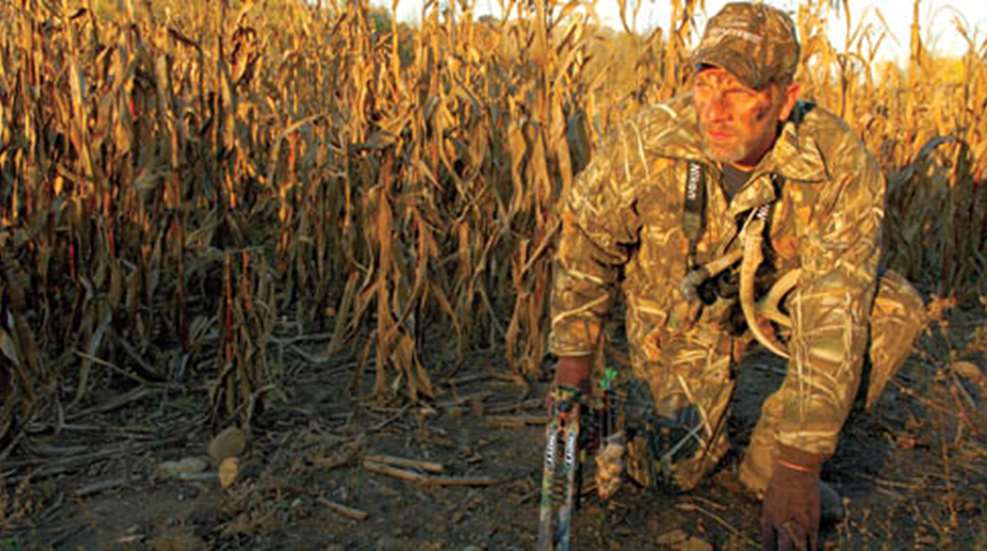
Standing Crops: This is the easiest method and one of the most effective. If you have to cover open ground, it makes sense to get double-duty out of your screen by planting a tall food source. I plant corn in these areas now, but I have also used forage sorghum (the 10-foot-tall stuff) in areas with high deer numbers. The deer won’t eat the sorghum when it is growing so it gains its full height and puts on a nice head before they start to feed on it. Corn, on the other hand, is like candy to deer during the summer, so if you have a large deer population you may find that they have eaten your screen to the ground before hunting season begins.
Tree Planting: I have a friend who used a tree mover to place cedar trees into a double row that permitted him to slip through open areas undetected. Granted, you need access to hundreds of trees if you are going to build a sizable cedar screen, but I can’t imagine a better way to slip around the edge of a feeding area than through a tunnel of cedars. The trees block the wind and their needles rarely fall.
Plot Screen: I have begun experimenting with a seed blend called Plot Screen from Frigid Forage. It is a mix of tall grain sorghum, Egyptian wheat and other plants to create a dense, tall screen behind which you can sneak. It grows 10 feet tall in just a few short months so you can literally plant a wall each spring that you can hide behind that fall. Although not a crop, switchgrass makes a reasonable screen if you take care of it properly.
In summary, the most important consideration when selecting a stand site is undetected access. Some properties have ample creeks and ditches that you should utilize. However, if the property you hunt doesn’t have natural terrain and cover features that allow you to stay out of sight, you need to create them. There are plenty of ways to do this with planting or with chainsaws. It is all about staying undetected. Be creative because a stealthy entrance and exit to keep deer unalarmed is what separates the consistently successful from the consistently befuddled.