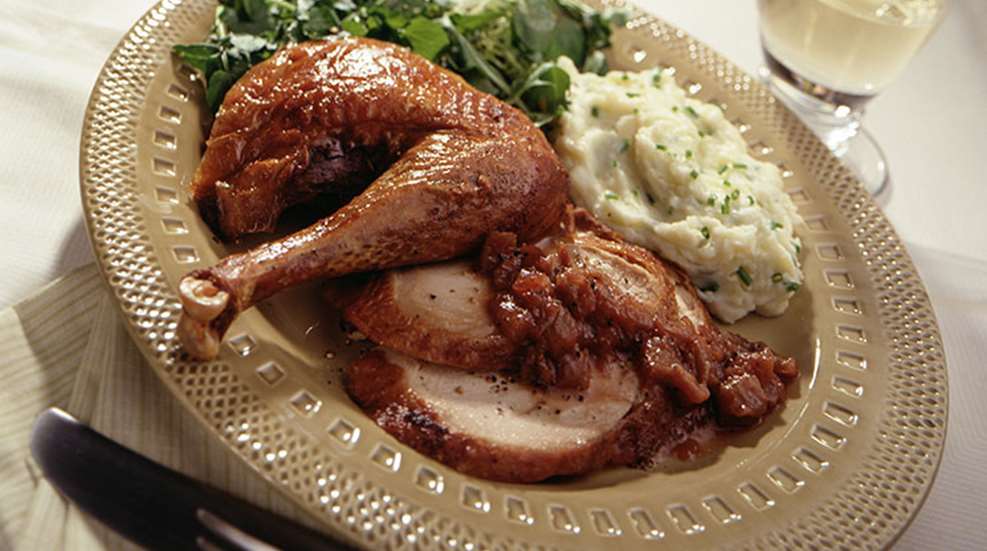
The first time I left the woods with a turkey over my back I was a 14-year-old kid with a Model 870 Wingmaster and no hunting mentor to tell me what to do. So I plucked the bird. Feathers were everywhere—who ever knew they had so many—but it finally looked almost like a store-bought turkey. Then I made a mistake. I asked my mother how to cook the turkey. She treated it like a fat, farm-raised bird and it came out of the oven looking golden and delicious, but when we cut it we found it was drier than the Griswolds’ turkey in “National Lampoon’s Christmas Vacation.”
After that experience, I learned to breast birds. That was fine, but by doing so I missed out on the drumsticks and other meat. I also lost the ambience of a roasted bird.
Thus began my quest to make a whole wild turkey that is moist and succulent. I tried deep fryers and slow cookers, and found they can make the meat so soft and moist it falls off the bone. But I wanted the aesthetic and aroma of a roasted turkey. Finally, I asked a friend who used to teach at the Culinary Institute of America for advice. Here’s the recipe we put together. After a little creative fine-tuning, it has resulted in a lot of succulent roasted wild turkeys for us.
1. Pluck the bird, and clean out the body cavity. Cut off the wings at the joint where they meet the breast, the legs at the knee, and the neck.
2. Scald the bird in a pot of water at about 145 degrees for 45 seconds to loosen the remaining pinfeathers, and remove them.
3. Use a blowtorch (a lighter works in a pinch) to burn off the hair feathers (filoplumes).
4. Generously rub butter (and/or olive oil), herbs and spices under the skin where you can, on the skin and inside the body cavity. I use a blend of rosemary, parsley and thyme. Sprinkle with salt and pepper to taste. I also wrap bacon around the legs.
5. Stuff the bird if you desire.
6. Sew the skin together in any places you tore while plucking. Tie the legs together to pull them into the body, and sew the body cavity shut.
7. Place the turkey breast-down in a shallow pan, as this allows the breast to self-baste. Don’t cover the bird, as covering the turkey during cooking steams the meat, which can toughen its fibers.
8. Roast for 1 hour at 325 degrees, basting every 20-30 minutes with the liquid in the pan. Then flip the bird over, and check the temperature of the legs and breast with a quality probe thermometer. To speed cooking, you can now remove the legs from the turkey and roast them alongside the breast; continue roasting the turkey breast-side up.
9. Remove meat from the pan in intervals as it finishes cooking—when it reaches an internal temperature of 165 degrees. (The legs will come out first.)
10. Place foil over the meat and rest it outside the oven for at least 30 minutes before carving.