Unlike riflery, hitting an airborne target with a shotgun actually requires letting go of most conscious thought and rigid discipline in order to let the eyes, brain and hands move fluidly as a unit. Aspiring wingshooters should learn to mount the gun, focus on the target with both eyes and pull the trigger in one smooth motion so the shotgun’s pattern strikes where the shooter anticipates the target will be. Here are three tips to get you on the road toward wingshooting wizardry.
Paramount is a Smooth Mount
Great wingshooters make shooting look easy because they don't appear to panic as the bird takes wing and the shotgun is mounted and swung with the target. It all looks like one fluid motion, because with practice, it is. It all starts with the mount.
Rather than mounting your shotgun to your shoulder then adjusting your cheek to its stock and then your eye down the barrel before finding the target, a shotgun should be pulled perfectly up to your shoulder and cheek so that it instantly conforms to you and not the other way around. The swing, or the act of moving the barrel to the place in space where you anticipate hitting the target, should begin happening as the gun is being mounted. Try this simple flashlight drill to practice your mount and swing so it’s as smooth as butter on a biscuit.
The Drill: With an unloaded shotgun, place a Mini-Mag flashlight in the barrel. (Use electrical tape to secure it in the barrel or even to the underside of the barrel so the beam matches the shotgun’s aiming point.)
Now stand in the middle of a room and focus your eyes on one corner of a wall where it meets the ceiling. Imagine a bird flying from one corner of the room straight across to the other corner.
With both eyes open and from a high-ready position, practice bringing the gun up to your shoulder and cheek while simultaneously clicking off the safety, guiding the flashlight’s beam along the seam in a smooth, steady swing to the other corner. Practice this from various positions in the room, going from left to right and right to left. Your goal is to minimize the amount of motion and effort needed to move the gun to your cheek while not disrupting the flashlight’s steady movement across the seam of the wall. With practice, you’ll find you have plenty of time to see a bird, mount the gun, continue your swing and pull the trigger so the whole “move” feels very slow and easy. It’s one of the keys to great wingshooting.
Start on Stationary Targets
New wingshooters should begin with stationary targets because it’s tough to focus on the mount when a target is moving. The goal here, again, is to focus on the target with both eyes open—not on the shotgun’s sights—so the shotgun’s pattern will strike where you look. In time and with practice, you’ll begin seeing a target, subconsciously calculating its speed and angle, pointing ahead of it, pulling the trigger and smashing it.
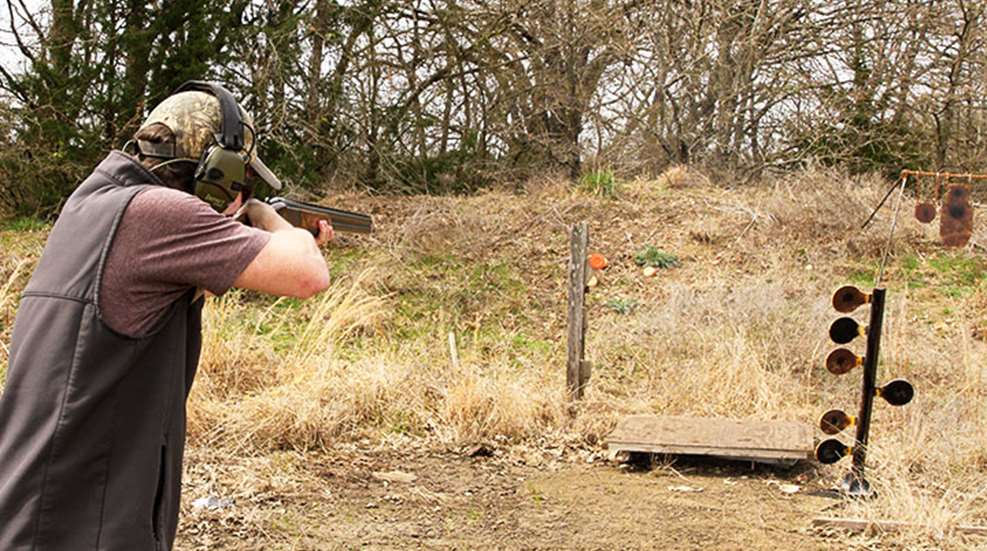
The Drill: Set clay pigeons on a dirt mound (or hung on a wooden stake) 20 yards distant from the firing line. With birdshot, load one shell into your shotgun and get into a good, comfortable stance with 65 percent of your weight on your lead foot. From a high-ready position, look at the center of one target with both eyes open. Then in one fluid motion, pull the gun to your cheek (the barrel should be moving toward the target), click off the safety with your trigger finger, and as soon as the shotgun touches your cheek and shoulder—which should be at or at almost the same time the front bead interrupts the full view of the target—pull the trigger. If you have done everything correctly and the shotgun prints its pattern where you’re looking, the clay target should be obliterated.
If, however, you find you are consistently missing the target to one side or high or low, it likely means the gun’s buttstock does not fit you properly or your head position is not perfect. Or it means you have a dominant eye problem—in which case you should seek additional advice.
When you can hit every stationary target just by looking at it and pulling the trigger the moment the gun touches your cheek and shoulder, you are ready for flying targets.
Red Ryder to the Rescue
While it’s best to practice the above drill with your shotgun using live rounds, it's not always an available option. A Red Ryder BB gun can be used with great fun and effect shooting aluminum cans! But remember: sights for wingshooting only serve as a reference point for beginners; the sooner you learn to ignore them, the better. Remove the sights from your BB gun and you’ll be amazed at how many times you hit the can merely by pointing at it!